

While you accurately contrasted it with reactive chatbots, the core shift is architectural:
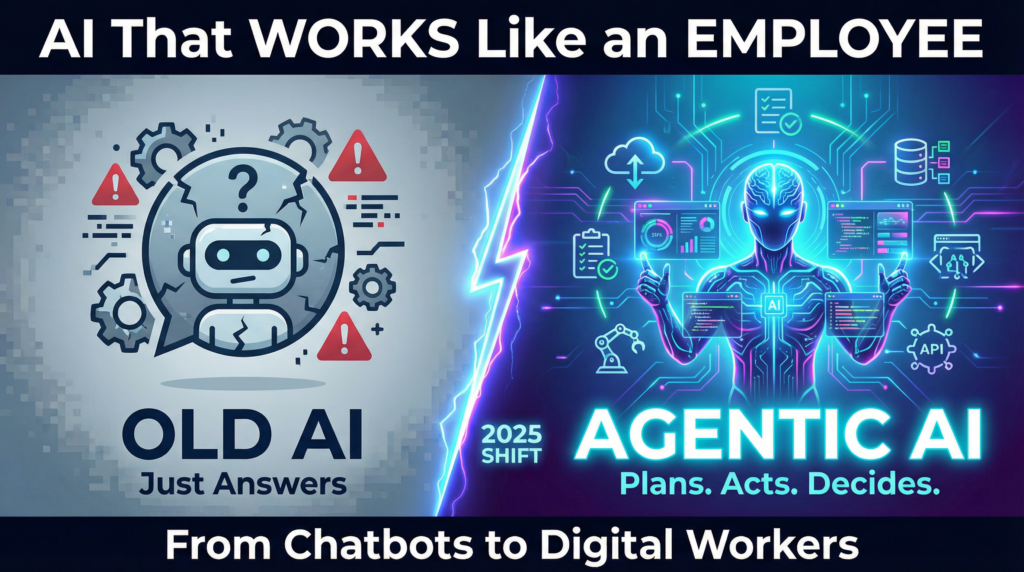
- From LLM as an Answer Engine to an Action Engine: Traditional generative AI uses a Large Language Model (LLM) as the sole component to produce a response. Agentic AI uses an LLM as the “reasoning engine” or “brain” within a larger system that includes:
- Planning Sub-agent: Breaks down a high-level goal (“optimize our cloud spend”) into a sequence of actionable steps.
- Tool-Use Sub-agent: Dynamically selects and uses software tools (API calls, SQL queries, a calculator).
- Memory & Context: Maintains a persistent record of past actions, outcomes, and user preferences.
- Reflection/Critique Sub-agent: Evaluates the results of an action and decides whether to retry, adjust, or proceed.
This turns the AI from a statistical parlor trick into a functional digital employee.
The “Why Now?” Drivers Beyond Hype
The trend is exploding in 2025 due to a convergence of factors:
- LLM Capability Maturity: Models (like GPT-4, Claude 3, Gemini Ultra) now have sufficient reasoning, instruction-following, and context window length to manage multi-step plans.
- Framework Proliferation: Developer tools have drastically lowered the barrier to building agents. LangGraph, AutoGen, CrewAI and platform-specific tools (AWS Agents, Microsoft AutoGen Studio) provide the scaffolding.
- Economic Pressure: In a climate focused on efficiency, the promise of automating not just tasks but entire job functions (e.g., a Level 1 IT support role) is irresistible for leadership.
- “AI-Native” Workflow Redesign: Companies are no longer just bolting AI onto old processes. They are redesigning workflows from the ground up to be executed by autonomous agents, with humans in supervisory roles.
Critical Challenges & Risks (Beyond Technical)
You mentioned governance and risk. Let’s detail the major hurdles:
- The “Opaque Autonomy” Problem: An agent’s chain of thought can be even harder to audit than a single LLM response. Explainability is a major barrier for regulated industries.
- Cost & Latency: An agent making 10+ LLM calls and API queries to solve one problem is expensive and slow compared to a simple chatbot. Optimization is key.
- Failure Mode Amplification: A hallucination isn’t just a wrong answer; it can trigger a cascade of incorrect actions (e.g., deleting the wrong database, sending incorrect legal notices).
- Security & Permission Boundaries: An agent with access to tools is a powerful attack vector if hijacked. Implementing robust permission sandboxing and action confirmation for high-stakes steps is critical.
- Agent Inertia & Infinite Loops: Agents can get “stuck” in planning or retry loops without knowing when to ask for human help. Designing elegant escalation protocols is a core challenge.
The Next Frontier: Multi-Agent Systems & Human Integration
The most transformative applications involve orchestrated teams of specialized agents:
- Example – Software Development: A “Product Manager” agent defines specs, a “Architect” agent breaks it down, “Developer” agents write code, a “QA Tester” agent runs tests, and a “DevOps” agent deploys. They collaborate and debate.
- Example – Business Strategy: A “Market Analyst” agent, a “Financial Modeler” agent, and a “Risk Assessor” agent work together to evaluate a potential M&A target.
- The Human Role Evolves: From executor to supervisor, editor, and strategist. The key skill becomes agent orchestration and objective-setting—clearly defining the goal, constraints, and success criteria for the AI team.
Future Outlook: The Road to 2026 and Beyond
- Specialized Agent OS: We’ll see the rise of operating systems designed specifically to run, monitor, and secure populations of agents.
- Agent-to-Agent Economy: Autonomous agents from different companies may negotiate and transact directly (e.g., a shipping agent negotiating rates with a warehouse agent).
- Self-Improving Agents: Agents that can analyze their own performance, suggest improvements to their own prompts or workflows, and even generate and test new tools.
- Embodied Agents: Moving from pure software into the physical world via robotics, making “agentic AI” the brain for autonomous vehicles, manufacturing robots, and domestic helpers.
Conclusion
Agentic AI represents the shift from assistive intelligence to delegative intelligence. It’s not about having a smarter chatbot; it’s about building organizations that can run at AI-speed and scale. As you noted, the trend for 2025 is scaling. The winners will be those who solve the profound integration, safety, and human-AI collaboration challenges that come with this new, powerful form of automation.
The central question is no longer “What can AI generate?” but “What can AI be tasked to accomplish on its own?” Agentic AI is the beginning of the answer.
Such a fun place to spend some time and make some extra cash. The community is great and the games are fair. Visit 888fbapp now.