

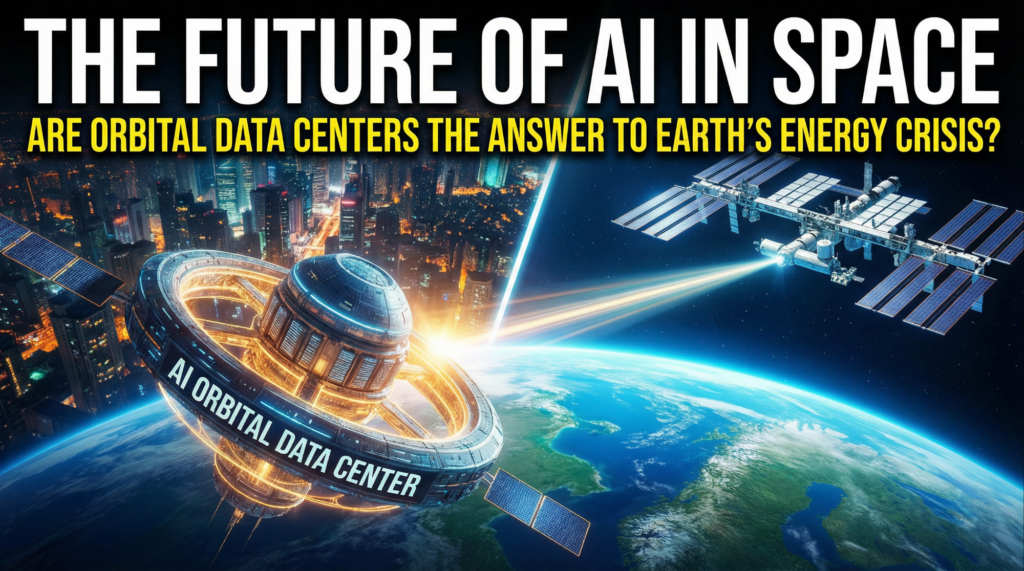
As artificial intelligence grows smarter and more powerful, a surprising problem is emerging—not in code, but in energy.
AI needs enormous computing power. That power needs electricity, land, and cooling. And here on Earth, all three are becoming increasingly limited. Data centers already consume massive amounts of energy, strain local power grids, and compete for land with cities and communities.
So tech leaders are asking a bold question:
What if the future of AI doesn’t live on Earth at all?
Welcome to the idea of space-based AI data centers—one of the most ambitious concepts shaping the next era of technology.
What Are Space-Based Data Centers?
Space-based data centers are exactly what they sound like: large computing facilities placed in orbit around Earth, designed to process data—especially for AI workloads.
Instead of sitting in deserts or industrial zones, these data centers would float above the planet, powered by sunlight and connected to Earth through advanced communication links.
It sounds futuristic—but serious companies are already working on it.
Why Move Data Centers to Space?
The push toward orbit isn’t about novelty. It’s about solving real problems that Earth-based infrastructure is struggling to handle.
🚀 Unlimited Solar Power
In space, the sun never sets.
Orbiting data centers could generate constant solar energy, free from weather, nighttime, or seasonal changes. This could dramatically reduce reliance on fossil fuels and overloaded power grids.
🌍 Escaping Earth’s Space Constraints
On Earth, data centers require:
- Massive land areas
- Proximity to power sources
- Access to cooling systems
As cities grow and land becomes scarce, expanding data centers is getting harder. Space removes these constraints entirely.
❄️ Natural Cooling Advantage
Cooling is one of the biggest energy costs for data centers.
In space, extreme cold can be used to passively dissipate heat, reducing the need for energy-hungry cooling systems. Less cooling means lower power consumption—and higher efficiency.
Why AI Makes Space Data Centers Necessary
AI is the real driver behind this shift.
Training large AI models requires:
- Huge amounts of data
- Continuous processing
- Extremely high-performance computing
Traditional data centers are already struggling to scale fast enough.
How Space-Based Centers Could Support AI
- High-performance computing for complex AI models
- Scalability, allowing infrastructure to grow without land limits
- Global connectivity, enabling faster data access across continents
In short, space-based data centers could become the backbone of next-generation AI systems.
Google’s Suncatcher Project: A Step Toward the Stars
One of the most closely watched initiatives in this space is Google’s Suncatcher project.
Suncatcher aims to test whether AI-focused data infrastructure can reliably operate in orbit.
What Makes Suncatcher Unique?
- Advanced solar energy capture designed for continuous power
- Experimental orbital testing to study performance in space conditions
- AI-first workloads, focused on handling massive data analysis from Earth
While details remain limited, Google’s involvement signals that this idea has moved beyond speculation.
When Will Testing Begin?
Exact timelines haven’t been fully disclosed, but early testing is expected in the near future. These tests will answer critical questions:
- Can servers survive long-term exposure to space?
- Can data be transmitted efficiently between Earth and orbit?
- Is the cost justified by performance and sustainability gains?
A successful trial could unlock a completely new direction for global tech infrastructure.
The Major Challenges Ahead
As exciting as the concept is, space-based data centers face serious obstacles.
💰 Launch Costs
Sending hardware into space is expensive. Even with reusable rockets, costs remain a major barrier. Long-term success depends on drastically reducing launch and maintenance expenses.
🛠️ Technical Durability
Space is harsh. Radiation, micro-meteoroids, and temperature extremes can damage electronics. Systems must be far more resilient than anything used on Earth.
📜 Regulation and Governance
Who regulates data centers in space?
Who controls orbital infrastructure?
How is data security enforced across borders?
These legal and regulatory questions are still largely unanswered.
The Social and Environmental Impact
If space-based data centers succeed, the benefits could be transformative.
🌱 A More Sustainable Future
Constant solar energy could dramatically reduce carbon emissions tied to AI and cloud computing.
🏙️ Less Land Conflict on Earth
Moving infrastructure off-planet frees valuable land for housing, agriculture, and nature.
👩🚀 New Jobs and Industries
From aerospace engineering to orbital maintenance, entirely new job sectors could emerge.
What Comes Next?
The future of space-based data centers won’t be built by one company alone.
Expect to See:
- Collaboration between tech firms, space agencies, and governments
- Increased investment in orbital infrastructure research
- New technologies developed specifically for off-Earth computing
What begins as AI infrastructure could eventually expand into space-based networks powering communications, science, and exploration.
Final Thoughts: When the Cloud Leaves Earth
For decades, we’ve talked about “the cloud” as if it were something abstract.
Soon, it may literally be above our heads.
Space-based AI data centers represent a bold response to Earth’s energy limits and AI’s explosive growth. Projects like Google’s Suncatcher hint at a future where technology doesn’t just adapt to our planet—but extends beyond it.
The idea may feel radical today.
But so did reusable rockets, electric cars, and AI assistants.
The question isn’t if computing will move to space—
It’s how soon we’ll be ready for it. 🌌