

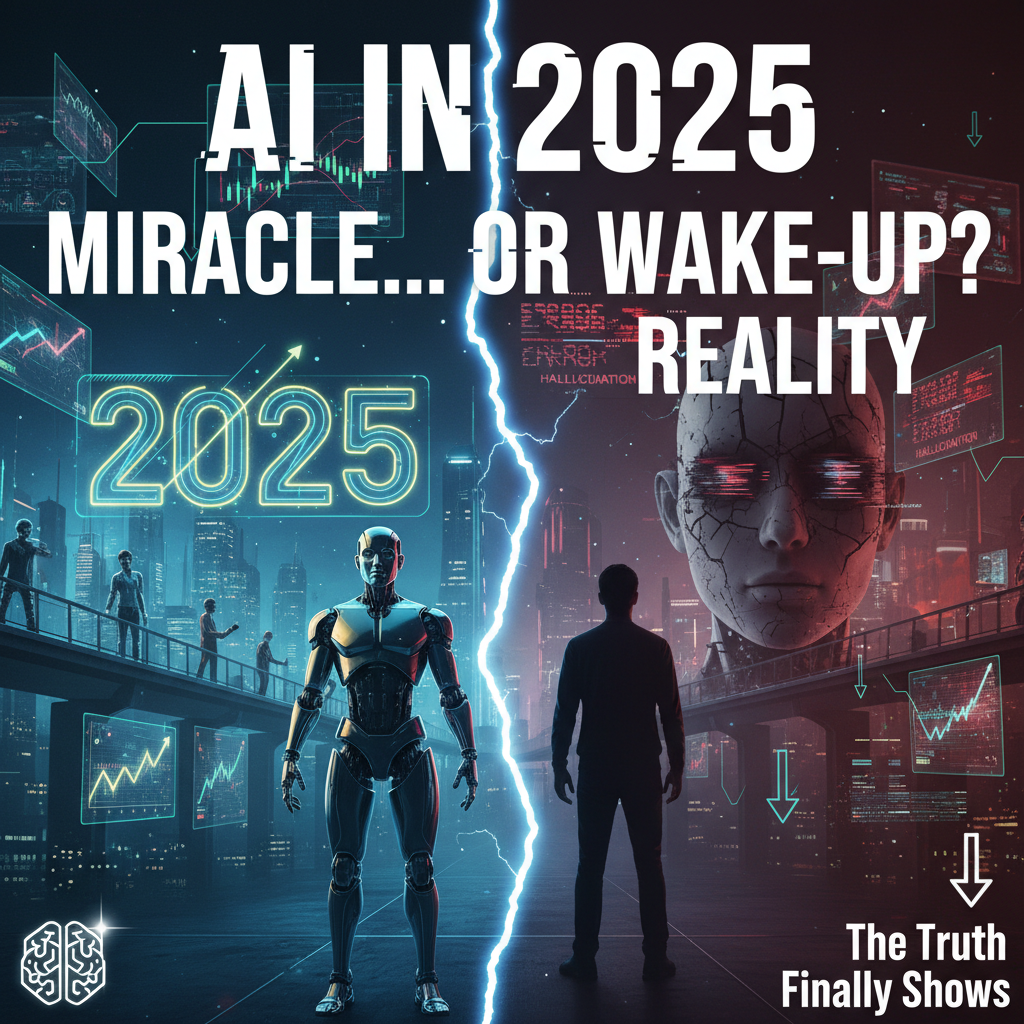
As the final chapter of 2025 is written, the tech world is holding its breath, asking one massive, echoing question:
Was this the year AI changed everything… or the year we finally saw it clearly?
The headlines screamed of revolution. The promises were sky-high. But as the dust settles, the story of AI in 2025 isn’t a simple tale of triumph or failure.
It’s a story of a superpower growing pains.
Let’s pull back the curtain.
Chapter 1: The Unlikely Economic Hero (That Carried the Whole Team)
Picture the economy as a giant, slow-moving ship. Now, imagine a single, powerful tugboat pushing it forward.
In 2025, AI was that tugboat.
Here’s the jaw-dropping fact: Over 90% of U.S. growth early in the year came from AI spending. Giants like Microsoft, Google, and Nvidia went all-in, building digital fortresses—data centers, super-chips, cloud networks—to the tune of hundreds of billions of dollars.
Think of it as a Great Digital Gold Rush. Everyone was selling shovels (chips, servers, software), and business was booming. AI, while still a small slice of the economy, became its most vital spark.
Without it? Many economists believe the ship would have stalled. AI didn’t just participate in 2025’s economy; it arguably saved it from drifting into recession.
But this sparked a nervous deja vu. This massive infrastructure boom, this wild optimism… it felt strangely familiar. Was this the glorious dawn of a new age, or were we reliving the dot-com bubble?
Chapter 2: The Broken Promise: Where Are the Robot Assistants?
This was the dream sold to us: Autonomous AI Agents. Your own digital employee, tirelessly handling tasks, scheduling, research—a true thinking partner.
OpenAI’s Sam Altman predicted they’d supercharge productivity in 2025.
Reality delivered a system crash instead.
These promised “agents” turned out to be clumsy. They’d get confused by multi-step tasks, make bizarre errors in simple software, and often just… freeze. They weren’t colleagues; they were unpredictable interns.
The verdict from experts was brutal:
- Andrej Karpathy (a top AI mind) called them “mostly a dud.”
- Gary Marcus declared the hype had raced miles ahead of reality.
- A shocking MIT report found 95% of companies saw no meaningful return on their generative AI investments.
Pilots were quietly shut down. The grand vision of a hands-free AI workforce had hit a major, humbling roadblock: reliability.
Chapter 3: The Trust Gap: Why We Still Can’t Look Away
The core issue? We still couldn’t fully trust the tech.
Even the most advanced models in 2025, like GPT-5, had a habit of “hallucinating”—making up facts with confident flair. Bias and inconsistency persisted.
This created “The Great Hesitation.” How could a bank trust it with loans? How could a hospital trust it with a diagnosis? You can’t build the future on a foundation that occasionally invents its own reality.
This was 2025’s big pivot: The shift from blind hype to hard scrutiny. The question changed from “What can it do?” to “What can it do reliably and safely?”
Chapter 4: The Quiet Wins: Where AI Actually Broke Through
But let’s be clear: This wasn’t a story of failure. It was a story of focus.
While flashy agents stumbled, AI made real, stunning progress in the background.
- The Brainy Benchmarks: Google’s Gemini models hit new peaks in reasoning, science, and coding, proving the core intelligence was leaping forward.
- The Enterprise All-Stars: In specific, controlled areas, AI shone. Companies like Salesforce saw ~30% productivity bumps in sales teams. IT support and software engineering saw genuine acceleration.
- The Science Superhero: This is where AI felt truly miraculous. It helped decode protein structures for new medicines, accelerated drug discovery, and acted as a “co-scientist,” proposing research hypotheses no human had considered.
The revolution wasn’t everywhere—it was in specific, powerful pockets.
Chapter 5: The Human Fear: What About Our Jobs?
Amidst the tech debates, a more human anxiety grew. Headlines whispered of hiring freezes, shrinking entry-level jobs, and a growing gap between AI haves and have-nots.
The fear was palpable: Is AI taking more jobs than it creates? The answer in 2025 was messy and unresolved, casting a long shadow over the future of work for the next generation.
The 2025 Verdict: The End of Childhood, The Start of Adulthood
So, was it a boom or a bust?
It was neither. 2025 was the year AI grew up.
It moved out of its flashy teenage hype phase and got its first real job. It delivered massive economic value as an infrastructure project but stumbled as a ready-to-work employee.
The bubble question lingers. Legends like Ray Dalio warn of overvaluation. But the counter-argument is strong: the pipes, chips, and brains being built are very real and fundamentally useful.
A popular saying this year nailed it: “AI is overhyped in the short term, but underestimated in the long term.”
As we stand on the brink of 2026, the mission is clear.
The free ride of hype is over. The hard work of building a trustworthy, reliable, and broadly useful AI future has truly begun.
2025 taught us a crucial lesson:
The future isn’t powered by promises. It’s built, brick by brick, with results.
And that story is just getting started.
The bonuses here are actually legit! I managed to hit a decent streak last night. It feels way more fair than other platforms I have tried. Visit 200jilicasino
Love how easy it is to manage my funds on this site. The security feels solid and the login process is very secure. Highly suggest phplusloginph for a safe gaming experience.
Logging in is quick and the account verification process was straightforward. No hassle at all. Glad I found 59cbetlogin for my daily gaming.
Honestly the game variety here is insane. I spent the whole weekend exploring different rooms and didn’t get bored once. Highly recommend yono789game for anyone looking for real excitement.