

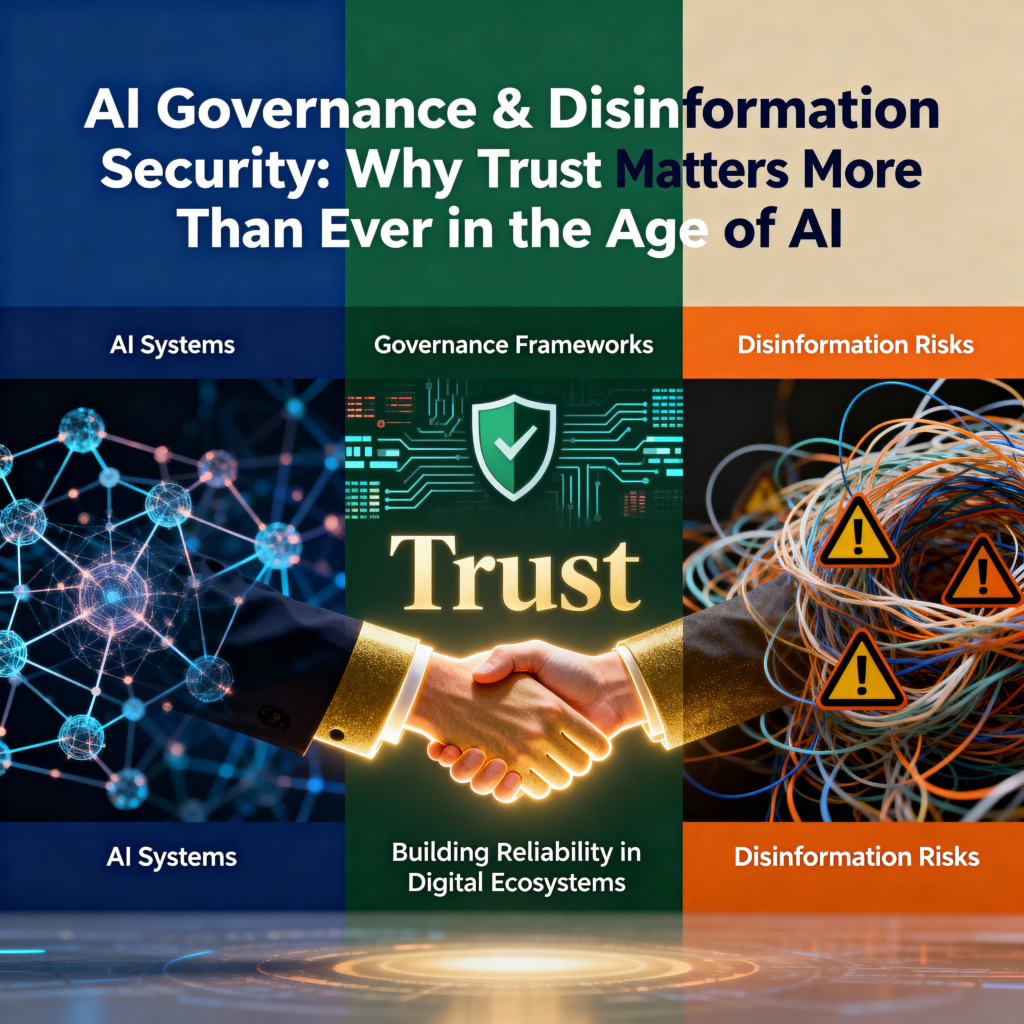
Artificial Intelligence is everywhere today. From writing emails and creating images to answering questions and making videos, generative AI has exploded at a speed no one expected. Platforms like ChatGPT alone reportedly reached hundreds of millions of weekly users, showing just how deeply AI has entered our daily lives.
But with this massive growth comes a serious problem: how do we control the risks?
As AI content floods the internet, governments and companies are now focusing on AI governance and disinformation security. This shift is not optional anymore — it’s necessary to protect trust, truth, and safety in the digital world.
What Is AI Governance?
AI governance simply means rules, systems, and practices that make sure AI is used responsibly.
It focuses on questions like:
- Can we trust AI output?
- Who is responsible if AI causes harm?
- Is the data biased or fair?
- Can we track where AI content comes from?
AI governance helps organizations use AI ethically, safely, and transparently, instead of blindly trusting whatever AI produces.
The Growing Problem of AI-Generated Risks
Generative AI is powerful, but it is not perfect. Some of the biggest risks include:
1. Deepfakes
AI can now create fake videos, voices, and images that look real. This can be used to:
- Spread fake news
- Damage reputations
- Influence elections
- Create scams
As deepfakes become more realistic, it becomes harder to tell what is real and what is fake.
2. Hallucinations
AI sometimes makes up information confidently. This is called an AI hallucination.
For example:
- Wrong facts
- Fake sources
- Incorrect advice
If people blindly trust AI answers, this can lead to serious misinformation.
3. Bias and Unfairness
AI learns from data created by humans — and humans are not perfect.
This means AI can:
- Favor certain groups
- Discriminate unintentionally
- Reinforce stereotypes
Without governance, these biases can quietly spread at scale.
4. Mass Disinformation
AI can create thousands of fake articles, posts, and videos in minutes.
This makes it easy to:
- Manipulate public opinion
- Spread propaganda
- Confuse people during crises
This is why disinformation security has become a major concern.
What Is Disinformation Security?
Disinformation security focuses on protecting people and organizations from fake or misleading AI-generated content.
Just like cybersecurity protects us from hackers, disinformation security protects us from:
- Fake news
- AI-generated lies
- Manipulated media
It is quickly becoming a new and essential layer of digital defense.
New Tools Fighting AI Disinformation
To control these risks, companies and governments are investing in new solutions.
1. AI Watermarking
Watermarking adds a hidden signal to AI-generated text, images, or videos.
This helps:
- Identify AI-created content
- Track its origin
- Distinguish real content from fake
It doesn’t stop AI creation, but it improves transparency.
2. AI Governance Platforms
These platforms help companies:
- Monitor AI systems
- Track data sources
- Detect bias
- Audit decisions
- Ensure compliance
Think of them as control dashboards for AI.
3. Disinformation Detection Tools
These tools use AI to fight AI.
They can:
- Detect deepfakes
- Flag fake content
- Monitor social media manipulation
- Alert organizations in real time
This is especially important for media companies, governments, and large brands.
Gartner’s Big Prediction for 2028
According to Gartner, the importance of disinformation security will grow rapidly.
By 2028:
- 50% of large companies will use dedicated disinformation defense tools
- Today, only around 5% use such systems
This shows how fast priorities are changing. Trust is becoming just as important as innovation.
Why Regulators Are Stepping In
Governments across the world are realizing that AI cannot be left unregulated.
Regulators are now focusing on:
- Transparency
- Accountability
- Ethical AI use
- Traceability of AI content
New rules are being designed to ensure that:
- People know when content is AI-generated
- Companies take responsibility for AI output
- Harmful uses of AI are limited
The goal is not to stop AI — but to guide it safely.
Why Trust Is the Real Currency of AI
In the past, speed and innovation mattered most. Now, trust matters more.
If people:
- Can’t trust what they see
- Can’t trust what they read
- Can’t trust what they hear
Then digital systems start to fail.
AI governance and disinformation security are about protecting trust in a world where content is easy to create but hard to verify.
What the Future Looks Like
In the coming years, we will see:
- Clear AI usage labels
- Stronger content verification systems
- AI ethics teams inside companies
- New careers in AI governance
- Better public awareness of AI risks
Using AI responsibly will become a basic expectation, not a bonus.
Final Thoughts
Generative AI is one of the most powerful technologies ever created. But power without control can be dangerous.
That’s why AI governance and disinformation security are no longer optional — they are essential.
As AI content continues to flood the internet, the winners won’t just be the fastest innovators, but the ones who build trust, transparency, and responsibility into their systems.
The future of AI is not just about intelligence.
It’s about truth.
A very straightforward platform that does not complicate things. I appreciate the transparency and the fair odds. I’ll be spending more time on kkk123 from now on.
The customer support is actually helpful and responsive which is rare these days. I felt safe depositing my money and the games are genuinely exciting. Love jiliuucasino!
Super easy to navigate and the bonuses are actually worth it. I am really enjoying my time on plataforma345vip