
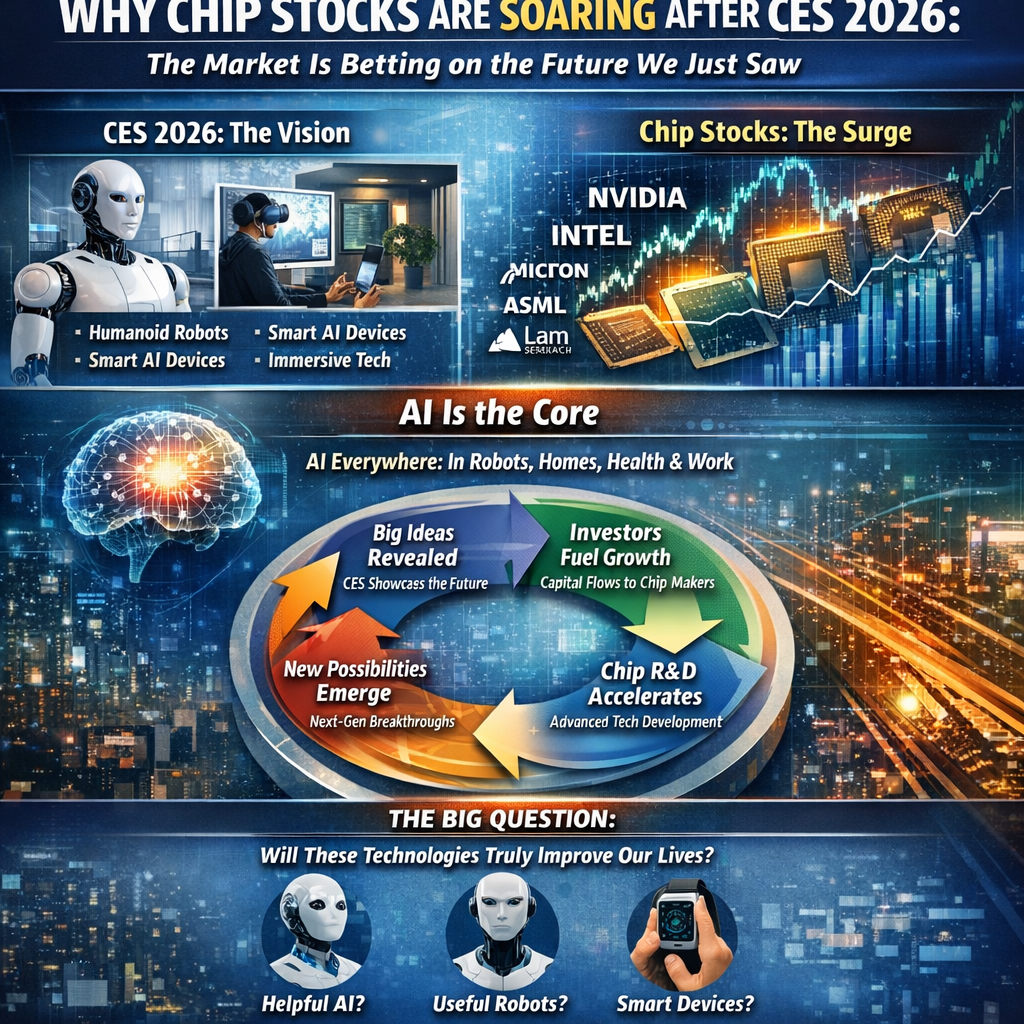
The powerful rally in chip stocks at the start of 2026 isn’t random hype—it’s a clear vote of confidence. Investors aren’t just reacting to earnings reports or short-term trends. They’re responding to something much bigger: the future that CES 2026 just put on display.
What happened in Las Vegas and what’s happening in the stock market are deeply connected. CES showed us what the next wave of technology will look like. The stock market rally is showing us how that future will be built—and who will profit from making it real.
Let’s break down why CES 2026 and the chip stock surge are truly two sides of the same coin.
CES Showed the Dream. Chip Stocks Are Funding the Reality.
CES 2026 was filled with bold ideas:
- Humanoid robots that interact like coworkers
- AI embedded into everyday objects
- Immersive displays that feel almost alive
- Wearables that constantly monitor health and context
These ideas feel futuristic—but they aren’t magic. They all depend on semiconductors.
Every robot needs a brain. Every AI system needs memory. Every smart device needs processing power. This is why companies like Nvidia, Intel, Micron, ASML, and Lam Research are at the center of the market rally.
- Micron’s rise reflects exploding demand for high-speed memory needed by AI models and robotics.
- ASML’s gains highlight a simple truth: without its advanced chipmaking machines, next-generation chips can’t exist.
- Nvidia and Intel are building the computational engines powering AI, robotics, and immersive computing.
CES showed us the vision. Investors are now paying to build the foundation beneath it.
AI Is the Thread Connecting Everything
One message from CES 2026 was impossible to miss: AI is no longer a feature—it’s the core.
AI isn’t just inside phones or apps anymore. It’s becoming:
- The decision-maker inside robots
- The intelligence running smart homes
- The invisible layer coordinating health, work, and entertainment
The stock market understands this shift. This is why the rally isn’t limited to one company or one product. It’s focused on AI infrastructure—the chips, tools, and manufacturing systems required to support AI everywhere.
This matters because it signals long-term demand, not a short-lived trend. As AI becomes embedded into more devices, the need for advanced semiconductors only grows stronger and more persistent.
The Innovation Flywheel Is Spinning Faster
What we’re witnessing is a self-reinforcing cycle of innovation, and CES 2026 made it visible.
Here’s how it works:
- Big Ideas Are Revealed
CES showcases ambitious AI-powered concepts—robots, smart environments, intelligent devices. - Markets Respond With Capital
Investors pour money into the chipmakers capable of supporting those ideas. - Chip Companies Accelerate R&D
With fresh capital, companies develop even more powerful processors and manufacturing tools. - Even Bigger Possibilities Emerge
Stronger chips unlock new use cases—setting the stage for CES 2027 and beyond.
This flywheel explains why chip stocks often rally before mass adoption happens. The market isn’t waiting for perfection—it’s investing in potential.
The Question That Still Matters Most
Despite all the excitement, one crucial question remains—for both investors and everyday users:
Will these technologies truly improve lives, or will they become expensive gimmicks?
CES presentations can be dazzling, but real success depends on:
- Whether AI feels genuinely helpful
- Whether humanoid robots solve real problems
- Whether smart devices reduce complexity instead of adding to it
Chip stocks can provide the horsepower, but technology companies must deliver experiences people actually want to use.
The future won’t be judged by demos—it will be judged by daily usefulness.
A Market Bet on Human–Machine Collaboration
The first weeks of 2026 have delivered a powerful narrative:
- CES 2026 gave us the vision of an AI-driven, interconnected world.
- The chip stock rally provided financial validation that this vision is believable—and investable.
This surge isn’t just about quarterly numbers. It’s a bet on a future where humans and machines work together more closely than ever before—quietly, intelligently, and continuously.
The market seems convinced that ambient, embodied, and intelligent AI isn’t a distant dream—it’s under construction right now. And at the center of that construction is a foundational layer of advanced semiconductors.
The excitement is no longer just about seeing the future on a CES stage.
It’s about investing in the infrastructure that will bring that future to life.
And judging by the market’s response, that future is already being built.