
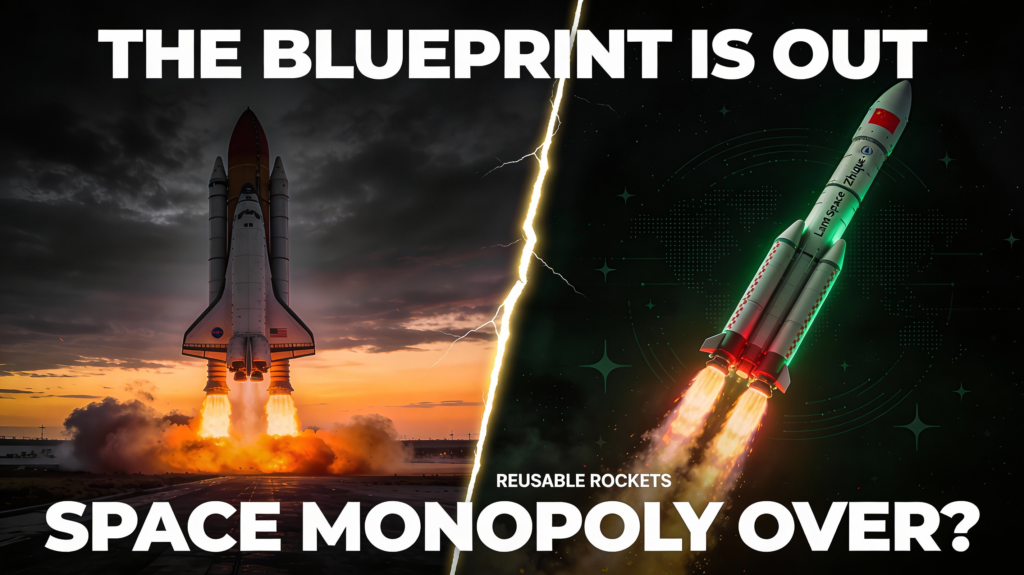
For a decade, SpaceX’s dominance seemed almost magical—a unique blend of Musk’s vision, iterative Silicon Valley engineering, and NASA support. LandSpace has just demystified it. They’ve shown that a private company, outside the traditional US aerospace context, can:
- Develop methane-LOX engines (their Tianque-12 engines are key).
- Build a large, orbital-class reusable rocket.
- Execute a complex mission profile (launch, stage separation, re-entry, landing burn attempt).
The landing failure is a footnote. The takeaway is: The technical path to reuse is now a known, viable roadmap, not a proprietary secret.
What This Means for the Global Market: A Forced Reckoning
- For SpaceX: This is the first true strategic validation of its core thesis from a competitor. It will force acceleration of Starship and next-gen Falcon optimizations. More importantly, it proves the market for reusable launch is real and global, potentially justifying SpaceX’s massive bets.
- For Western Competitors (Rocket Lab, Relativity Space, etc.): The pressure just intensified exponentially. They are no longer just chasing SpaceX; they now face a well-funded, state-adjacent competitor with a potentially vast, protected domestic market (China’s national satellite constellations) to bootstrap costs and iteration cycles.
- For China’s Ecosystem: LandSpace is the pace car. Their progress will drag the entire Chinese private space sector (“NewSpace”) forward, fostering suppliers, talent, and investor confidence. Expect more companies (iSpace, Galactic Energy) to accelerate their reusable plans.
The Geopolitical Dimension: A “Dual Circulation” Space Strategy
China’s strategy mirrors its economic model: foster fierce domestic competition among private companies, then let the winners compete globally. LandSpace and Zhuque-3 are tools for:
- Domestic Independence: Securing affordable, sovereign access to space for national projects (like the Guowang mega-constellation, China’s answer to Starlink).
- Global Influence: Eventually offering competitive commercial launches, especially to nations and companies seeking an alternative to Western providers.
The Critical Unknowns: Sustainability and Scale
LandSpace has proven technical viability. The next questions are harder:
- Launch Tempo: Can they achieve and sustain the rapid, reliable launch frequency that makes reusability economically transformative? (This is SpaceX’s real moat).
- Global Reach: Will their rockets attract international commercial customers amid geopolitical tensions and existing US launch service agreements?
- Innovation Cycle: Can they move from replication to innovation? What will their “Starship moment” be?
Bottom Line: The Monopoly is Over
The era where one company held the only keys to affordable, reusable orbital launch is officially ending. LandSpace’s Zhuque-3 test is the opening shot in the commercial heavy-lift reuse era.
This doesn’t mean SpaceX is dethroned—it remains years ahead in operational maturity. But it does mean the future landscape will be multipolar. Competition will drive down costs and accelerate technological progress across the board.
The new space race isn’t about who gets there first anymore. It’s about who builds the most resilient, scalable, and economically dominant ecosystem in orbit—and beyond. LandSpace just secured China a formidable seat at that table.