


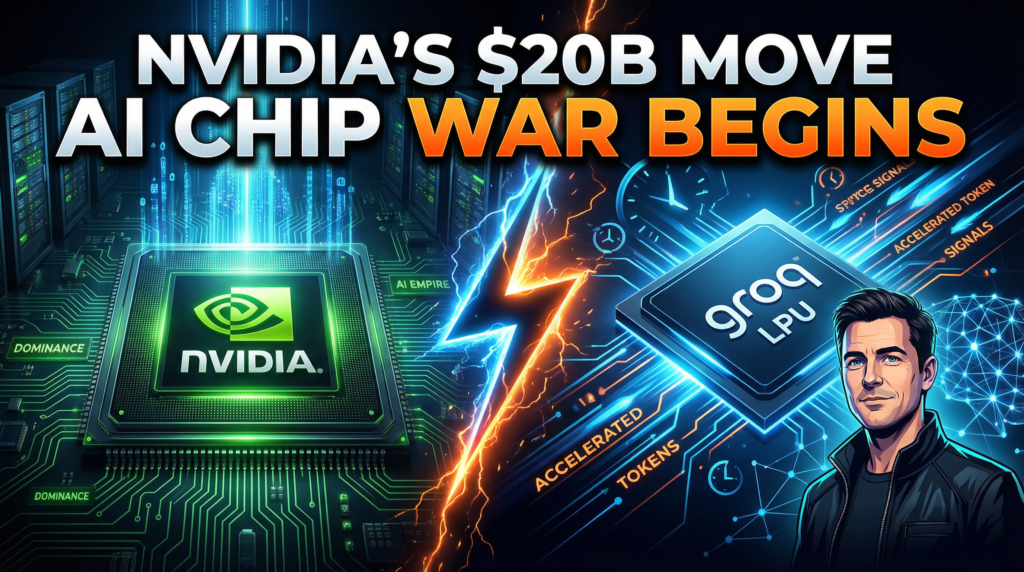
This is not a simple acquisition or a standard partnership. It’s a talent and technology capture wrapped in a licensing deal. Nvidia is systematically neutralizing a potential future threat while supercharging its own roadmap.
1. The “Acqui-hire” at Its Grandest Scale:
While labeled a licensing deal, the real prize is Jonathan Ross and his team. Ross didn’t just work on TPUs; he invented the core systolic array architecture that made them so effective for AI. By bringing this brain trust in-house, Nvidia isn’t just buying technology—it’s buying years of accelerated R&D and preventing that talent from building a competitive powerhouse elsewhere.
2. Plugging Nvidia’s (Relative) Weakness:
Nvidia’s GPUs are brilliant, general-purpose AI engines. Groq’s LPUs (Language Processing Units) are specialized, deterministic engines for ultra-low latency inference. They can run LLMs like Llama or Mistral at breathtaking speeds (hundreds of tokens per second). For applications where instantaneous response is critical (real-time translation, interactive agents, financial analysis), this specialization matters. Nvidia now gets to fuse this deterministic speed with its own incredible ecosystem (CUDA, software stack).
3. A Defensive Masterstroke Against the “Chiplet” Future:
The biggest long-term threat to Nvidia’s monolithic GPU dominance is the rise of modular chiplet designs—where companies mix and match specialized blocks (e.g., an inference block, a memory block, a networking block). Groq’s architecture is inherently modular and composable. By internalizing this expertise, Nvidia can lead this transition on its own terms, rather than be disrupted by it.
What This Means for Different Players:
- For Competitors (Google TPU, AWS Inferentia, AMD): The message is stark. Nvidia is not resting on its CUDA moat. It is actively co-opting innovative architectures that could challenge it. The barrier to entry just got higher.
- For AI Startups and Cloud Customers: In the short term, you’ll likely see Nvidia-powered inference become dramatically faster and cheaper. In the long term, there’s a risk of reduced choice. A key independent innovator in the inference space is now aligned with the dominant player.
- For the Broader AI Ecosystem: This accelerates the shift from “training-centric” to “inference-centric” metrics. The focus will move from “How big can we make this model?” to “How fast and cheaply can we run it at scale for millions of users?” This is essential for AI’s integration into daily life and business processes.
The Crucial Unanswered Question: Independence.
The “non-exclusive” nature of the deal is its most fascinating clause. Will Groq, now with its founder and key leaders at Nvidia, continue to innovate independently and serve competitors? Or does this mark the beginning of Groq’s technology being absorbed into the Nvidia behemoth, with the startup gradually becoming a shell? The answer will determine if this fosters innovation or stifles it.
Bottom Line:
You are correct—this is a defining moment in the AI hardware war. Nvidia has executed a brilliant, pre-emptive move:
- Talent: Captured a world-class architect and team.
- Technology: Licensed a complementary, threat-level architecture.
- Strategy: Fortified its inference capabilities and hedged against architectural shifts.
The deal ensures that whether the future of AI chips is dominated by monolithic GPUs, specialized inferencing units, or modular chiplets, Nvidia intends to own the foundational technology and the brains behind it. The race isn’t just heating up—Nvidia is absorbing the track’s fastest competitors into its own engine.