


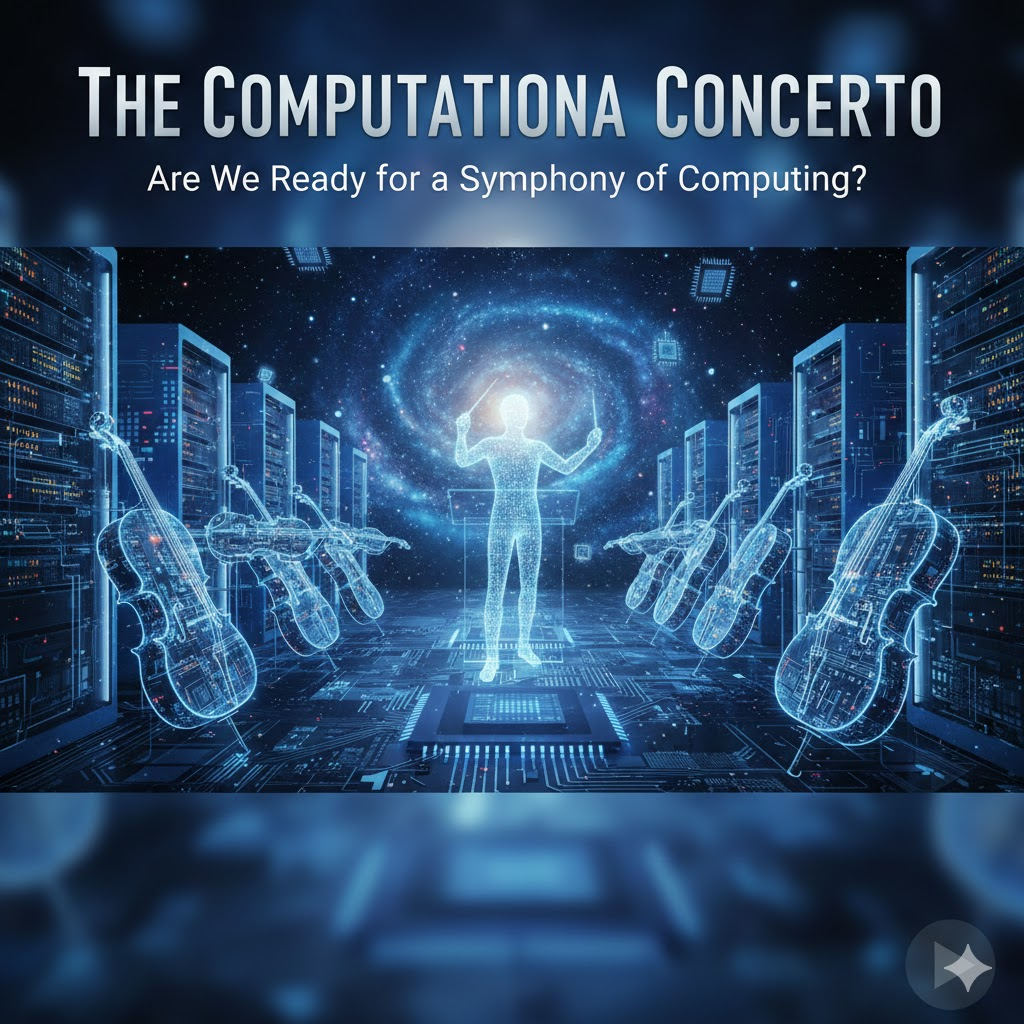
Have you ever stopped to wonder why our computers have to pick a lane? They’re either the brilliant-but-brutish classical machines we know, the mysterious quantum probables of tomorrow, or the brain-inspired neuromorphic networks still in their infancy. What if we stopped asking them to choose and, instead, started conducting an orchestra?
Welcome to the horizon of hybrid computing—the most tantalizing “what if” in technology today. It’s a trend that’s less about a single new gadget and more about a fundamental philosophy: mashing together the best of all computational worlds to create a mega-machine capable of tackling the problems we currently label “unsolvable.”
The All-Star Team of Processing Power
Forget the old rivalry. Imagine a computational all-star team.
Your reliable classical computer is the seasoned workhorse, handling the everyday tasks with flawless precision. The quantum processor is the probability wizard, exploring millions of possibilities simultaneously to find answers to questions that would take traditional computers millennia. And the neuromorphic chip? It’s the artist, thinking and learning in a way that mimics the human brain, perfect for spotting patterns and making intuitive leaps.
This isn’t just a fantasy. Gartner’s latest trends report places this hybrid approach at the heart of the future, where storage, networks, and these “exotic engines” fuse together. The goal? To create high-speed havens where AI can finally transcend its current limits and where the line between human and machine input starts to blur.
Beyond the Hype: Where Does the Magic Happen?
So, what does this hybrid world actually look like? The whispers from the biggest thinkers are painting a fascinating picture.
- Greener, Smarter Worlds: As McKinsey and Talkspirit point out, this isn’t just about raw power—it’s about smarter power. Imagine industrial metaverses and immersive digital twins of entire cities, running on hybrid systems that optimize energy grids in real-time, creating greener data flows and making our carbon footprint a design consideration, not an afterthought.
- Hardware That Harmonizes: The fusion goes deeper than just software. The World Economic Forum’s emerging tech list hints at this with things like structural batteries for EVs—where the very body of the car becomes part of the power source. This is hardware harmony, where components are designed to work together from the ground up, not just bolted on.
- The Connected Enterprise: On a human level, Exploding Topics notes the rise of connected governance layers. Think of an entire organization—from the factory floor to the C-suite—operating as a single, intelligent organism, streamlined by this fusion of data and processing power.
The Ultimate Question: What About Us?
Here’s where the curiosity really spikes. What happens when this incredible power turns its focus inward?
Gartner flags the potential for “body-as-platform” personalization. Let that sink in. We’re talking about a future that could range from neural enhancements that help us learn a new skill in an instant to autonomous factories so intelligent they feel less like machines and more like extensions of human will. The question isn’t just “Can we build it?” but “What does it mean to plug in?”
Of course, no frontier is without its dragons. Analysts warn of “antipatterns”—a fancy term for the massive integration headaches and security nightmares that come from trying to make these vastly different systems speak the same language.
But as one insightful analyst mused, navigating these challenges isn’t a burden; it’s our “star map for safe innovation.” It’s the guide that ensures we compose this future with intention, not accident.
We are truly on the cusp of a computational concerto. The instruments are being tuned, and the composers—that’s us—are stepping up to the podium.
So, I have to ask: In this era of magnificent mashups, what symphonies will we compose? Share your most curious “what if” in the comments below.