


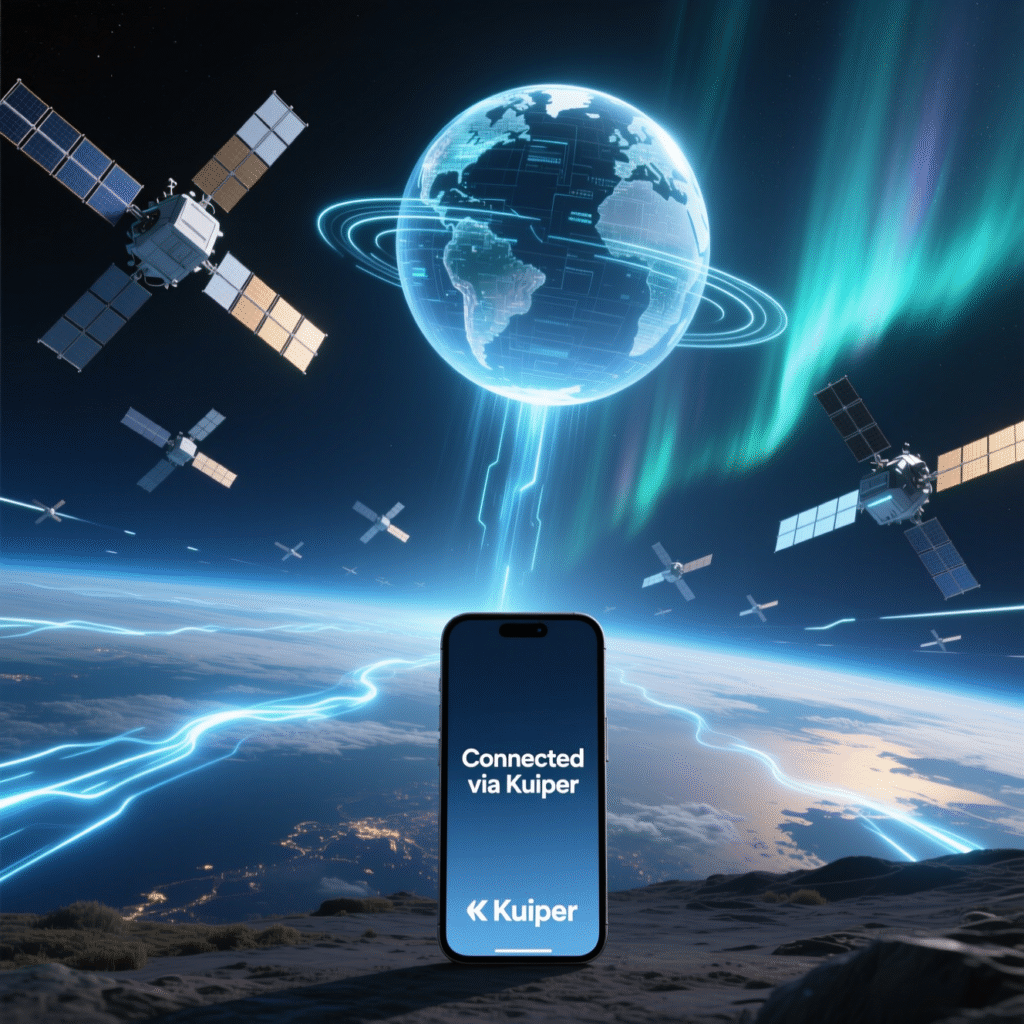
Raise your hand if you’ve ever fantasized about lightning-fast internet in the middle of nowhere—where mountains, deserts, forests, and forgotten postal codes finally get the digital dignity they deserve.
Well, Amazon’s Project Kuiper just took that dream and strapped a rocket to it.
With the reveal of its new LEO Ultra terminal, the project has officially dialed satellite internet into a new dimension—one powered by gigabit downloads, ultra-low latency, and data duplexing that could make even urban fiber blush.
And suddenly, the world is asking:
Could the sky finally solve what the ground never could?
Let’s unpack the hype.
🚀 Kuiper’s LEO Ultra Terminal: The Beast in Orbit’s Basement
Amazon didn’t just unveil a terminal—they unveiled a statement.
The LEO Ultra, debuting amid November’s burst of space headlines, is built for enterprise-grade demands: governments, infrastructure giants, remote industries, and sprawling organizations that need bulletproof connectivity at the literal edge of the earth.
Here’s what makes it jaw-dropping:
- 1 Gbps download speeds
- 400 Mbps uploads—thanks to next-gen phased-array antennas
- Seamless duplex data for mission-critical applications
- Low-latency performance that mimics terrestrial broadband
- A 2026 full-scale deployment timeline
Designed to survive harsh weather, punishing terrain, and bandwidth-hungry workloads, the LEO Ultra isn’t trying to compete with home Wi-Fi—it’s trying to replace outdated terrestrial infrastructure altogether.
Think:
Oil rigs, disaster zones, rural hospitals, border outposts, construction megasites, national grids, and remote scientific hubs.
If Starlink was a wake-up call, Kuiper is the caffeine jolt.
🌍 A Planet on the Verge of Connection—or Congestion?
Kuiper’s ambitions arrive at a fascinating moment in global connectivity:
SpaceX is hitting major constellation milestones
Their LEO network already blankets massive swaths of the globe with high-speed access.
India’s satellite-tech surge is exploding
Startups are securing hefty funding, building LEO hardware, and installing terminals in rural belts once left off the digital map. It’s not just internet—it’s economic oxygen.
Governments are eyeing sovereignty in space
Secure, satellite-fed communication is becoming as important as physical borders.
So, when Kuiper’s Ultra terminal dropped, the internet reacted instantly—especially on X (Twitter):
“From ants to colonies—unstoppable connectivity?”
“Is this hive-mind infrastructure?”
“Sky-net, but wholesome?”
Kindred Labs’ “hive-mind” metaphor went viral: the idea that billions of people, sensors, and devices could sync across a planetary mesh network—no dead zones, no divides, no lost signals.
But the big question buzzing around feeds is less sci-fi and more grounded:
Are we on the cusp of the most equitable connectivity moment in history…
or the most congested era of orbit we’ve ever seen?
⚡ Why the Orbital Buzz Today?
Two reasons: 5G gaps and AI energy anxiety.
1. 5G Isn’t Everywhere—Not Even Close
Despite the marketing, rural gaps remain giant.
Underserved countries? Even bigger.
Kuiper is pitching a solution that’s not just faster—it’s fairer.
2. Viral Clips of AI Data Centers Are Scaring Everyone
We’ve all seen the “what needs to happen to AI centers” videos—massive facilities sucking megawatts to train large models.
People wonder if more satellite networks will accelerate the energy crunch… or decentralize it.
So the curiosity spike is natural:
- What happens when satellite internet becomes the new default?
- Do we knit a truly connected planet—rural remote workers, telemedicine, drone fleets, climate sensors, global classrooms?
- Or do we litter the sky with e-waste and orbital debris?
Kuiper’s answer?
A “responsible constellation” design with active debris avoidance and end-of-life burn-up protocols.
The world remains… cautiously curious.
🛰️ Kuiper vs. Starlink: The Quiet War Above the Clouds
Though the companies avoid direct mudslinging, everyone knows the duel is on.
- Starlink is ahead in deployment.
- Kuiper is betting big on enterprise and industrial power-users.
- Both want to dominate rural connectivity.
The result?
A competitive leapfrog that could drive prices down and speeds up.
Consumers win.
Industries win.
Rural communities win.
And orbit? Well… we’ll see.
🌌 Final Thought: Is This the Beginning of Borderless Broadband?
Amazon’s Kuiper isn’t just launching satellites—it’s launching a new philosophy around connection:
That geography shouldn’t dictate opportunity.
That forests and fishing towns deserve the same speeds as cities.
That the sky could be a bridge, not a barrier.
But with ambition this sky-high comes equally sky-high risk—orbital clutter, energy demand, and regulatory chaos.
So here’s the curiosity question that lingers:
Is Kuiper about to give us a truly connected planet…
or is it the beginning of an overcrowded orbital future?
Either way, one thing is certain:
Access just reached a new altitude.
And your first beam could be a remote-work desk in the mountains…
or a world where cosmic comms are as normal as cellular bars.
Which possibility excites you more?