
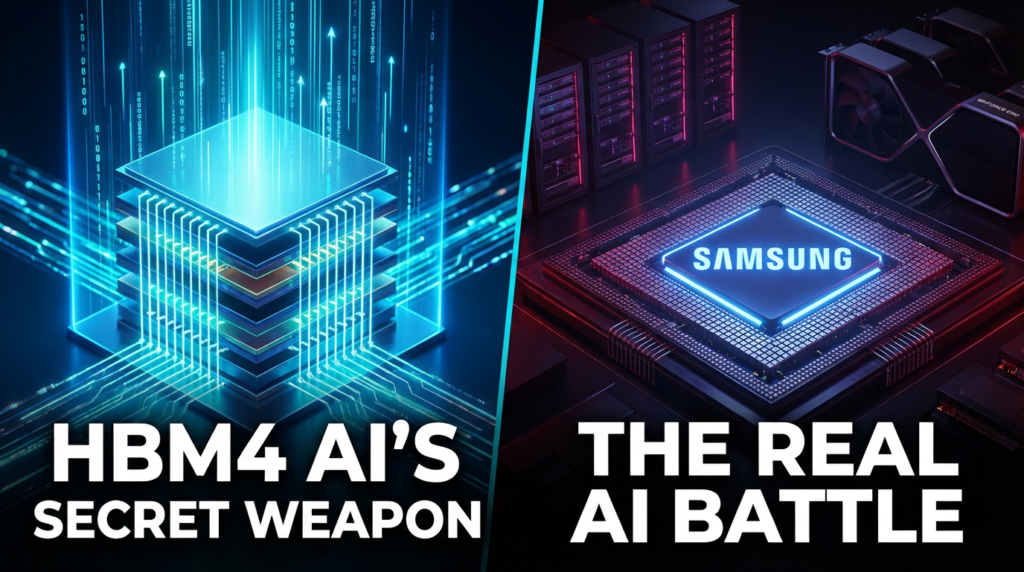
When people talk about the AI revolution, most eyes go straight to powerful processors from NVIDIA or AMD. But behind every breakthrough AI model lies a quieter hero—memory. And right now, Samsung is making a bold move to dominate this hidden battlefield with its next-generation HBM4 (High Bandwidth Memory).
This isn’t just another product upgrade. It’s a strategic shift that could redefine how fast, efficient, and powerful AI systems become over the next decade.
So why is HBM4 such a big deal—and why is Samsung racing ahead?
Let’s break it down.
Why Memory Is the Real Bottleneck in AI
Modern AI models don’t just need raw computing power—they need data, fast and constantly. Large language models, real-time inference, and advanced simulations push memory systems to their limits.
Traditional memory simply can’t keep up.
That’s where HBM (High Bandwidth Memory) comes in. By stacking memory chips vertically and placing them extremely close to processors, HBM dramatically increases data speed while reducing power consumption.
HBM4 is the next giant leap.
What Makes HBM4 So Revolutionary?
HBM4 is expected to go far beyond current HBM3 standards in several critical ways:
- Higher bandwidth to feed AI accelerators faster
- More stacked layers (expected to exceed 12 layers)
- Better power efficiency, essential for massive data centers
- Advanced packaging, especially technologies like TSV (Through-Silicon Vias)
In simple terms: HBM4 allows AI chips to think faster, learn more, and waste less energy.
And Samsung wants to lead that future.
Samsung’s Strategic Push: More Than Just Memory
Samsung’s aggressive move into HBM4 is not accidental—it’s deeply strategic.
Unlike many competitors, Samsung has strong vertical integration. It controls much of its own memory design, manufacturing, and packaging. This gives it a powerful advantage in speed, scale, and coordination.
Major AI chipmakers are already paying attention.
Strong customer signals suggest that Samsung isn’t just catching up—it’s aiming to set the standard for AI memory in the coming years.
The Supply Chain Challenge No One Talks About
However, the road to HBM4 dominance is far from smooth.
The global semiconductor supply chain is one of the most complex systems ever built. It relies on:
- Advanced materials
- Precision manufacturing equipment
- Specialized packaging technologies
- Globally distributed suppliers
Technologies like TSV, which are essential for stacking memory layers, require extreme accuracy and high yields. Any disruption—geopolitical tension, trade restrictions, or logistics failures—can slow everything down.
Even for a giant like Samsung, supply chain resilience will be tested.
Engineering at the Edge of Physics
HBM4 is not just difficult—it’s pushing physical limits.
As memory stacks grow taller and denser, engineers face major challenges:
- Heat management: More layers mean more heat in a smaller space
- Signal integrity: Data must move faster without errors
- Yield rates: One defect can ruin an entire stack
Balancing performance, reliability, and cost is an enormous engineering puzzle. Solving it will separate true leaders from followers.
Timing Is Everything in the AI Race
Even the best technology can fail if the timing is wrong.
Samsung’s HBM4 success depends on perfect alignment with the launch cycles of major customers—especially companies like:
- NVIDIA
- AMD
- Other next-gen AI accelerator developers
At the same time, industry-wide standards for HBM4 must be clearly defined and adopted. Without common standards, large-scale adoption becomes risky and slow.
Winning the technology race isn’t enough—you must win the ecosystem.
2026: A Potential Inflection Point
Samsung is targeting 2026 as a key milestone for HBM4 rollout—and that date could mark a turning point for the entire tech industry.
If successful, HBM4 could unlock:
- More complex AI models
- Faster real-time decision-making
- Breakthroughs in scientific research
- Ultra-realistic graphics and immersive computing
For everyday users, these advances will quietly improve:
- AI assistants
- Cloud services
- Gaming visuals
- Data-driven applications
The benefits may be invisible—but they will be everywhere.
The Bigger Picture: Memory Is the New Power Center
As AI competition intensifies, the spotlight is slowly shifting.
Yes, processors matter.
But memory is the foundation they rely on.
The battle for AI supremacy is no longer just about faster chips—it’s about who controls the data flow beneath them.
Samsung’s leap into HBM4 is a decisive move in this foundational war.
Final Thoughts: A Quiet Move with Loud Consequences
Samsung’s push into HBM4 is more than a product launch—it’s a strategic reassertion of leadership in one of the most profitable and critical segments of future computing.
If Samsung succeeds, it won’t just supply components.
It will enable the next wave of AI innovation.
The journey to 2026 will be filled with technical challenges, market pressures, and geopolitical risks—but it will also define the hardware backbone of the AI era.
And while processors may grab the headlines, memory—quietly, invisibly—will decide who truly wins.
This is a race worth watching. 🚀