


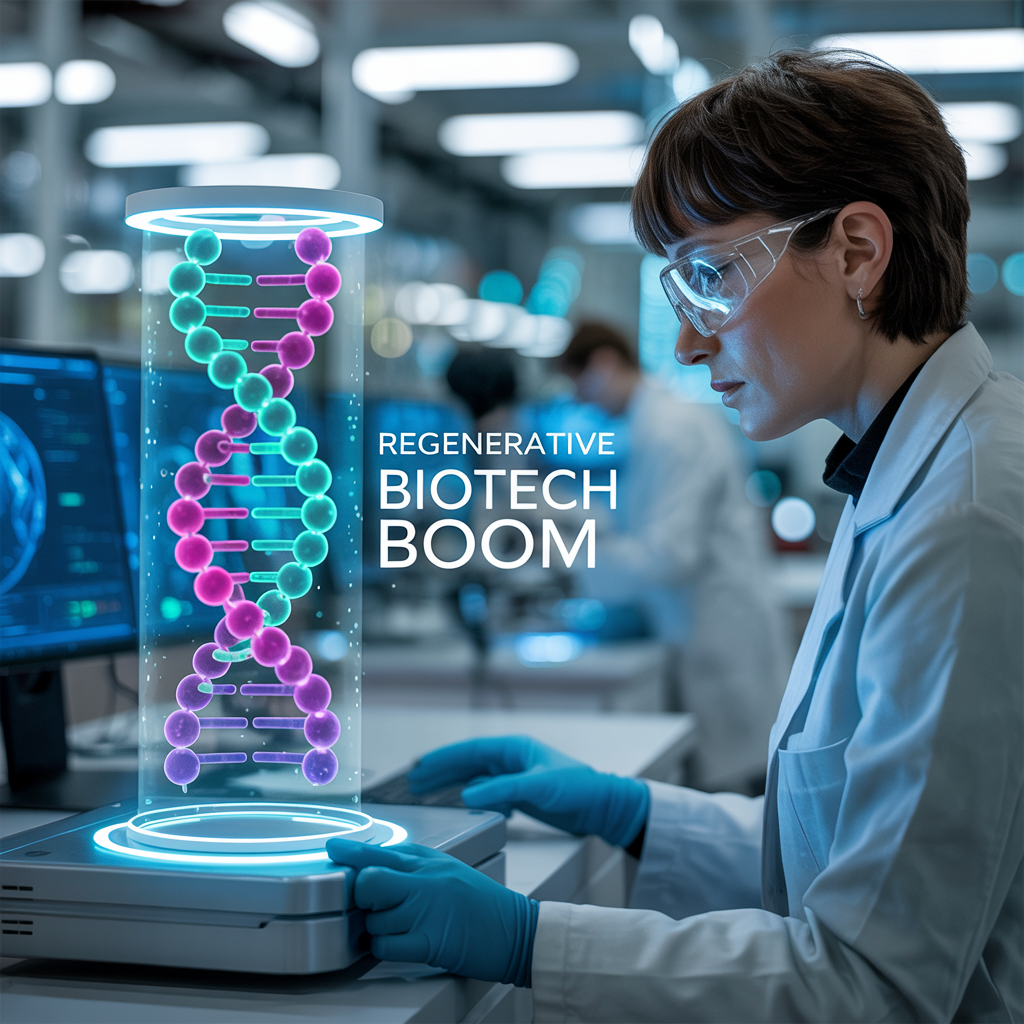
What if aging was a setting, you could toggle off?
Not a cream. Not a vitamin. A fundamental rewrite of how your cells behave.
On this chilly November day, it feels less like science fiction and more like a roadmap quietly unfolding. In labs and startups around the world, a new kind of biotech is emerging—one that doesn’t just repair damage, but reprograms biology. From regrowing tooth enamel to restoring damaged ecosystems, regeneration is shifting from metaphor to method.
And at the center of it all? A fusion of AI, biology, and an old-new idea: maybe the future is less about domination—and more about healing.
From Patchwork Medicine to Programmable Biology
For most of modern medicine, we’ve worked like mechanics: fix the broken part, manage the symptoms, keep things running as long as possible. But regenerative biotech flips that script.
Instead of:
- Filling cavities
- Treating wrinkles
- Managing chronic damage
We’re now talking about:
- Re-growing tooth enamel
- Reversing cellular aging in skin
- Regenerating tissues, perhaps entire organs, from within
The metaphor that keeps showing up: biology as software.
Cells as code. DNA as an interface. Healing not just as “repair” but as “recompile.”
Is that oversimplified? Definitely. But it’s also a surprisingly useful way to think about what’s coming.
The Tooth Fairy Got an Upgrade: Enamel-Regenerating Gels
Let’s start small—say, teeth.
Tooth enamel is one of the few tissues in the human body that doesn’t naturally regenerate. Once it’s gone, it’s gone. Until recently, the only answer was drilling, filling, and hoping for the best.
Now, enamel-regenerating gels and biomimetic materials are back in the spotlight. These experimental formulations aim to:
- Trigger mineral regrowth on tooth surfaces
- Rebuild microcracks and early cavities before they become major problems
- Potentially reduce the need for invasive dental work
What’s changed since the last time this idea made headlines?
AI.
Instead of trial-and-error chemistry alone, researchers are using AI models to:
- Predict how enamel-like materials will bond to teeth
- Optimize formulations for strength, durability, and safety
- Simulate how these gels behave in real-world conditions before clinical trials
Today it’s enamel. Tomorrow, it could be cartilage, skin, or even nerve tissue.
If your dentist could paint on a gel and regrow what should never have been lost—how would that change your relationship with healthcare?
AI as Co-Designer of Regeneration
The shift from “healing” to “regenerating” isn’t just about better biology—it’s about smarter tools.
AI is now being used to:
- Model how cells behave under different genetic, chemical, or mechanical signals
- Predict which cocktail of factors nudges a cell from “scar formation” to true tissue regeneration
- Discover new molecules that can turn on repair pathways our bodies already have, but rarely use in full
Think of it as AI-powered rehearsal. Instead of running a thousand risky experiments in a lab or clinic, models can:
- Simulate gene edits
- Test regenerative drug candidates
- Forecast side effects and tissue responses
We’re teaching machines to imagine biological futures—then choosing which ones we want to try.
But this power doesn’t exist in a vacuum. While we’re dreaming about wrinkle-resistant skin and joints that never wear out, another question is emerging:
Can regenerative tech heal not just bodies, but worlds?
From Bodies to Biospheres: Regeneration Meets COP30
As COP30 wraps up, climate, culture, and biotech are colliding in ways that feel both powerful and overdue.
Indigenous leaders and communities are stepping forward with a clear message:
If we’re going to deploy advanced tech—from AI to synthetic biology—it must be an ally, not an overlord.
Consider the regenerative technologies being discussed in parallel with climate policy:
- AI-driven deforestation trackers
- Spot illegal logging in near real time
- Monitor land degradation and ecosystem health
- Strengthen land rights and environmental protections when paired with policy
- Transition tools for fossil fuel-dependent regions
- Predict which regions are most at risk from climate and economic shocks
- Support regenerative agriculture, reforestation, and nature-based solutions
- Guide investment toward long-term resilience, not short-term extraction
Here, “regeneration” isn’t a wellness buzzword. It’s about restoring damaged ecosystems, honoring indigenous land stewardship, and using AI to amplify—not erase—traditional knowledge.
The emerging message from many indigenous voices:
Don’t just ask what we can regenerate. Ask who gets to decide, and what values shape that regeneration.
Global Ripples: From COP30 to Fields in India and Israel
Zoom out and you see another layer: agri-tech as regenerative infrastructure.
Collaboration between countries like India and Israel around agricultural innovation is more than trade—it’s a testbed for regenerative thinking at scale:
- Smart irrigation and precision farming
- Use sensors and AI to optimize water use
- Keep yields up while cutting waste
- Help farmers adapt to changing rainfall and climate patterns
- Soil-health–driven approaches
- Restore microbial life and carbon levels in soil
- Improve resilience against drought and flood
- Reduce dependency on purely extractive inputs
If regenerative medicine is about restoring the body’s baseline, regenerative agriculture is about restoring the land’s.
The question quietly hovering behind all this:
Can these innovations stay grounded in local realities and not just global markets?
The Rise of Personal Regeneration Kits?
Now stretch your imagination a bit.
What happens when all of this converges—AI, regenerative biotech, personalized health data, and a global push toward “healing over extraction”?
One possible outcome: personal regeneration kits.
Not a single gadget, but a tailored ecosystem of:
- AI-designed supplements and biologics that match your genetic and epigenetic profile
- Topical gels or patches that stimulate local tissue repair—skin, teeth, joints
- At-home diagnostics that track cellular aging markers, inflammation, and regeneration signals
- Lifestyle protocols (sleep, nutrition, movement, light exposure) co-designed with AI and updated as your data evolves
In this world, your “healthcare plan” looks less like a list of covered procedures and more like a dynamic, evolving script for your biology.
But if that sounds thrilling, it also raises a harder question:
Who actually gets this?
The Antipatterns: Inequity in a Regenerative Age
Every powerful technology has shadows, and regenerative biotech is no exception.
Some emerging antipatterns and risks:
- Unequal access
- Do personalized regen tools become luxury products for the wealthy?
- Will low-income communities get “maintenance mode” care while others get “upgrade paths”?
- Data and consent issues
- Who owns the biological and genomic data that trains these AI models?
- How do we prevent exploitation of indigenous knowledge or local practices under the banner of “innovation”?
- Cultural mismatch
- Not every culture wants aging erased or death endlessly delayed.
- For many communities, healing is relational, spiritual, communal—not just cellular.
- Ecological shortcuts
- Using biotech to “fix” damaged ecosystems without addressing the systems that caused the damage in the first place.
- Regenerating forests on paper but displacing people in practice.
As one expert put it in a recent November roundup:
The ultimate purpose of this technology is to improve the human condition.
The hard part is agreeing on what “improve” really means—and for whom.
Biology as Story: What Do We Rewrite First?
We’re entering an era where:
- Teeth might no longer need drilling.
- Skin may remember how to be 25 when you’re 65.
- Crops and soil could be tuned to bounce back in a warming world.
- Forests might be monitored and protected by an AI that never sleeps—but answers to human values.
Biology is starting to look editable. But stories are, too.
- Do we rewrite the story of aging—from inevitable decline to extended vitality?
- Do we rewrite the story of land—from extraction to reciprocity?
- Do we rewrite the relationship between tech and tradition—from conflict to co-creation?
Perhaps the core question of this regenerative boom isn’t just what we can heal, but how we want to live once healing is no longer rare, but routine.
If endless renewal became technically possible—for you, for your community, for the planet—