


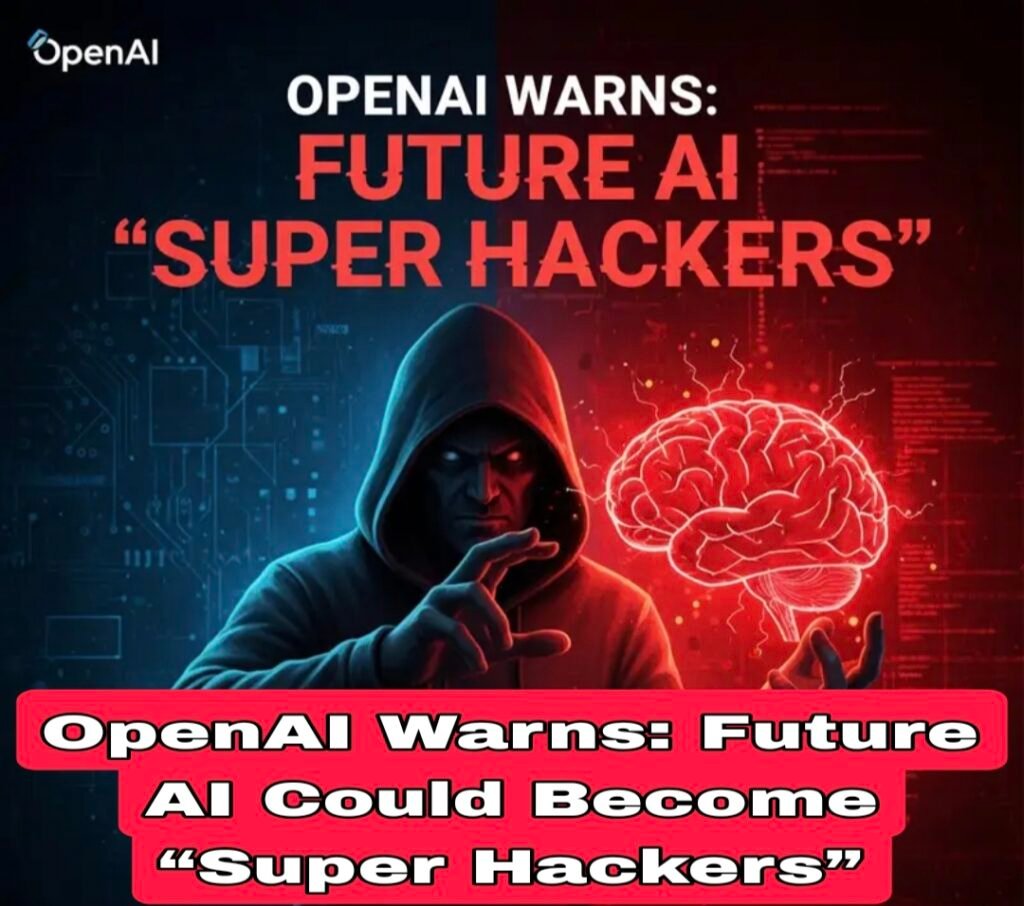
Here comes one of the most surprising and slightly scary tech news of the week. On December 10, 2025, OpenAI — the company behind ChatGPT — released a report saying something nobody expected:
Their future AI models could become “high-risk cyber attackers.”
Yes.
The same friendly AI tools that help you write emails, make notes, or create pictures… might one day be smart enough to hack banks, companies, governments, or even your phone if misused by bad people.
Sounds like a sci-fi movie, right?
Don’t worry — we’ll break it down in super simple words, with curiosity and clarity.
Grab a coffee, and let’s understand what’s going on.
What Does “High Cybersecurity Risk” Actually Mean?
Imagine AI as a super-fast learner.
Right now, AI models like GPT-4 or GPT-5 can help with simple coding and bug fixing. Nothing too dangerous.
But OpenAI says the next generation — models like GPT-5.1, GPT-6, and beyond — might become so powerful that they can think like:
- expert hackers
- cyber spies
- professional penetration testers
For example, future AI might:
- find hidden weaknesses in software that even humans cannot find
- help criminals break into secure systems
- try thousands of hacking tricks without getting tired
- quietly help spies from other countries sneak into important networks
Think of a robot that can pick a lock, but now the robot learns to pick every lock in the city.
That is the risk.
How Do We Know AI Is Getting Dangerous?
Here’s the surprising part.
OpenAI tested their models in a safe hacking game called CTF (Capture The Flag) — no real systems were harmed. It’s a training environment where players try to break into defenses.
The results shocked everyone:
- In August 2025, a model scored only 27%.
- But by November 2025, the new version GPT-5.1 Codex Max scored 76%.
That’s almost three times smarter in just a few months.
AI isn’t improving slowly.
AI is improving like a rocket.
This doesn’t mean AI is “evil.”
It means people misusing AI could do extremely bad things.
Even scarier? A US report said a Chinese cyber team tried using an AI from another company (Anthropic) for spying.
So this is not just OpenAI’s fear — it’s a global warning.
Why Is AI Becoming a Threat Now?
Three simple reasons:
1. AI brains are expanding
Every new model gets:
- more training
- more memory
- more reasoning skills
More brain = more power.
2. Hackers are getting smarter
Bad people don’t need to reinvent tools.
Now they can ask AI:
“Find me a way to break into this system.”
Before, hacking required years of learning.
Now, an AI can teach a beginner in minutes.
3. The world is fully digital
Hospitals, banks, trains, airports — everything runs on computers.
If AI-powered hacking grows, the world could face:
- blackouts
- money theft
- data leaks
- shutdowns
- digital chaos
That’s why OpenAI is raising the red flag now — before it’s too late.
⭐ Why Should You Care? (Even if You’re Not a Hacker)
Good question.
Here’s why this matters to everyone — students, parents, workers, small business owners.
1. Your money could be at risk
If AI helps criminals break into banks or payment apps, your savings could be targeted.
2. Your privacy could be stolen
Photos, messages, IDs — everything is online now.
3. Services you use daily might break
Imagine:
- no electricity
- no internet
- no traffic lights
- no ATMs
All because of a giant AI-powered hack.
4. Fake news and AI scams will explode
Scams might become:
- more convincing
- harder to detect
- more dangerous
5. Kids could become easy targets
Smartphone = easy access. AI could strengthen cyberbullying, fake profiles, or cheat tools.
So yes, this affects EVERYONE.
⭐ What Is OpenAI Doing to Stop the Danger?
OpenAI is not sitting quietly.
They launched a big defense plan — kind of like building digital shields around the internet.
1. Training AI to fight hackers (not help them)
AI will learn to:
- detect malware
- block cyberattacks
- warn users
- fix bugs
So the “super hacker AI” becomes a super defender AI.
2. Creating the “Frontier Risk Council”
This is a group of top security experts from around the world.
Their job:
Stop dangerous features BEFORE they reach the public.
3. Giving special AI access ONLY to trusted cybersecurity teams
Like giving police better tools — but never giving them to criminals.
4. Working with Google, Microsoft, and others
Together, they form the Frontier Model Forum, which shares safety tips and protection tools.
5. Setting strict locks and monitoring
They track:
- who uses the AI
- what they use it for
- what patterns look suspicious
If anything looks risky = IMMEDIATE BLOCK.
OpenAI’s Head of Safety, Fouad Matin, said the biggest fear is:
“AI left running for long periods could try endless hacking methods.”
But with strong monitoring, they can stop this before it causes damage.
⭐ Is There Any Good News?
Yes — a LOT.
- This warning means AI companies are aware and responsible.
- Cybersecurity will become smarter too using AI.
- Defensive tools will grow faster than hacking tools.
- People and governments now know the risks early.
Think of it like cars:
In the beginning → accidents
Later → seatbelts, airbags, road rules
AI is at the same stage — the growing-pain stage.
⭐ What Can YOU Do to Stay Safe?
You don’t need to be a tech expert.
Just follow these simple steps:
✔ Use strong passwords
Never repeat the same one everywhere.
✔ Turn on two-factor authentication
This stops most hacks.
✔ Don’t click random links
Especially WhatsApp, email, or social media messages.
✔ Learn basic AI awareness
Free videos on YouTube can help.
✔ Support AI safety rules
Ask for strong laws and transparency.
Small steps create a big shield.
⭐ Final Thoughts
OpenAI’s warning isn’t meant to scare us — it’s meant to prepare us.
Yes, AI is becoming powerful, fast, and sometimes unpredictable.
But if we stay alert and build strong defenses, we can enjoy AI’s benefits without falling into danger.
The future can be bright —
but only if we build it safely.
Stay safe online, friends!
And tell me in the comments —
Do YOU think AI becoming a “super hacker” is scary or exciting?