
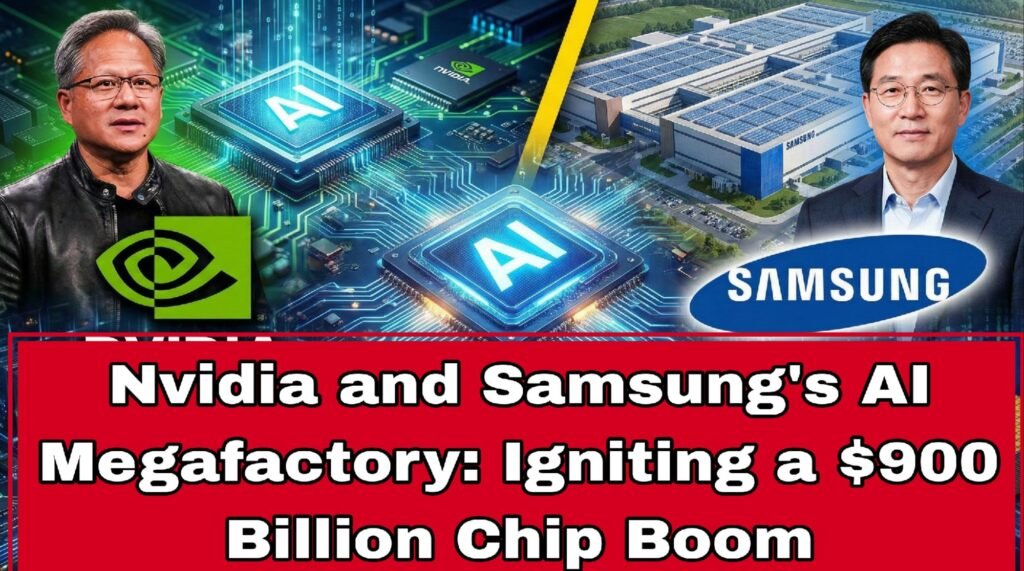
In the ever-accelerating world of artificial intelligence, partnerships between tech titans are not just collaborations—they’re seismic shifts that redefine industries. Enter the recent announcement from Nvidia and Samsung: the creation of an “AI Megafactory,” a sprawling facility powered by over 50,000 Nvidia GPUs. This isn’t just another factory; it’s a blueprint for the future of intelligent manufacturing, where AI doesn’t just assist but fundamentally transforms how semiconductors are designed, produced, and optimized. As we stand on the cusp of what could be a $900 billion AI chip market by 2030, this venture signals a boom that’s set to reshape global economies, tech innovation, and even everyday life.
The Genesis of a Powerhouse Partnership
Nvidia and Samsung’s alliance isn’t new—it’s a 25-year saga of mutual growth in semiconductors. Nvidia, the undisputed king of GPUs, has powered everything from gaming rigs to supercomputers, while Samsung dominates memory chips and foundry services. But this latest move takes their synergy to unprecedented heights. Announced in late October 2025, the AI Megafactory will integrate Nvidia’s cutting-edge platforms like Omniverse for digital twins and high-bandwidth memory (HBM) advancements from Samsung.
At its core, the megafactory is about embedding AI into every facet of Samsung’s global manufacturing network. Imagine 50,000 Nvidia GPUs humming in unison, analyzing real-time data from production lines to predict failures, optimize workflows, and even simulate entire factories in virtual environments. This isn’t sci-fi; it’s happening now. Nvidia’s Omniverse platform will create digital replicas of Samsung’s fabs, allowing engineers to test changes virtually before implementing them physically, slashing downtime and costs. The result? Faster production of next-gen chips, including HBM4 memory crucial for AI training models that demand massive computational power.
This partnership comes at a pivotal time. The AI boom, fueled by generative models like those from OpenAI and Google, has created insatiable demand for high-performance chips. Nvidia’s Blackwell and Rubin GPUs are already backlogged with $500 billion in orders through 2026, but supply chains have struggled to keep pace. Samsung’s role as a foundry giant positions it perfectly to scale production, while Nvidia provides the AI brains to make it smarter.
Transforming Manufacturing: From Assembly Lines to AI-Orchestrated Symphonies
Gone are the days of rigid, human-dependent factories. The AI Megafactory represents a paradigm shift toward “intelligent manufacturing.” Using Nvidia’s GPUs, Samsung will deploy AI for real-time analytics, predictive maintenance, and autonomous optimization. For instance, machine learning algorithms can detect microscopic defects in chips before they cascade into costly recalls, potentially boosting yield rates by double digits.
Digital twins—virtual models that mirror physical assets—are a game-changer here. Powered by Omniverse, these twins allow Samsung to simulate scenarios like supply chain disruptions or energy fluctuations, ensuring resilience in an era of geopolitical tensions and climate challenges. Nvidia engineers will even embed directly with Samsung teams to fine-tune GPU integration, ensuring seamless operation.
This isn’t limited to chips. The technology could ripple into other sectors: automotive assembly lines predicting part failures, pharmaceutical plants optimizing drug synthesis, or even consumer electronics like Samsung’s Galaxy devices getting AI-infused production boosts. As one industry insider noted on X, this could mark the “AI Industrial Revolution,” where factories evolve into self-improving ecosystems.
The $900 Billion Horizon: Market Implications and Growth Forecasts
The megafactory isn’t just about efficiency—it’s a catalyst for explosive market growth. Analysts project the AI chip market to surge from around $92 billion today to over $330 billion by 2030, with some forecasts pushing toward $900 billion when including broader AI infrastructure.Why such optimism? AI’s voracious appetite for compute power. Training models like GPT-4 requires trillions of parameters, and future multimodal AI (handling text, images, video) will demand even more.
Nvidia, already commanding a lion’s share, could see its dominance solidified. Its market cap has soared past $3 trillion, but with Samsung’s manufacturing muscle, production bottlenecks ease, unlocking new revenue streams. China leads in growth projections at 283%, but U.S.-led alliances like this one ensure Western tech stays ahead amid export restrictions.
Broader economic impacts are profound. Job creation in high-tech manufacturing could number in the tens of thousands, while AI-optimized supply chains reduce global waste. However, challenges loom: energy consumption from 50,000 GPUs is enormous, raising sustainability questions. Nvidia’s push for efficient architectures helps, but orbital data centers—hinted at in some reports—might be the next frontier.
Competitors aren’t idle. TSMC, Broadcom, and even Micron are ramping up HBM production, with Micron’s $9.6 billion Japan factory aiming to challenge Samsung.Yet, Nvidia-Samsung’s integrated approach—combining hardware, software, and fabs—gives them an edge in the “chip wars.”
Challenges and the Road Ahead
No revolution is without hurdles. Geopolitical risks, like U.S.-China tensions, could disrupt supply chains. Samsung’s memory shortages, exacerbated by AI demand, highlight bottlenecks in raw materials. Ethical concerns around AI in manufacturing—job displacement, data privacy—must be addressed.
Looking forward, this megafactory could spawn a network of AI-powered facilities worldwide. By 2030, we might see AI chips enabling everything from autonomous robots to personalized medicine. As Demis Hassabis of Google DeepMind predicts, multimodal convergence will blend text, images, and video, supercharged by these chips.
Conclusion: A New Era Dawns
Nvidia and Samsung’s AI Megafactory isn’t merely a factory—it’s a launchpad for the next technological epoch. By harnessing 50,000 GPUs to redefine manufacturing, they’re not just building chips; they’re building the future. With a projected $900 billion market on the horizon, this partnership underscores AI’s transformative power. As tech enthusiasts on platforms like X buzz about its implications, one thing is clear: the chip boom is here, and it’s bigger than ever.