
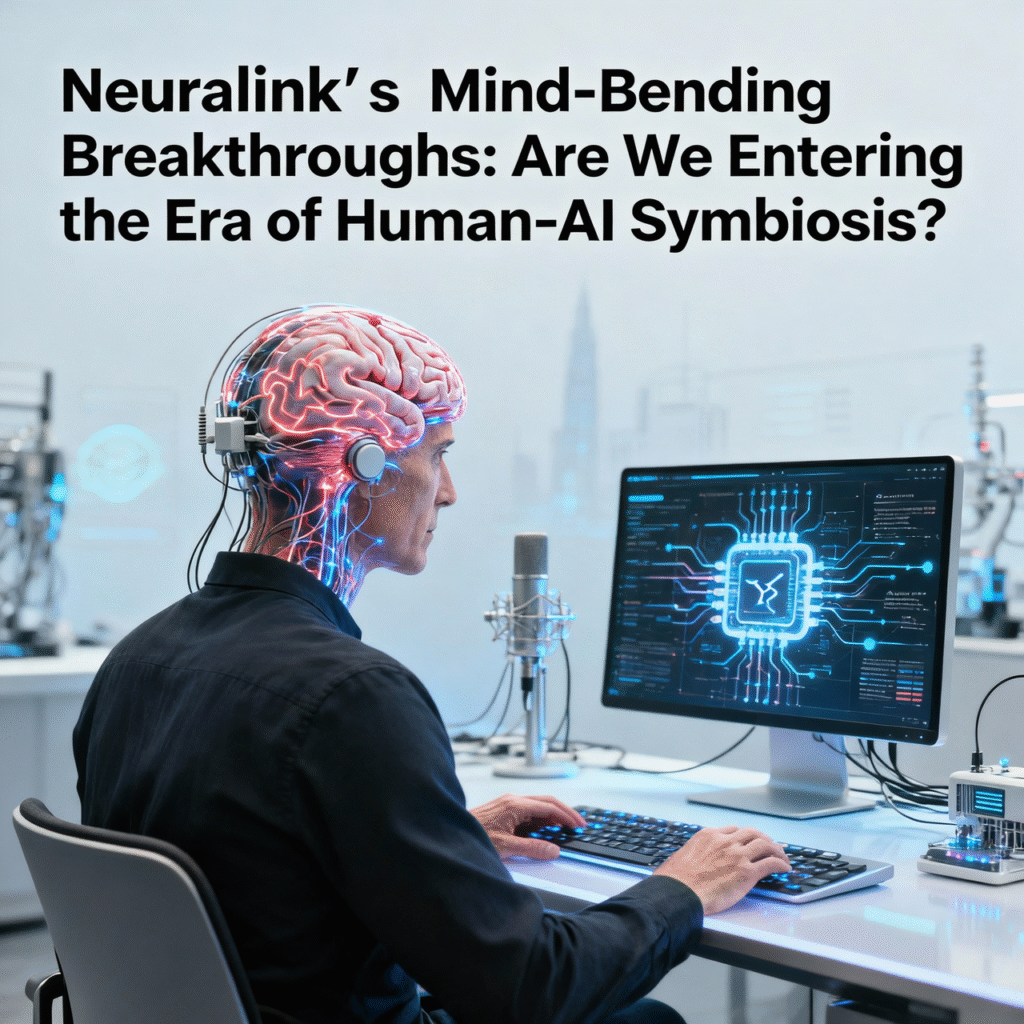
What if blindness, paralysis, or deafness were no longer permanent?
What if we could control phones, computers, or prosthetics using only our thoughts?
Just a few years ago, these ideas belonged in sci-fi movies.
Today, they’re showing signs of becoming real — and the world is paying attention.
🧠 Neuralink’s Latest Leap: Restoring Human Ability
Elon Musk’s brain-computer interface company, Neuralink, is trending everywhere again after sharing new progress on its implants — and the updates are astonishing.
Based on current testing and development, Neuralink aims to help people:
- See without working eyes
- Hear without functioning ears
- Move without physical muscle control
- Control devices — not with hands — but with thoughts
A viral surgical demonstration video circulating on X already has over 187,000 views and 2,300+ likes, sparking a global conversation:
Is the boundary between biology and technology dissolving?
👁️ From Darkness to Vision: Rebuilding Sight Through Signals
One of the most groundbreaking goals is enabling completely blind individuals to see artificially generated imagery through neural stimulation.
Imagine experiencing vision not through eyes —
but through a digital system translating electrical impulses directly to the brain.
We’re talking about the early stages of synthetic vision.
Not just restoring — but reimagining human perception.
🎧 Hearing Through the Brain — No Ears Needed
Similar to sight restoration, Neutralino aims to bypass damaged auditory systems and communicate sound signals directly into the brain.
This could mean:
- People born deaf may hear for the first time
- Those who lost hearing could regain it
- Sound could be personalized — volume, frequency, clarity — using AI
It’s not just medicine.
It’s neural rewriting.
♿ Thought-Powered Mobility: A Lifeline for Paralysis Patients
Perhaps the most immediate and life-changing application is mobility restoration.
Neutralino tests have already shown people able to:
- Move cursors with their mind
- Interact with digital interfaces
- Control robotic devices
The long-term vision?
🦾 Walking again — even after spinal injury — through neural rerouting.
This blends biology, robotics, and machine learning into a single framework:
thought-driven movement.
🧬 The Bigger Trend: Humans and AI Merging
Neuralink isn’t happening in isolation.
Forbes data on 2025 emerging technology trends points to one clear direction:
Human and machine intelligence are no longer separate — they’re beginning to integrate.
McKinsey predicts that AI in healthcare alone could generate trillions in value by 2040, especially as neural data, predictive AI, and personalized medicine converge.
We’re moving from healthcare that treats symptoms…
to systems that restore — and even enhance — human potential.
⚖️ The Ethical Crossroads
As excitement spreads, so do debates.
On X and across tech forums, people are raising critical questions:
- Who controls implanted intelligence?
- Could thoughts be monitored or hacked?
- Will enhanced humans create new inequality?
- Where does humanity end — and technology begin?
The conversation is no longer if —
but how far should we go?
🧠🖥️ A Future of Thought-Controlled Everything?
Right now, Neuralink is building for medical restoration.
But many believe this is only step one.
Tomorrow’s possibilities could include:
- Typing with your mind
- Communicating telepathically through digital channels
- Expanding memory with external storage
- Personalized AI assistants integrated into thought
We may be witnessing the early foundation of a hybrid species — Homo Technological.
🔮 Final Thought
Neuralink’s breakthroughs are more than medical advancements —
they’re opening a doorway humanity has never walked through.
A doorway where:
- Disability becomes optional
- The mind becomes an interface
- Technology becomes a natural extension of the human body
Whether thrilling or terrifying, one truth is undeniable:
We’re closer than ever to a future where thinking is doing — and human limits become negotiable.