


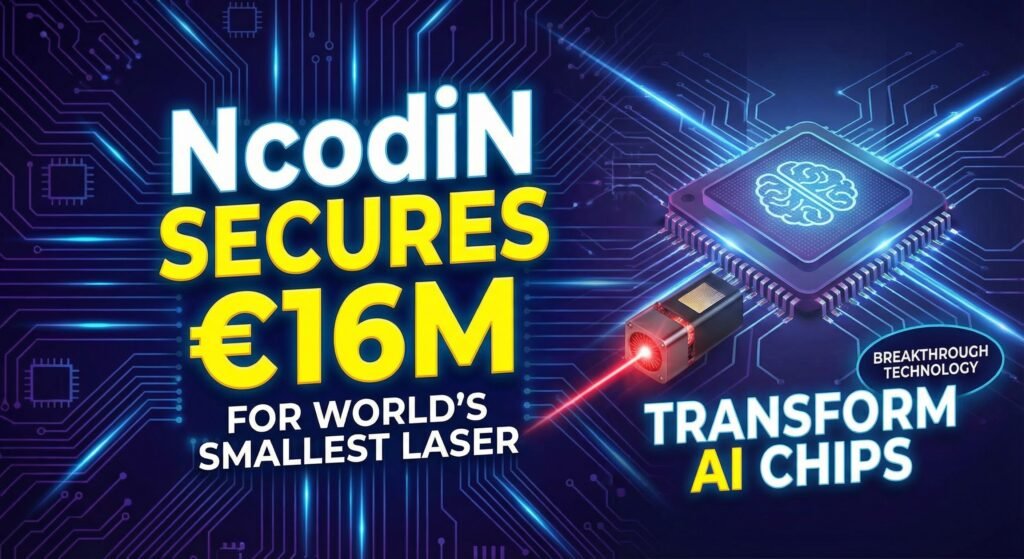
The race to build faster, greener, and more powerful AI chips just took a major leap forward.
French photonics startup NcodiN has raised €16 million to develop what may become the world’s smallest laser, designed specifically for next-generation AI hardware.
This tiny innovation could have massive impact:
from energy-hungry data centers to multi-billion-parameter AI models, everything could soon run faster and far more efficiently.
Let’s explore why the tech world is buzzing.
What Makes NcodiN’s Laser Revolutionary?
NcodiN is developing nanoscale lasers for optical interconnects — the ultra-fast communication channels inside AI accelerators and chips.
Why this matters
Traditional electrical connections create heat
AI chips require massive bandwidth
Data center energy consumption keeps rising
NcodiN’s laser solves all three challenges.
🔥 Key Advantages
Shrinks lasers dramatically — more lasers fit into a chip
Boosts communication speed between AI components
Cuts heat production and energy loss
Enables denser, more compact AI hardware
This could drastically reshape how AI supercomputers are built.
Up to 50% Lower Power Consumption — A Game Changer
Data centers powering AI models burn huge amounts of electricity.
NcodiN’s optical solution may reduce energy usage in large-scale computing by up to 50%.
Benefits
- AI becomes more sustainable
- Cheaper to run LLMs
- Lower operational costs for cloud giants
- Reduced environmental footprint
- As AI demand skyrockets, this efficiency boost is more important than ever.
Why Investors Are Excited
The €16M funding round reflects growing confidence in photonic AI hardware — a booming sector as traditional chip limits become clear.
Investors see NcodiN as part of the next wave of:
AI accelerators
Optical computing
Ultra-efficient chip designs
These innovations are essential as GPUs struggle with heat, size, and power constraints.
🔮 What’s Next?
NcodiN plans to use the funding to:
Finalize nanoscale laser prototypes
Partner with AI chipmakers
Integrate optical interconnects into commercial hardware
If successful, this could set a new global standard for sustainable AI computing.
The future of AI might be not just digital — but photonic.
NcodiN’s €16M funding isn’t just another startup headline.
It signals a massive shift toward energy-efficient, laser-powered AI hardware.
With the world racing to build faster AI models, nanoscale photonics could become the foundation for the next decade of innovation.
And the smallest laser in the world may soon power the biggest breakthroughs in AI.