
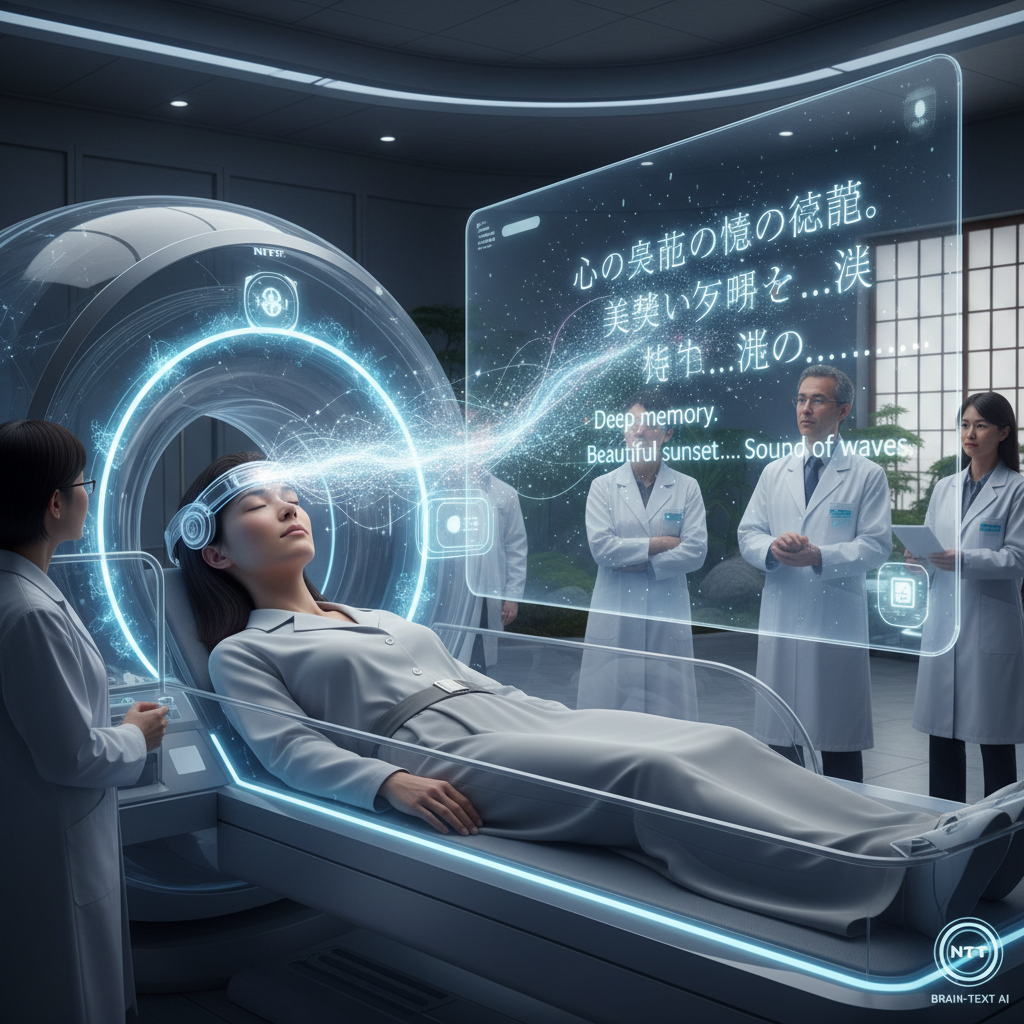
Imagine a world where your thoughts aren’t just private echoes in your skull, but a tangible stream of words, ready to be read, shared, or even documented. It sounds like something ripped straight from a science fiction novel, right? Well, buckle up, because Japan’s telecommunications giant, NTT, just unveiled a technology that’s blurring the lines between fiction and a very near future.
The buzz across Japanese media, echoing with an emphatic “Sugoi!” (amazing!), is all about NTT’s groundbreaking Brain-Computer Interface (BCI). This isn’t just another incremental tech update; it’s a profound leap forward that could redefine how we interact with technology, communicate, and even understand ourselves.
So, What Exactly Did NTT Do?
Here’s the mind-boggling part: NTT’s new system uses advanced fMRI (functional Magnetic Resonance Imaging) to scan brain activity. But not just any activity – specifically, the neural patterns generated while someone is either watching a video or, even more remarkably, recalling a video they’ve previously seen.
Once this brain data is captured, a sophisticated AI goes to work, analyzing the intricate electrical signals and converting them into… wait for it… text descriptions.
Think about that for a second. Your brain generates a thought, a memory, a visual experience, and this AI can translate it into words.
Beyond the “Wow”: A Game-Changer on Multiple Fronts
The implications are absolutely staggering, and frankly, a little overwhelming to fully grasp. The immediate, positive impacts are crystal clear:
- Unprecedented Accessibility: For individuals with severe communication disabilities, this could be a revolutionary lifeline. Imagine someone unable to speak or type, now able to articulate complex thoughts, feelings, and needs simply by thinking them. This isn’t just assistive technology; it’s empowering liberation.
- Memory Augmentation & Recall: Ever wish you could perfectly recall every detail of an important meeting, a loved one’s face, or a beautiful sunset? This tech could act as a sophisticated “thought recorder,” allowing you to literally access and transcribe your mental archives. Forget forgetting!
- Creative Unleashing: What if authors could dictate their novels purely by thought? Or artists could describe their mental imagery directly to a generative AI? The barriers between imagination and execution could simply dissolve.
- The “Mind-Reading” Interface: While NTT highlights accessibility and memory, the underlying capability is undeniably a form of “mind-reading.” This is where the hype intersects with profound ethical questions.
The Global BCI Race: NTT, Neuralink, and the WEF
This announcement isn’t happening in a vacuum. It slots perfectly into the burgeoning global BCI landscape, often drawing comparisons to Elon Musk’s Neuralink. While Neuralink focuses on invasive implants for direct brain-computer interaction, NTT’s non-invasive fMRI approach offers a potentially more accessible (and less intimidating) pathway to thought-to-text communication.
It also aligns perfectly with trends identified by the World Economic Forum, particularly “human-machine synergy” – the idea of blurring the lines between human cognition and technological capabilities. This isn’t just about controlling machines with our minds; it’s about machines understanding our minds.
Revolutionary or Dystopian? X Users Are Divided.
As expected, the internet is buzzing. X (formerly Twitter) users are in a fierce debate:
- The Enthusiasts: Hailing it as a pinnacle of human ingenuity, dreaming of a future free from communication barriers, enhanced intelligence, and seamless interaction with the digital world.
- The Skeptics & Ethicists: Raising alarm bells about privacy, surveillance, and the fundamental right to mental solitude. If thoughts can be read, even with consent, what’s next? Who owns your thoughts? Could companies or governments access our inner monologues? The “black mirror” scenarios are easy to conjure.
Neuroscience: The Sleeper Hit of 2025
And this isn’t the only frontier neuroscience is conquering. With advancements in areas like quantum clocks refining brain imaging, and even efforts to create digital simulations of entire mouse brains, it’s clear that our understanding and manipulation of the brain are accelerating at an unprecedented pace. The original article hints that “neuroscience is the sleeper hit of 2025,” and honestly, it feels like it’s already waking up with a bang.
Where Do We Go From Here?
NTT’s thought-to-text AI is more than just a technological marvel; it’s a philosophical challenge. It forces us to confront fundamental questions about consciousness, identity, and the very nature of human interaction.
While the “sugoi!” factor is undeniable, we, as a society, need to engage in urgent, thoughtful discussions about the ethical guardrails, regulatory frameworks, and societal norms that must accompany such powerful technology.
This isn’t just about reading thoughts; it’s about understanding and shaping our future. What do you think? Is this the dawn of a new era of human potential, or a terrifying step towards an Orwellian nightmare? Let me know in the comments below!