


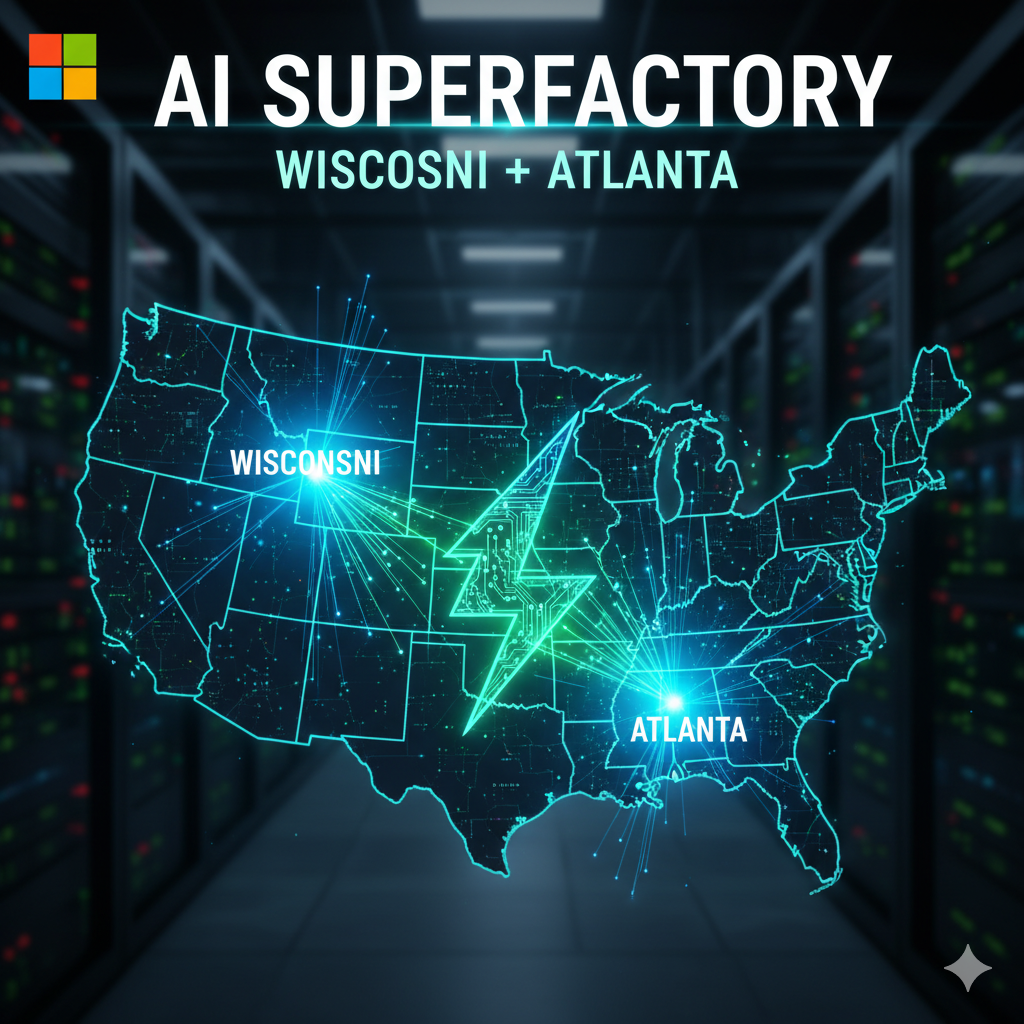
Imagine a factory — not for cars, not for phones, but for artificial intelligence. A super-site built to train vast AI systems, crunching huge data, at unprecedented scale. That’s exactly what Microsoft has revealed. Its new network of hyperscale data centers — forms a “superfactory” for AI. What’s going on, why now, and what it may mean for the future? Let’s dive in.
What’s the Big News?
Earlier this month, Microsoft announced the activation of its first AI “superfactory” by linking two of its highest-capacity data centres: one in Wisconsin and one in Atlanta.
Key points:
- The Wisconsin site is part of its Fairwater data-centre family.
- The Atlanta Fairwater site went live in October and forms the second connected node.
- These aren’t independent data centres; they are connected via a high-speed dedicated network (an AI WAN) so they operate together as one massive computing system.
- The architecture is designed specifically for training large AI models and Copilot-type workloads at scale.
What Makes It Different From “Old” Data Centres?
Traditional cloud data centres typically run many separate applications for many customers. But Microsoft describes these new sites as a different beast:
“It’s running one complex job across millions of pieces of hardware — and it’s not just a single site, it’s multiple sites supporting that one job.”
Some of the standout technical features:
- Rack-scale systems with highly advanced GPUs (NVIDIA Blackwell etc.) and liquid cooling to maximise density.
- A dedicated fibre-optic backbone linking sites across states, so data and compute can flow with minimal latency.
- Two-storey building designs (in the Atlanta site) allowing more racks and higher power density.
In short: this isn’t “just another data centre” — it’s a compute factory built for the largest scale of AI tasks.
Why Now? What’s Driving This Rush?
There are several forces pushing Microsoft and others into this kind of infrastructure build-out:
- Skyrocketing AI compute demand: As more powerful AI models get trained (and retrained), the amount of hardware, storage and energy needed is growing rapidly.
- Efficiency and scale matter: By distributing the workload across multiple sites working as one, you can reduce bottlenecks, increase speed, and lower cost per unit of compute.
- Competitive edge: In the race for AI capabilities (models, chips, data, applications), having world-class infrastructure gives a major advantage.
- Energy & sustainability constraints: These new centres are also designed to reduce water usage, improve cooling efficiency, and manage power in smarter ways — because AI compute eats resources fast. Source
The timing aligns with other major shifts in tech: governments moving to regulate AI (e.g., the EU AI Act) and new global players (like China) gaining traction in AI model-building. That global pressure makes infrastructure not just a cost but a strategic asset.
4. What’s the Bigger Implication? “Superfactory” & Beyond
Calling it a superfactory signals a vision that goes beyond individual data centres. It implies:
- A network of sites all working together as a unified compute machine.
- The possibility of space-based data centres, or other unconventional locations, as energy & cooling constraints push innovation forward. Microsoft hints at future ideas beyond “landlocked” centres. Source
- New forms of AI deployment: bigger models, real-time data flows, global reach.
Essentially, this may mark a paradigm shift: from “cloud services run everywhere” to “dedicated AI compute factories” built for one purpose. And if Microsoft is doing it now, many others will follow.
5. Why It Matters to You (and the World)
- For businesses and developers: more and more compute power means new opportunities — but also higher stakes and costs.
- For society: the race for AI infrastructure raises questions of energy consumption, resource use, environmental impact, and even geopolitics (which region hosts the next superfactory?).
- For you as a reader: even though you’re not building data centres, this trend affects everything from the tools you use (AI in your phone, your work) to the global tech direction.
Final Thoughts
Microsoft’s “AI Superfactory” isn’t just a flashy headline — it’s a window into the future of AI computing. Two mighty data centres, thousands of GPUs, ultra-fast networks — all built to train the next generation of AI models in weeks instead of months.
The question now isn’t “can we build this infrastructure?” but “who will build it fastest, most sustainably, and make the most of it?”
And in that race, the stakes are huge — for companies, countries, and all of us who’ll live in a world shaped by the intelligence those machines create.
Stay curious. Because the machines are waking up — and so are the factories behind them.