


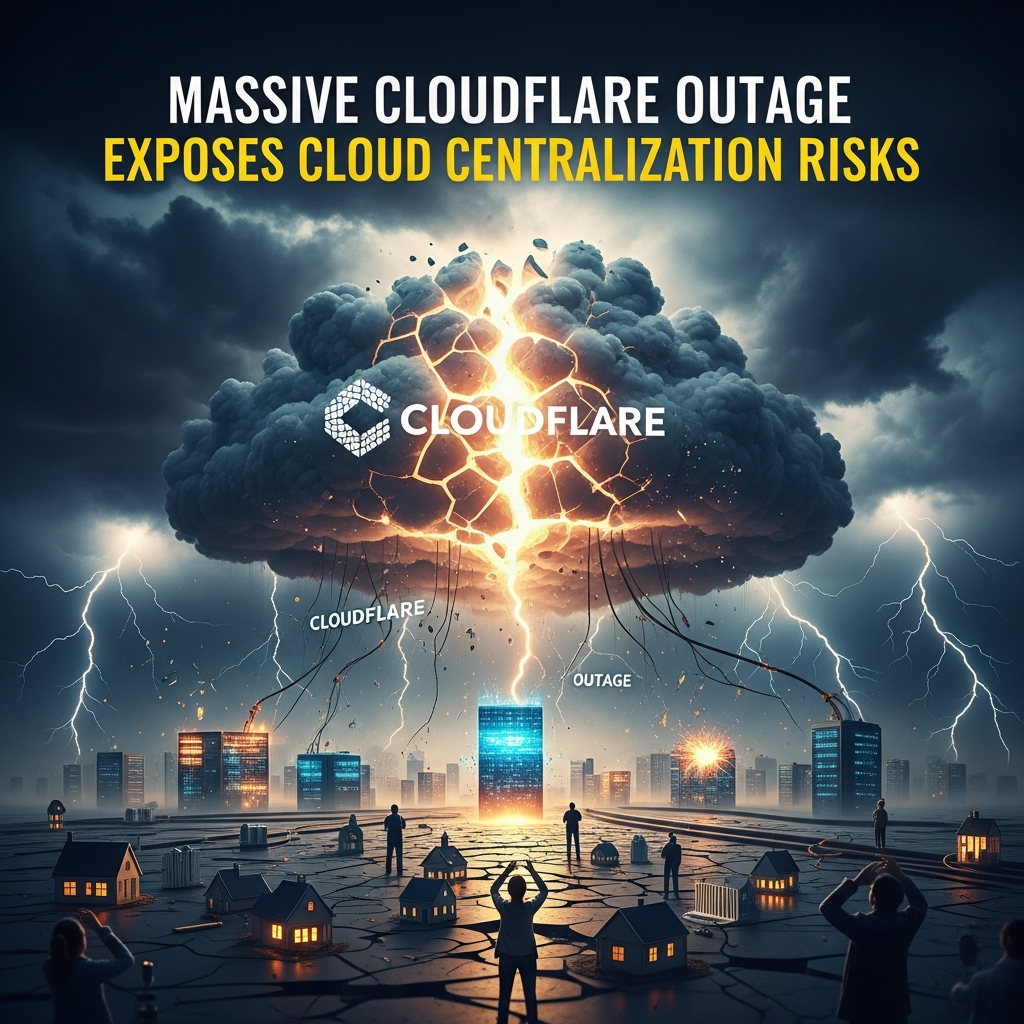
For a few tense hours, the internet felt… fragile.
Websites wouldn’t load. Payment gateways stalled. Some emergency and public services struggled to stay online. And the cause wasn’t a global cyberattack or a catastrophic hardware failure—it was a bug at one company: Cloudflare.
If you’ve ever wondered how much of the modern web quietly runs through a handful of infrastructure providers, this outage was your answer.
What looked like “the internet is down” in many places was, in reality, something more specific—and more unsettling:
A single provider had become a single point of failure for a staggering slice of global digital infrastructure.
Let’s unpack what this moment really means.
When One Bug Ripples Across the World
Cloudflare sits behind a huge portion of the internet:
- Websites use it for CDN (content delivery),
- APIs and apps trust it for security and performance,
- Payment gateways and SaaS tools rely on its edge network,
- Even critical services depend on its routing and protection.
So when a widespread bug hit Cloudflare, the impact wasn’t localized or contained. It was systemic.
The symptoms were familiar:
- Websites appearing offline, even though their origin servers were up
- Apps “breaking” at the edge
- Requests timing out or being blocked
- Users (and businesses) suddenly realizing how much they relied on an invisible middleman
The outage didn’t just disrupt services; it revealed something deeper about how we’ve been building the cloud.
The Pattern We Don’t Want to See (But Need To)
This wasn’t the first big outage from a major provider—and it won’t be the last.
Over the past few years, we’ve seen similar disruption from:
- Hyperscalers (AWS, Azure, Google Cloud)
- DNS providers
- Large SaaS platforms
- Payment processors and authentication services
Each time, the narrative is the same:
“We didn’t realize how many things depended on this one system.”
Yet we keep optimizing for convenience, speed, and consolidation—and quietly increasing our exposure to massive, correlated failures.
Cloud Centralization: Convenient… Until It’s Not
Why does this keep happening?
Because centralization is extremely attractive—until it isn’t.
We consolidate around a few big providers because:
- It’s cheap (economies of scale)
- It’s fast to build on (great tooling and ecosystems)
- It’s easy to manage (one bill, one vendor, one integration)
But the tradeoff is structural:
- One provider outage → global impact
- One DNS or routing issue → entire services vanish
- One misconfig or bug → millions of users affected
In other words, we’re building mission‑critical systems on top of what can quickly become monocultures.
And monocultures are fragile.
X Erupts: “Single Point of Failure” in the Spotlight
When the Cloudflare outage hit, X (Twitter) lit up with a recurring theme:
“We’re discovering in real time what happens when the internet is effectively centralized behind a few companies.”
Engineers, founders, and observers pointed out:
- How many major platforms simultaneously failed
- How thin the line is between “high availability” and “centralized dependency”
- How often architectural diagrams assume Cloudflare (or another big provider) is simply “always up”
In a world where AI workloads are piling additional demand on shared cloud infrastructure, this conversation becomes even more urgent:
- More inference and training at the edge
- More latency-sensitive apps
- More global traffic funneled through the same networks and providers
We’re scaling complexity on top of a foundation that can still be knocked over by a single bug.
The Rising Case for Decentralization & Resilience
So what’s the alternative? Not abandoning the cloud—but rethinking how we use it.
The Cloudflare outage is part of a wider macro trend in 2024 and beyond:
- Optimizing hardware and infrastructure for efficiency
- Spotting antipatterns in scaling—choices that work at small scale but break at large scale
- Rethinking architecture around resilience, not just performance
Key ideas that are regaining attention:
1. Multi-Provider Architectures
Instead of betting everything on one edge or cloud provider:
- Use multi‑CDN strategies
- Support failover across regions and vendors
- Build abstractions so your app isn’t tightly coupled to one vendor’s ecosystem
Yes, it’s more work. But so is explaining to your customers why “the internet being down” really meant “our provider had an issue.”
2. Redundant Paths for Critical Services
For payment, authentication, or critical public services:
- Have at least one backup path independent of your main provider
- Design systems that degrade gracefully, rather than failing completely
- Avoid putting all DNS, routing, and edge logic in a single external basket
3. Embracing More Distributed Models
Decentralized and distributed approaches—from peer‑to‑peer systems to more federated architectures—may not replace traditional cloud in the short term, but they can:
- Reduce single points of failure
- Improve resilience under partial outages
- Challenge the “everything behind one gatekeeper” model
The AI Angle: More Load, Same Fragility
Overlay AI on top of all of this, and the stakes climb further.
As AI becomes:
- Integrated into search, productivity tools, and customer support
- Deployed at the edge for real-time inference
- Dependent on high-throughput, low-latency networks
We’re concentrating even more value and functionality onto the same underlying infrastructure that just proved how brittle it can be.
Outages stop being “annoying” and start becoming systemic shocks:
- AI assistants that power workflows go dark
- Automated decision systems fail or stall
- Real-time analytics and operations dashboards vanish
When AI is the “brain” of your system, an outage hits more like a blackout than a small glitch.
A Wake-Up Call, Not Just a Blip
It’s easy to treat the Cloudflare incident as “one bad day” for one company. But it’s more than that.
It’s a living diagram of:
- How interdependent our online systems have become
- How much invisible trust we place in a few infrastructure providers
- How little architectural redundancy many organizations really have
In a year defined by:
- Macro trends in optimized hardware
- Growing concern around scaling antipatterns
- Intensifying AI infrastructure demands
This outage lands as a clear message:
Convenience has quietly outrun resilience. It’s time to rebalance.
A Question to Leave You With
If one provider glitch can make the modern web feel like it’s breaking—
What does a truly resilient internet look like, and who is willing to pay the upfront cost to build it?
Because as AI, cloud, and edge computing continue to fuse into our daily lives, the real differentiator may not be who can scale the fastest…
…but who can stay online when everyone else goes dark.