
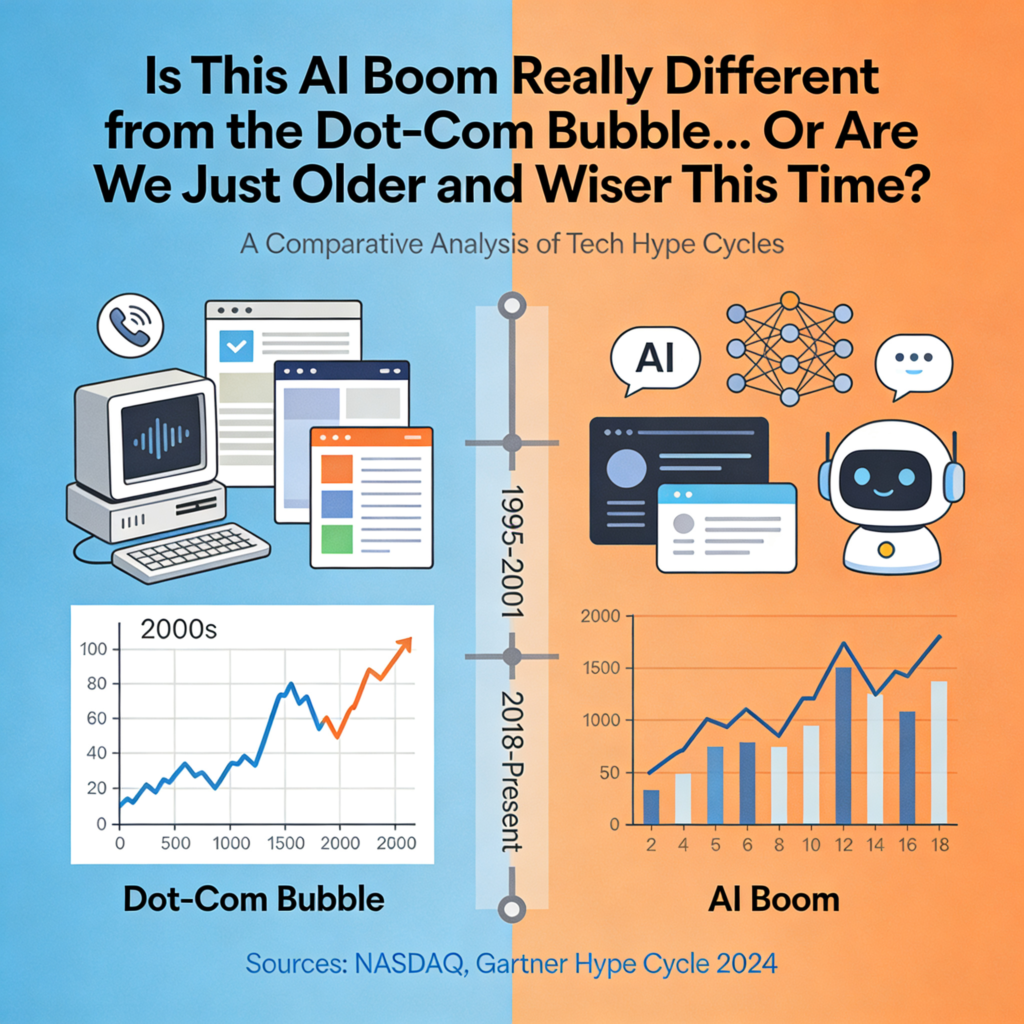
I keep hearing the same sentence in every VC café in San Francisco:
“This time is different.”
They said it in 1999 too.
Yet something actually feels different in 2025, and I can’t decide if it’s maturity… or just better marketing. So let’s poke at it together with genuine curiosity instead of the usual tribal shouting.
1999 vs. 2025: Spot the Difference
In 1999, the killer app was putting “.com” at the end of your company name.
Pets.com raised $82 million to sell dog food over a 56k modem.
The infrastructure barely existed. Most Americans still had dial-up. The cultural shift hadn’t happened. We were betting on a future that required millions of people to change their behavior before breakfast.
In 2025, I can open Midjourney and type “cyberpunk clinic, Tokyo 2085, neon and empathy” and get a usable medical UI mockup in 11 seconds.
I can drop Gemini 3.0 Flash into a Google Sheet and have it write perfect Spanish, Arabic, and Hindi outreach emails for a rural health NGO before my coffee gets cold.
My friend’s dermatology practice in Lisbon is already using a $29/month AI to triage skin-cancer photos with higher accuracy than the average general practitioner.
The infrastructure is here.
The cultural shift already happened during COVID — we all learned to trust algorithms with our health, our kids’ homework, and our grandparents’ grocery orders.
The value is being captured today, not in 5–10 years.
That’s the bullish argument, anyway.
But the Numbers Still Look Insane
Anthropic is valued at $40 billion after burning $8 billion in 18 months.
OpenAI is supposedly raising at $150 billion while still being months away from consistent profitability.
CoreWeave (a GPU cloud company you’d never heard of two years ago) just hit a $23 billion valuation.
These are dot-com-level multiples.
So which is it?
Are we in a “more mature mania” because the tech actually works…
or are we just running the same play but with better PowerPoint decks and Jensen Huang’s leather jacket?
The Maturity Hypothesis
Here’s what keeps nagging at me in a hopeful way:
- Revenue is showing up faster than anyone admits publicly
- Microsoft’s AI-assisted cloud growth is already in the tens of billions annualized.
- GitHub Copilot went from zero to $1 billion ARR in under two years — something that took Salesforce seven years.
- Even tiny startups like Perplexity and Cursor are hitting eight-figure ARR within months.
- The applications are embarrassingly practical
I’m not talking about “AI girlfriend” apps (though those exist).
I’m talking about:- AI that caught my friend’s rare heart condition from an Apple Watch ECG when three cardiologists missed it.
- AI agents that negotiate cloud bills and save companies 30% with zero human oversight.
- Multimodal models that let Paraguayan farmers describe crop diseases in Guaraní and get instant treatment advice.
- The talent concentration is historically insane
In 1999, the smartest engineers I knew were building flash intros.
In 2025, the best minds from physics, neuroscience, and mathematics are all competing to make language models one token cheaper and one point smarter.
The Skeptic’s Rebuttal (My Own Voice in My Head)
Every single one of those “practical” wins is still a narrow use case.
We’re seeing the Bear Stearns moment of AI — two funds just blew up, but everyone insists the system is fine.
The energy requirements are becoming politically impossible.
And we still don’t have a single AI company (outside Microsoft’s coattails) that is undeniably profitable at scale.
Plus, we’re doing the exact same cultural rituals:
- Founding teams wearing Patagonia vests instead of mock turtlenecks
- “Blitzscaling” rebranded as “default alive or die”
- The same investors who were “too early” on crypto now telling you they’re “too early” on AGI
So… Which Is It?
Honestly? I think we’re in a hybrid state no one wants to name.
It’s a bubble, but a bubble wrapped around a genuine technological inflection point.
Like the internet in 1999, the eventual winners will be worth trillions — but 95% of today’s market cap will evaporate. The difference is the inflection point is happening now, not in 2005–2015.
The companies that survive will be the ones already shipping boring, revenue-generating, defensible products today — not the ones with the best storytelling.
Final Curious Question
If I showed you the cap table of Amazon, Google, and Pets.com in March 2000, could you have picked the winners?
I couldn’t have.
But I’m starting to think the odds are better this time — not because humans got smarter, but because the technology finally showed up to the party on time.
What do you think?
Are we older and wiser… or just older?
Drop your hottest take below. I’m genuinely curious where this lands for you.