
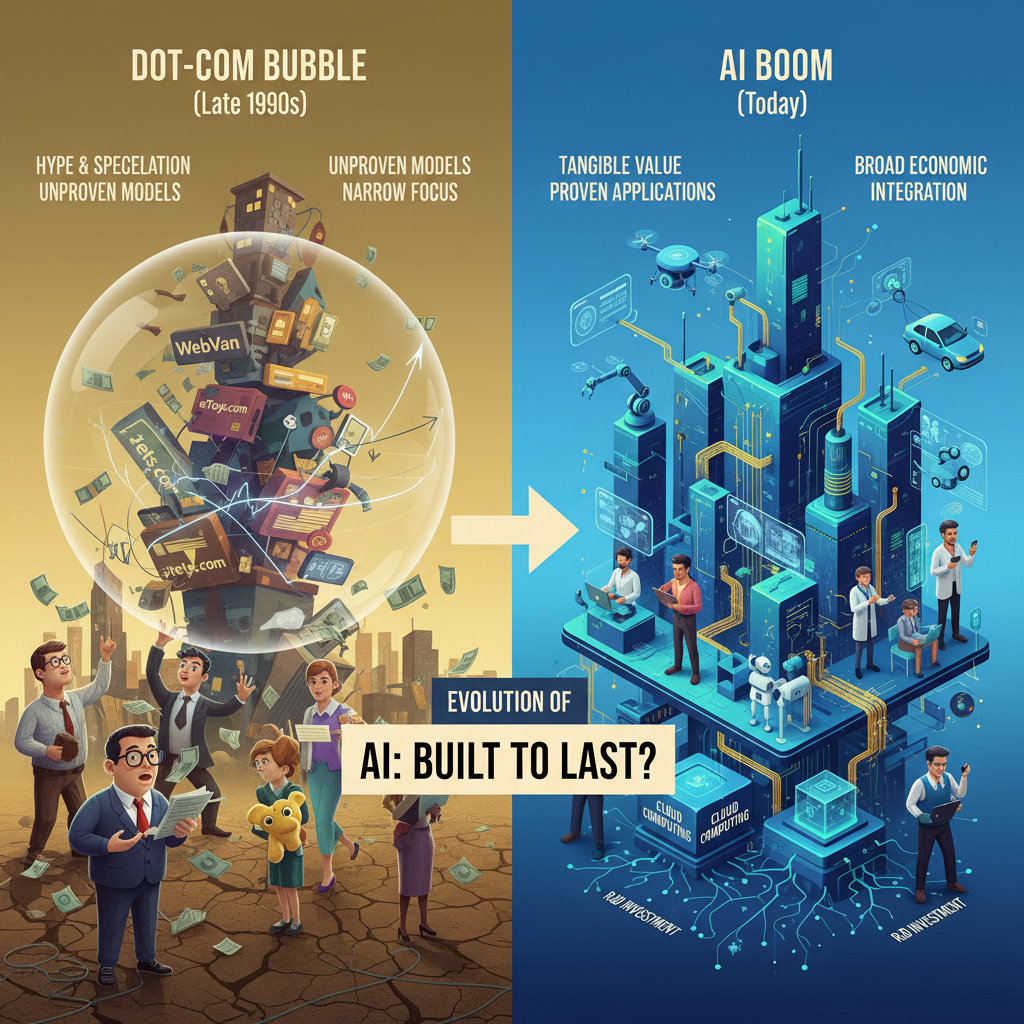
If you’ve been anywhere near tech news lately, you’ve probably felt the same mix of excitement and déjà vu I have. Everywhere you look, people are comparing today’s AI frenzy to the dot-com bubble of the late 1990s. Headlines scream “AI bubble” or “the next dot-com crash.” On one hand, the parallels are uncanny: sky-high valuations, massive hype, and a flood of startups promising to change everything. On the other hand… something feels different this time. And I can’t stop wondering: is the AI boom really another bubble waiting to burst, or are we witnessing the early days of a transformation that’s actually sustainable?
Let’s dig in with fresh eyes and see what’s really going on.
1. Speed of Adoption: The Internet Took Years—AI Is Moving at Warp Speed
Back in the late 90s, the internet was revolutionary, but it was also slow to reach the mainstream. Most companies were still figuring out how to build a website, and consumers were dialing up on 56k modems. It took nearly a decade for the internet to become indispensable.
AI, by contrast, is spreading like wildfire. ChatGPT alone now has over 800 million weekly active users. That’s not just consumer curiosity—that’s businesses racing to integrate AI into their workflows. From customer support to code generation to drug discovery, enterprises are moving faster than anyone expected. McKinsey, Gartner, and Deloitte all point to the same thing: AI adoption is happening at a pace the internet never did.
Question: If companies are already seeing real ROI, does that make this boom more grounded than the dot-com era?
2. The Power of Real Revenue (and Real Problems Being Solved)
During the dot-com bubble, many companies had no revenue, no clear path to profit, and were valued purely on “eyeballs” and “mindshare.” Pets.com anyone?
Today’s top AI companies—OpenAI, Anthropic, xAI, Cohere, and even the big cloud players—are generating serious revenue. OpenAI reportedly hit $3.4 billion in annualized revenue in 2024, and that number is climbing fast. More importantly, the use cases are concrete: reducing customer-service costs by 30–50%, accelerating software development by 20–40%, discovering new materials in weeks instead of years.
That doesn’t mean there aren’t overvalued startups or hype-driven rounds. There absolutely are. But the underlying demand feels different—businesses are paying for AI because it solves real, expensive problems, not because they’re afraid of missing out.
3. The Infrastructure Race: Nvidia vs. Google vs. Everyone Else
One of the most fascinating subplots right now is the battle for AI compute dominance.
Nvidia has been the undisputed king of GPUs, and their stock has soared on the back of AI training demand. But cracks are showing. Google’s TPUs are now training some of the largest models (including Gemini) more efficiently than Nvidia GPUs in certain workloads. Meta, Amazon, Microsoft, and even startups like Groq and Cerebras are building custom silicon. On X, people are already asking: “Is Nvidia’s moat starting to crack?”
The bigger picture: we’re seeing a shift toward “AI-native” platforms and supercomputing clusters that could make today’s GPU-centric world look like the mainframe era. Gartner predicts that by 2026, most enterprises will be running AI workloads on specialized hardware and multi-modal platforms rather than generic cloud instances.
So the question becomes: will the infrastructure winners of 2026 look a lot like today’s leaders, or are we on the cusp of another seismic shift?
4. The Hype Cycle Is Real—But So Is the Long Tail
Yes, there’s overhype. Some AI startups are raising hundreds of millions on nothing more than a demo and a promise. Valuations are eye-watering. And yes, some of those companies will disappear when the funding dries up.
But the internet bubble didn’t kill the internet—it just weeded out the weak players. Amazon, Google, eBay, and others survived and thrived. The same thing is likely to happen here. The companies that build defensible moats—whether through proprietary data, superior models, or vertical integration—will come out stronger.
Deloitte’s 2026 forecast is especially interesting: they predict the rise of “AI-native” platforms that are built from the ground up for intelligence, not retrofitted. Think of it as the difference between a horse-drawn carriage with a motor bolted on versus a Tesla.
So… Bubble or Transformation?
Here’s where I land after thinking about all this:
- The AI boom is moving faster and solving more immediate problems than the internet did in its early days.
- There’s real revenue, real enterprise adoption, and massive competitive pressure driving innovation.
- The infrastructure layer is evolving rapidly, which could create new winners and losers.
That doesn’t mean there won’t be pain. Corrections happen. Valuations will reset. Some high-flying startups will crash and burn.
But unlike the dot-com era, the underlying technology already has traction, customers, and measurable impact. The internet took years to prove itself; AI is proving itself right now.
So I’m left with a mix of caution and genuine curiosity: What if this time really is different? What if we’re not just in another bubble, but at the beginning of something that will reshape every industry the way the internet did—only faster?
I don’t have the final answer (nobody does yet). But I’m definitely keeping my eyes open—and I’d love to hear what you think. Are you betting on the AI boom, hedging your bets, or calling it the next dot-com bust?
Drop your thoughts in the comments. The next few years are going to be wild.
(And yes, I’ll be watching Nvidia, Google, OpenAI, and the rest very closely.)