
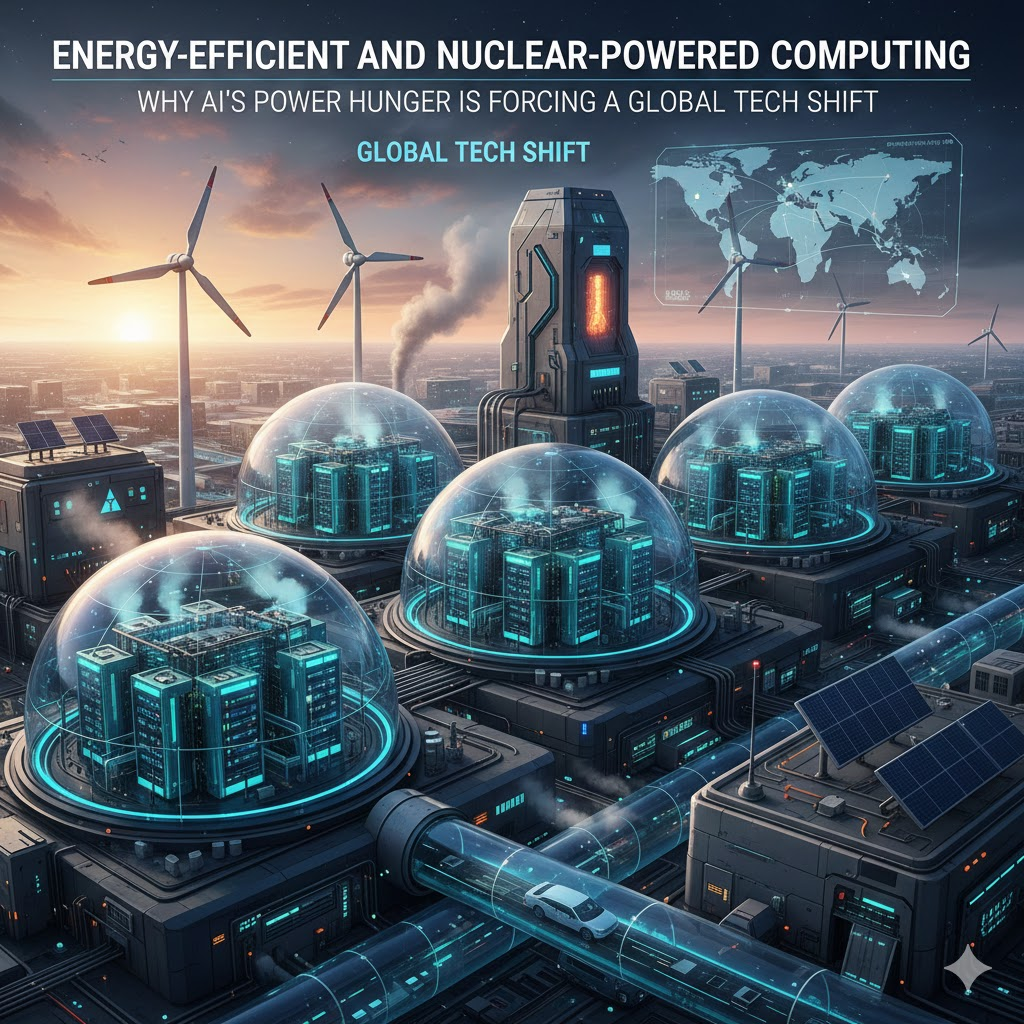
What if the future of computing doesn’t just depend on smarter algorithms… but on who can power them?
In the shadows of AI’s breakthroughs, an unexpected crisis is quietly unfolding — one that has nothing to do with chips, data, or regulation. It’s electricity.
Today’s AI systems are devouring energy at a pace the world has never seen. Data centers already swallow 8% of global power, and we’re just warming up. By the time next-generation models roll out, our current grids may not survive the demand. So the question echoing through Silicon Valley, policy rooms, and Wall Street is simple:
What will power the AI era?
And surprisingly, the answer is taking us back to a technology many assumed we’d left behind.
The Great Power Panic: Why Renewables Aren’t Enough
AI’s appetite is outgrowing solar fields and wind farms.
Forbes recently spotlighted a trend tech insiders have whispered about for months: big tech is quietly investing in nuclear reactors.
Google, Microsoft, Amazon, and even lesser-known hyperscalers are exploring nuclear microreactors and SMRs (Small Modular Reactors) to guarantee uninterrupted, massive-scale energy for their AI clusters. Why the urgency?
Because renewables can’t deliver 24/7 power at the volume required for billion-parameter models, hyper-dense GPU farms, and real-time global inference.
Suddenly, nuclear is no longer old-fashioned — it’s the only option game-changing enough.
Hybrid Computing: The Future According to Deloitte
While energy infrastructure transforms, the computing architecture itself is also being re-engineered.
Deloitte’s Tech Trends report places a spotlight on hybrid computing — a strategic mix of classical, cloud, edge, and quantum systems working together to squeeze every drop of efficiency out of computation.
Why does this matter?
Because even with nuclear power, AI must become leaner.
- Inference workloads need to run closer to users to reduce energy waste.
- Edge devices will take tasks once reserved for massive GPU clusters.
- Quantum (yes, quantum) will later take on problems too heavy for silicon.
We’re stepping into a world where efficiency is no longer optional — it’s the currency of competition.
Wall Street Smells the Shift: AI Stocks Surge
While engineers debate power grids, investors are already voting with their portfolios.
Today’s rally saw the Nasdaq jump 2.7%, fueled largely by optimism around AI infrastructure spending. Alphabet and Tesla are leading the momentum as their capex plans hint at something bigger than hardware upgrades — they’re preparing for an energy-computing convergence era.
Where tech used to be defined by code, chips, and cloud, the next frontier is physical and infrastructural.
AI is forcing companies to think like utility providers.
Warning Signals From X: Bottlenecks Ahead
On social media — especially X — analysts are sounding the alarm:
- Power grids are not ready.
- Transmission networks are insufficient.
- Permitting for new reactors moves slower than AI models evolve.
- Telecom infrastructure is next in line to crack under pressure.
A viral thread from TheFastMode highlights a crucial twist: inference AI is reshaping telecom networks at a foundational level.
Think:
- edge nodes rebuilt,
- fiber capacity expanded,
- cooling systems redesigned.
We’re not just upgrading software — we’re rebuilding the digital world’s plumbing.
The Big Picture: A Global Race to Power Intelligence
What we’re witnessing is the early stage of a massive shift:
AI is no longer just a software revolution. It’s an energy revolution.
The companies that win won’t just have the fastest models — they’ll have the most reliable and scalable power sources.
Nuclear is making a comeback not because it’s trendy, but because it’s necessary.
And efficiency is emerging as the quiet superpower — the invisible factor that will separate AI leaders from followers.
Final Thought: The Story Is Just Beginning
If AI shaped the past decade through innovation, it will shape the next through infrastructure.
From nuclear reactors to fiber networks to hybrid computing stacks, the foundations of tomorrow’s AI aren’t being built in code — they’re being built in concrete, metal, and megawatts.
The real question now is:
Who will adapt fast enough to power the future?