
Hey there, silicon sleuths and future-forward thinkers!
Welcome back to the lab where curiosity sparks deeper questions and tech trends transform into tomorrow’s revolution. Buckle up, because today we’re diving straight into the heart of a hardware war that’s shaking the AI world to its core.
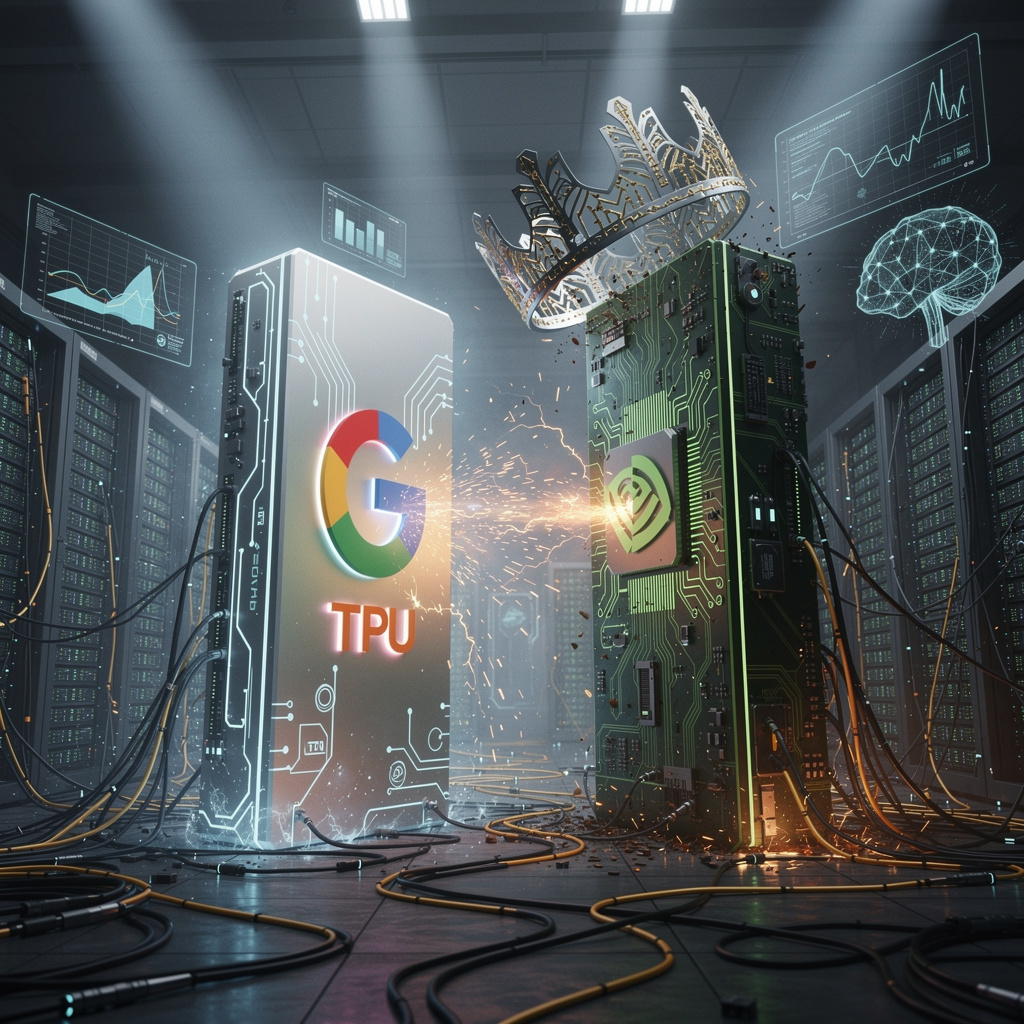
Yes, we’re talking about the silicon storm brewing between Google’s TPUs and Nvidia’s GPUs — a battle that could reshape who gets to innovate, who gets left behind, and how fast the future arrives.
⚡ The Silicon Storm: Why Everyone Is Talking About TPUs Right Now
If you’ve felt a subtle rumble in the techosphere lately, that’s because Google’s Tensor Processing Units (TPUs) have suddenly moved from “cool internal tool” to “global disruptor,” sending shockwaves across AI labs, boardrooms, and semiconductor markets.
Reports suggest Google is exploring selling TPUs to outside companies — including Meta and Anthropic — which is huge because for years, TPUs were tightly guarded in Google’s own infrastructure.
Now?
They’re primed to become weapons in a hardware holy war.
And the timing couldn’t be more dramatic.
🚀 Google’s Power Move: Cracking the GPU Monopoly
Let’s break it down:
🧠 TPUs = Custom silicon purpose-built for AI
For years, Google has quietly been iterating on TPU generations designed exclusively for machine learning workloads. Think:
- ultra-fast matrix math
- high-efficiency ML pipelines
- mind-bending inference speeds
They’re lean, specialized, and laser-focused on AI.
Meanwhile, Nvidia’s GPUs have ruled the world with raw power and unmatched developer ecosystem dominance.
🎯 But now the plot twist:
Anthropic has reportedly committed to using a whopping 1 million TPUs.
Meta has been in billion-dollar purchasing discussions.
And Google is teasing a wider TPU marketplace.
This isn’t a ripple — it’s a tectonic shudder.
🔥 “Crown Slipping?” — The X Debates Erupt
Hop onto X (formerly Twitter) and it’s a battlefield of hot takes:
“Google’s TPUs shaking Nvidia — is the crown finally slipping?”
— @ChipChaser
“1M TPUs for Anthropic? This is INSANE scale.”
— @ModelWhisperer
“Custom silicon is the future. GPUs are too general, too inefficient.”
— @SiliconSage
And as if the debates weren’t already fiery enough, Samsung poured gasoline on the conversation with a breakthrough:
⚡ Samsung’s NAND Flash Miracle: 96% Less Power?!
Samsung just unveiled a radically efficient NAND flash storage technology cutting power consumption by up to 96%.
Think about it:
If your compute becomes efficient and your storage becomes efficient — the entire AI ecosystem gets greener, faster, and cheaper.
Combine that with TPUs’ specialized acceleration and…
Let’s just say: hardware disruption is no longer hypothetical — it’s happening.
🧩 Gartner’s “Hybrid Computing” Vision: The Plot Thickens
Gartner’s 2025 trend report is amplifying the noise. They’ve identified Hybrid Computing — a blend of classical chips + custom accelerators + quantum/neuromorphic/edge components — as a defining theme.
TPUs fit this perfectly.
We’re moving beyond the “one chip to rule them all” era toward an environment where specialized chips collaborate, each optimized for its own niche.
In this universe, TPUs aren’t just a GPU alternative…
They’re part of a multi-paradigm computing revolution.
💰 The Curiosity Spike: Why TPUs Are Trending Hard Today
Let’s connect the dots.
📌 1. The Capex Crunch
AI labs are drowning in compute costs.
GPUs are scarce.
Training massive models can cost hundreds of millions.
Enter TPUs:
Cheaper.
More efficient.
Optimized specifically for AI.
📌 2. The Barriers to Entry Are Crumbling
If TPUs become widely available, more startups and smaller labs can train frontier-scale models.
This could democratize innovation — or…
📌 3. It Could Ignite Antitrust Wildfires
Google is already withdrawing long-standing antitrust complaints against Microsoft.
Coincidence?
Or a strategic clearing of the legal runway before selling its chips to half the industry?
📌 4. Big Tech Power Consolidation?
If the world shifts from one giant’s hardware (Nvidia) to another giant’s hardware (Google), do we fix the bottleneck…
or just change its name?
Welcome to the ethical tightrope.
🧠 The Big Question: Will TPUs Accelerate Innovation—or Entrench Big Tech?
Let’s explore both possibilities:
✔️ Scenario 1: TPU Triumph = Faster, Fairer Innovation
- More efficiency = lower training costs
- Lower costs = more developers and startups
- More players = more innovation
- Custom chips = better performance for foundational models
This world looks bright, competitive, and democratized.
✔️ Scenario 2: TPU Dominance = Big Tech Tightens Its Grip
- If Google sells the most efficient silicon…
- And also controls the best data centres…
- And also owns pivotal AI tools…
Uh oh.
This could consolidate power, not distribute it.
The hardware bottleneck vanishes — but a new gatekeeper arises.
🔍 And the Cliffhanger: What Happens Next?
This story is still unfolding in real time.
But here’s what’s likely coming soon:
🔮 Hardware Shake-Up Predictions
- Nvidia will drop an even more powerful next-gen GPU.
- Google will open-source more TPU tools to lure developers.
- Meta will hedge its bets with both GPUs & TPUs.
- Anthropic becomes the world’s biggest TPU customer.
- Samsung’s breakthrough starts a storage-efficiency race.
- Governments step in — hardware is too strategic to ignore.
The hardware wars are just beginning.
And we’re all standing front-row.
🧵 Join the Conversation: TPU or GPU — Who Wins?
Your turn, silicon explorers!
⚔️ Does Google dethrone Nvidia?
⚙️ Will custom chips replace general-purpose GPUs?
🔋 Can Samsung’s storage revolution change the energy equation?
🏛️ Will regulators step in before the hardware battle gets out of hand?
Drop your take in the comments — let’s spark the debate together.
✨ Final Word: This Is Hardware’s High-Wire Act
Google’s move into selling TPUs isn’t just a competitive flex — it’s the opening act of a global recalibration of power, profit, and possibility.
We’re witnessing the moment where silicon stops being “just hardware” and becomes the keystone of AI sovereignty.
So buckle up.
The next breakthrough AI model — the one that changes how we live, learn, and imagine — might not run on Nvidia’s silicon anymore.
It might be born on a TPU.
Until next time…
Stay curious. Stay questioning. Stay wired into the wonder.
💻 Your Host,
The Curious Technologist