

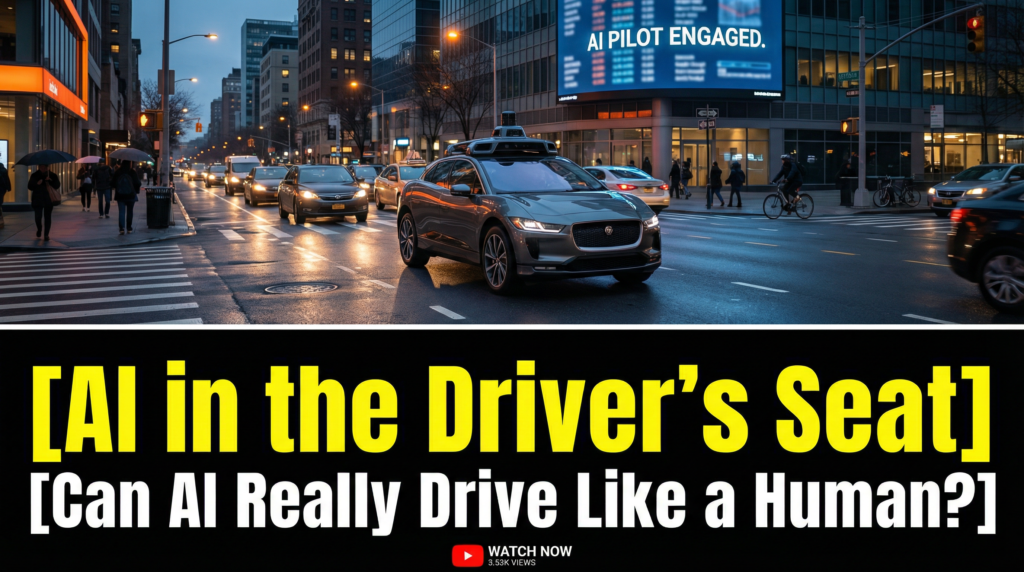
NVIDIA’s CES Breakthroughs Are Bringing Autonomous Cars Closer Than Ever**
For years, self-driving cars have felt like a promise from the future—exciting, impressive, but always just a little far away. At CES, NVIDIA made it clear that this future is no longer distant. It’s taking shape right now.
In NVIDIA’s powerful CES keynote, one message stood out:
👉 AI is no longer limited to screens and software—it is moving into the physical world.
From smarter AI computing platforms like Vera Rubin to new “reasoning” technology such as Alpamayo, NVIDIA is building the brain that will help autonomous cars think, decide, and react more like humans.
Let’s break it all down in simple words and explore why this matters so much.
🚗 From Digital AI to Physical AI: A Big Shift
Until recently, most AI lived inside computers—chatbots, image tools, and software assistants. NVIDIA is now pushing AI beyond the digital world and into real-life machines, especially cars.
This is what NVIDIA calls physical AI:
- AI that understands the real world
- AI that reacts to movement, weather, traffic, and people
- AI that can make fast decisions in unpredictable situations
For autonomous driving, this shift is game-changing.
🧠 Meet Vera Rubin: The New Brain for AI Computing
One of the biggest announcements at CES was NVIDIA’s Vera Rubin platform.
In simple terms, Vera Rubin is a powerful and efficient AI brain designed to handle massive amounts of data while using energy more wisely.
Why is this important for self-driving cars?
- Cars collect data from cameras, sensors, and radars every second
- AI must process this data instantly
- Any delay could mean danger
Vera Rubin allows AI systems to:
- Think faster
- Learn better
- Operate more efficiently
This makes advanced autonomous driving more practical and scalable.
🧩 Alpamayo: Teaching Cars to “Reason”
Driving is not just about following rules—it’s about judgment.
This is where NVIDIA’s Alpamayo technology comes in.
Instead of just reacting to objects, Alpamayo helps AI:
- Understand why something is happening
- Predict what might happen next
- Choose the safest action
For example:
- A pedestrian hesitates before crossing
- A cyclist suddenly changes direction
- A car ahead behaves unpredictably
Humans handle these situations naturally. Alpamayo is NVIDIA’s step toward giving cars that same reasoning ability.
🛣️ Handling Complex Scenarios Like Humans
Traditional self-driving systems struggle in messy, real-world situations. Roads are not perfect. People don’t always follow rules.
NVIDIA’s AI advancements aim to help vehicles:
- Handle crowded city traffic
- Navigate construction zones
- Drive safely in rain, fog, or low light
- React to unexpected human behavior
Instead of freezing or making unsafe moves, the car can now analyze context, just like a human driver would.
🚘 Moving Toward Level 4 Autonomy
You may have heard about “levels” of autonomous driving.
Level 4 autonomy means:
- The car can drive itself without human help
- Only within specific conditions or areas
- No constant driver attention needed
NVIDIA believes its AI stack is now strong enough to support this level.
This doesn’t mean every car will be fully autonomous tomorrow—but it does mean:
👉 The technology is finally ready for real-world deployment.
🤝 Real-World Proof: Partnership with Mercedes-Benz
Technology alone isn’t enough—it must work on real roads.
That’s why NVIDIA’s partnership with Mercedes-Benz is so important.
Together, they are:
- Integrating NVIDIA AI platforms into luxury vehicles
- Using AI for driving, safety, and in-car experiences
- Testing advanced autonomous features in real conditions
This partnership shows that NVIDIA’s vision is not just experimental—it’s already being applied.
🔒 Safety Comes First
One of the strongest points NVIDIA emphasized was safety.
AI systems are being trained using:
- Simulated environments
- Millions of driving scenarios
- Rare and dangerous situations humans rarely experience
This helps autonomous systems prepare for the unexpected—sometimes even better than human drivers.
🌍 Why This Matters for Everyday Life
Autonomous driving isn’t just about convenience. It can:
- Reduce accidents caused by human error
- Help elderly and disabled people travel independently
- Improve traffic flow and reduce congestion
- Lower stress for daily commuters
NVIDIA’s work brings us closer to these benefits becoming normal, not rare.
🔮 So, Are Self-Driving Cars Finally Ready?
The honest answer: We are closer than ever—but still careful.
What NVIDIA showed at CES proves that:
- AI can now reason, not just react
- Computing power is no longer the main limitation
- Real-world partnerships are making progress faster
The road ahead still needs testing, trust, and regulations—but the foundation is now strong.
✨ Final Thoughts
NVIDIA’s CES keynote didn’t feel like a promise—it felt like proof of progress.
With platforms like Vera Rubin and reasoning technology like Alpamayo, AI is learning to see the world the way humans do. Autonomous driving is no longer a dream of the future—it’s a reality being built step by step.
The question is no longer if AI will drive—but how soon we’ll trust it to take the wheel. 🚘✨
Finally found a platform that actually treats its players right. The bonuses are generous and the customer service is very helpful. Give perabetcasino a try!