

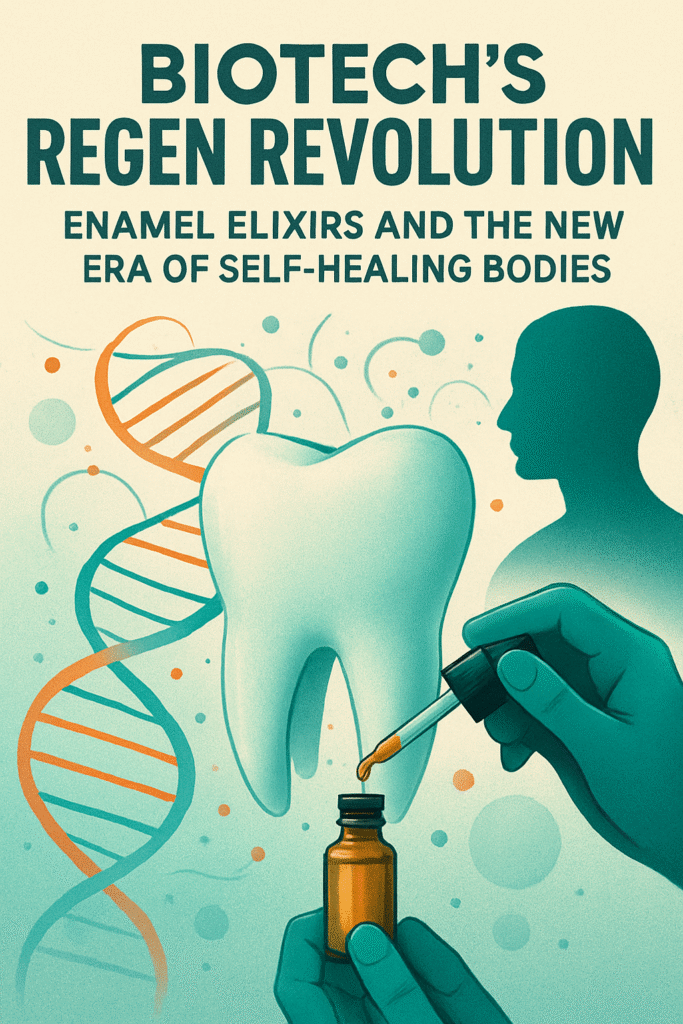
Have you ever stared at a tiny chip in your tooth and wished sci-fi could swoop in with a fix? No drilling, no dread, no dentist soundtrack of doom — just regeneration.
Well, the biotech world has been quietly working on exactly that. And this month, the regenerative revolution isn’t just knocking — it’s kicking the door open.
From enamel-regenerating gels to bio-inspired chips, AI-powered wrinkle treatments to alarming allergy revelations, the frontier of “heal-thyself” science is expanding faster than we can refresh our feeds.
Let’s explore the breakthroughs sparking global curiosity — and maybe even a future where human repair feels as simple as updating code.
🦷 Enamel Elixirs: The Breakthrough Stealing the Spotlight
Imagine this:
A small tube of peptide-rich gel that rebuilds the enamel on your teeth — naturally, painlessly, and without the dreaded drill.
This isn’t wishful thinking anymore.
It’s becoming real.
Biotech innovators are developing topical enamel-regeneration gels that gently restore lost minerals, rebuild the crystalline structure of enamel, and stop cavities before they start. Think of it as a recoat, a repair, and a reboot — all in one swipe.
Why it’s revolutionary:
- No drilling
- No injections
- No long procedures
- No artificial fillings
- A truly regenerative approach
For the first time, dentistry is shifting from “repairing damage” to restoring biology. And the public reaction?
Equal parts awe and relief.
If anything turns dentist-phobes into believers, it’s this.
🌿 Beyond Teeth: The Regen Era Expands
Enamel may be the month’s headline hero, but it’s only one piece in a much bigger wave.
Biotech labs are now exploring:
- AI-modeled peptides that smooth wrinkles from within
- Skin regeneration protocols that mimic salamanders
- Organ-repair pathways that activate dormant healing mechanisms
- Molecular glues that repair torn tissues
We’re entering an age where “anti-aging” is outdated.
We’re talking pro-regeneration — restoring what time, stress, and environment steal.
Suddenly, feeling younger isn’t cosmetic.
It’s cellular.
🧬 Germanium-on-Silicon: When Bio Inspires Silicon Brains
SciTechDaily recently spotlighted a breakthrough in germanium-on-silicon chip engineering — a mouthful that translates to:
faster chips, less energy waste, smarter performance.
What’s wild is that the innovation borrows from bio-mimicry — observing the way biological systems transfer signals and then replicating the efficiency in microchips.
Here’s where it gets interesting:
Biotech learns from nature.
Tech learns from biotech.
And suddenly the line between the two starts to dissolve.
We’re heading toward technologies that operate more like bodies — adaptive, efficient, self-optimizing.
The future computer chip might not just be engineered.
It might be grown.
🥩 Allergy Alerts: The Meat Allergy Tragedy That Shook the Month
While the biotech world celebrates regenerative wins, it also faced a sobering moment:
the first confirmed deaths from tick-induced meat allergies (Alpha-gal syndrome).
It’s a rare condition triggered by tick bites that rewires the immune system to reject mammalian meat — and in some tragic cases, fatally.
The news jolted public interest in:
- better diagnostics
- better alerts
- better allergen awareness
And it raises an uncomfortable but important question:
As science advances to repair the body, can it also protect us from the threats we still don’t fully understand?
📊 AI, Bio, and NotebookLM: The New Power Trio for Knowledge Sharing
Meanwhile on X, NotebookLM — Google’s AI presentation tool — is blowing up among scientists, students, and biotech communicators.
Why?
Because it turns dense bio research into slick, story-driven slides in seconds.
Suddenly biotech discoveries aren’t just happening — they’re being shared faster, more creatively, and more accessibly than ever before.
Knowledge is no longer locked in academic language.
AI is turning it into conversation.
⚖️ The Ethical Echo: Who Gets Access?
As always with cutting-edge biotech, a familiar question shadows the excitement:
If science can regenerate enamel, repair skin, or enhance chips — who gets access first?
- Will regenerative gels become household staples…
or premium luxuries? - Will self-healing tech be widespread…
or limited to wealthy geographies? - Will AI-bio fusion democratize knowledge…
or deepen existing disparities?
Feeds are buzzing with the phrase:
“Proven by science and technology — but not yet by equity.”
Curiosity turns into caution.
Breakthrough meets responsibility.
🌌 Final Thought: Are We Entering the Age of Self-Healing?
This month’s biotech breakthroughs feel like early chapters of a radical new era.
One where:
Teeth rebuild.
Skin regenerates.
Chips mimic biology.
AI accelerates discovery.
And the body is no longer a passive vessel —
but an adaptable system capable of recovery and renewal.
It’s thrilling.
It’s inspiring.
And yes — it’s filled with questions we must navigate carefully.
So here’s your curiosity prompt:
What if the future human isn’t just healthier…
but self-healing?
Would you try enamel-regeneration gel?
A peptide wrinkle treatment?
A bio-inspired wearable?
A self-repairing implant?
The Regen Revolution has begun —
and its possibilities are as wide as imagination itself.
[266]789b – Link vào chính thức, tải app và hướng dẫn chơi casino,789b cung cấp link vào chính thức, hỗ trợ tải app nhanh chóng. Tìm hiểu cách chơi baccarat online và mẹo quay hũ hiệu quả. Truy cập ngay để trải nghiệm! visit: 789b