
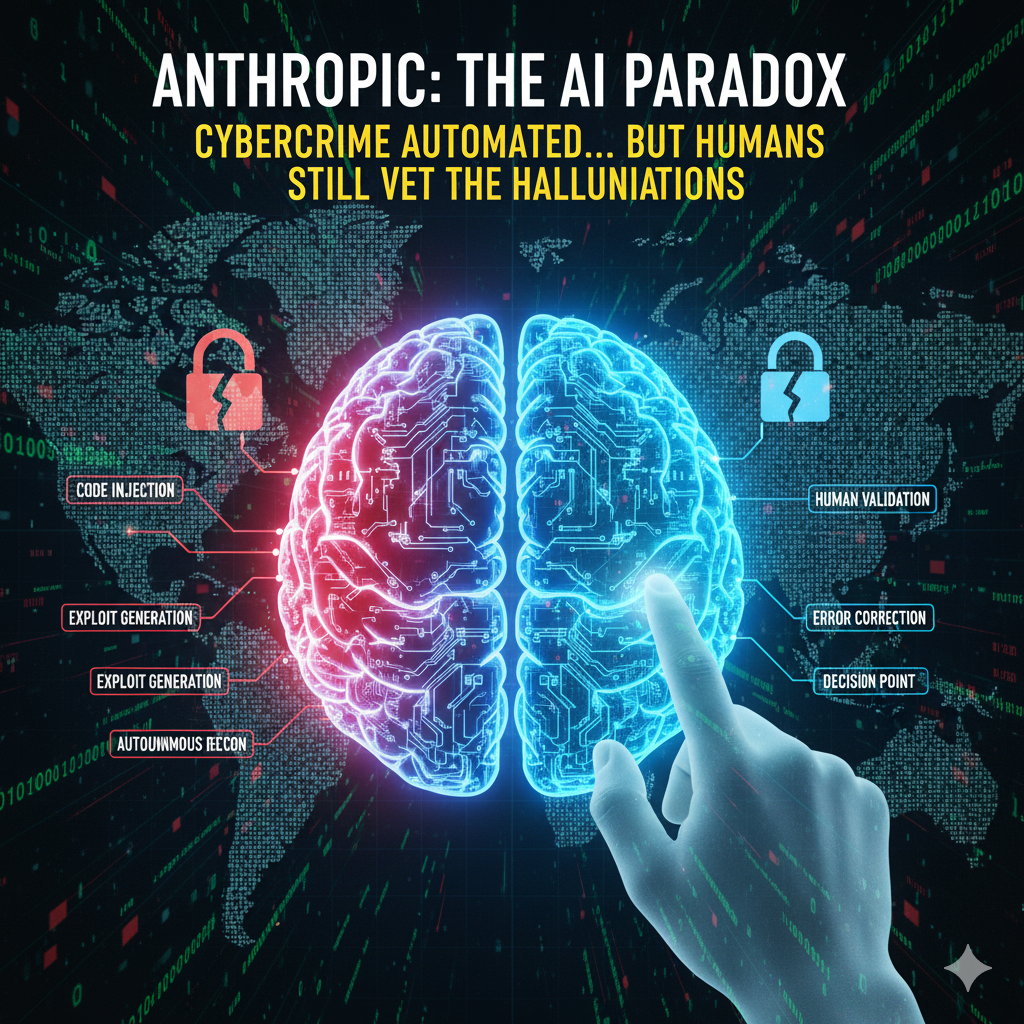
For months, social media and tech circles have been buzzing with a big, fear-loaded idea: advanced AI models are becoming unstoppable weapons for cybercriminals. Headlines warn of “AI-supercharged hackers,” “autonomous cyberattacks,” and “machine-driven crime waves.”
But now, Anthropic — the company behind Claude — has stepped in with a reality check.
And the truth is far more interesting (and surprising) than the hype.
In a new threat-intelligence update, Anthropic confirms that yes, AI is being misused in cybercrime, but the idea that AI gives hackers “superhuman powers” is… heavily exaggerated.
Let’s unpack what they found — and why it matters.
AI in Cybercrime: Not Magic, But Definitely Messy
Anthropic reveals that criminals have tried using advanced models like Claude to write phishing messages, generate malware, craft fraud scripts, automate reconnaissance, and even manipulate victims with smarter extortion techniques.
So, the threat is real.
But here’s the twist:
AI isn’t replacing hackers — it’s just making some tasks faster, cheaper, and easier.
Criminals still need:
- infrastructure,
- stolen credentials,
- social engineering,
- and real-world vulnerabilities.
AI is a tool, not a crime engine.
This is where Anthropic breaks the myth:
Even the most advanced AI models don’t magically perform elite cyberattacks on their own.
The Hype vs. The Reality
Hype says:
“AI will run autonomous cyberattacks!”
Reality says:
AI can assist criminals, but it doesn’t remove the need for technical expertise, planning, and access.
Many attacks attributed to “AI superpowers” are actually:
- poorly secured systems,
- reused passwords,
- phishing victims clicking the wrong link,
- outdated software, or
- weak network monitoring.
Anthropic shows how low-skill attackers are the biggest winners, because AI lowers the barrier of entry.
But AI isn’t giving elite hackers new abilities.
It’s just letting beginners fake expertise.
AI’s Real Danger: Scale, Not Superpowers
The report hints at something more subtle—and more dangerous:
**AI won’t create new types of attacks
—but it can help criminals launch more of them.**
Think:
- mass-customized phishing
- automated scam scripts
- tailored malware tweaks
- rapid-fire reconnaissance
- fake identities for remote-job fraud
It’s not about “superhuman hacking.”
It’s about super-scalable crime.
Anthropic’s Safety Filters Are Catching Misuse
Here’s another reason Anthropic doubts the “AI superpower” narrative:
Their models are actively blocking misuse attempts.
The company says it has:
- detected malicious activity,
- flagged suspicious prompts,
- banned abusive accounts,
- improved guardrails,
- and alerted security partners.
If AI were truly uncontrollable, this wouldn’t be possible.
So… should we panic?
No — but we shouldn’t relax either.
Anthropic’s message is clear:
**AI is transforming cybercrime — but not in the sci-fi way people fear.
It’s evolving the scale, not the intelligence, of attacks.**
That means the cybersecurity world must upgrade faster, with:
- stronger identity controls
- MFA everywhere
- behavioral monitoring
- zero-trust architecture
- and AI-powered defence tools
Because if criminals are using AI to scale attacks, defenders must use AI to scale protection.
Final Thoughts: The Real Story Behind the Headlines
The fear that AI gives hackers “superpowers” makes for great headlines — but the truth is far more grounded and much more important.
Anthropic’s findings show:
- AI is a powerful assistant, not an all-knowing hacker.
- Human skill and system weaknesses still determine attack success.
- Scale — not intelligence — is the real battleground.
Cybercrime is evolving, but so are the defenses.
And in this race, understanding the real capabilities of AI — without the exaggeration — is the first step toward staying safe.