

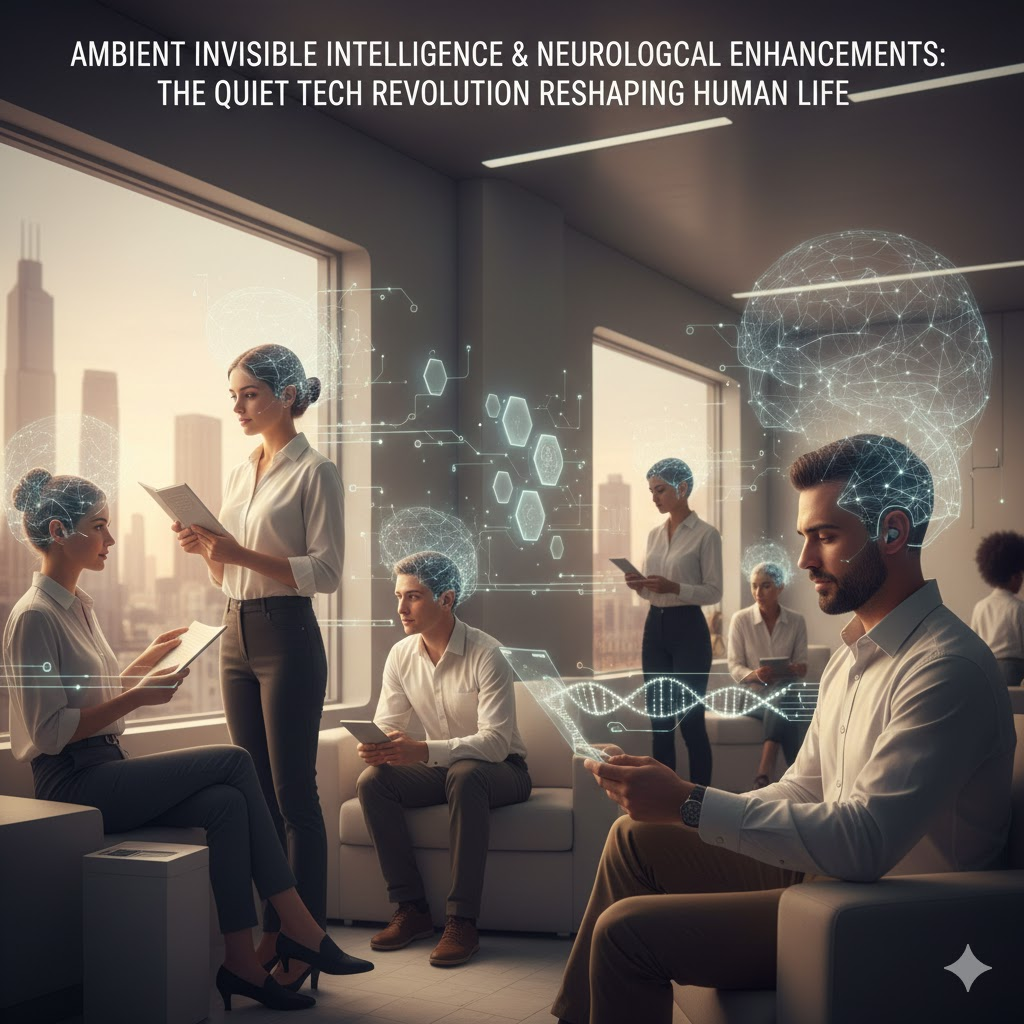
Imagine living in a world where technology doesn’t just sit on your desk or in your pocket — it surrounds you, senses you, responds to you, and even thinks with you.
Welcome to the era of Ambient Invisible Intelligence — a future where AI blends into environments so seamlessly that you might forget it’s even there. And paired with rapid breakthroughs in neurological enhancements and brain–computer interfaces (BCIs), this revolution is no longer science fiction… it’s quietly unfolding right now.
This blog dives into the trends powering this shift — from edge AI and XR innovations to global “Small AI” strategies — and why 2026 may mark a point where human ability and machine intelligence merge like never before.
1. AI That Fades Into the Background — Until You Need It
Gartner’s Top Strategic Tech Trends list features a fascinating entry:
Ambient Intelligence (AmI) — AI woven into physical spaces, devices, and everyday tools.
Think of it as the opposite of today’s app-heavy, screen-dependent world.
In the AmI era:
- Your home adjusts its lighting based on your mood.
- Your office predicts your workflow before you log in.
- Your car senses stress levels and suggests calming routes.
- Your devices collaborate silently at the edge, no cloud lag, no friction.
This is AI that disappears into the environment — becoming an intuitive extension of you.
Accenture builds on this in its Human + AI research, suggesting we’re entering a world where humans and machines don’t compete… they co-create. Our intelligence expands through AI, while AI becomes more human-aware through us.
2. The Rise of BCIs: From Thought to Action
If ambient intelligence is the environment evolving, neurological enhancements are us evolving.
BCIs are gaining momentum far beyond medical rehabilitation.
We’re moving toward systems that can:
- translate neural signals into digital commands,
- enhance cognitive performance,
- accelerate learning,
- and eventually allow devices to respond to intention rather than action.
The future may not require typing, touching, or even speaking — just thinking.
Yes, that’s the level of human–AI synergy being unlocked.
3. “Small AI”: How the World Bank Sees the Next Big Leap
While Big Tech focuses on mega models and power-hungry clusters, the World Bank’s DPTR 2025 report zooms in on a quietly transformative force:
Small AI — lightweight, efficient, purpose-specific models running on low-cost devices.
These aren’t headline-grabbing LLMs.
They’re AI tools designed for:
- farmers managing soil and water,
- clinics triaging patients,
- supply-chain workers navigating inventory,
- communities lacking high-speed internet or cloud access.
By 2026, Small AI is set to become the world’s most widespread intelligence layer, enabling real-world impact where it’s needed most.
This is ambient intelligence with a humanitarian heartbeat.
4. Everyday Tech Is Becoming Your “Eyes, Ears, and Hands”
On X, Logitech’s CEO recently described AI as the new set of:
- eyes (perception),
- ears (context awareness),
- hands (execution)
for everyday devices.
Your mouse, keyboard, webcam, earbuds, monitors — they’re all turning into smart companions that understand behavior, adapt in real time, and anticipate your needs.
This isn’t AI replacing humans; it’s AI amplifying humans.
5. XR & the Future of Immersive Intelligence
Extended Reality (XR), VR, and AR are maturing faster than ever:
- Apple Vision Pro is redefining spatial computing.
- Microsoft HoloLens is anchoring the enterprise metaverse.
- Bluesoft reports 70% reductions in VR motion sickness, a breakthrough solving the biggest barrier to immersion.
Soon, your reality will be layered with information, assistance, and interaction — seamlessly blending digital and physical worlds.
We’re approaching the moment when “reality” becomes customizable.
6. The Trend Table: 2026 at a Glance
Here’s a snapshot of what’s driving the global intelligent-tech shift:
| Trend | Key Driver | Projected Impact by 2026 |
|---|---|---|
| Agentic AI | Capgemini survey (70% exec priority), Qwen3-VL benchmarks | 30% robots reach Level 3 autonomy |
| AI Governance | Singapore’s mandates, Gartner forecast | 50% organizations adopt disinformation-defense tools |
| Quantum Computing | IBM/Google chips, ASPI Tracker | $10B+ market; China leads in 8/9 key research fields |
| Energy-Efficient Computing | Nuclear investments, Nasdaq AI rally | 20% reduction in data-center emissions |
| Ambient Intelligence | World Bank “Small AI,” BCI progress | Edge AI in 40% of devices worldwide |
The Future: Technology That Becomes an Extension of You
The biggest tech revolutions rarely announce themselves with noise — they arrive quietly, invisibly, and then suddenly become indispensable.
Ambient intelligence and neurological enhancements are setting the stage for a world where:
- AI blends into our environment,
- devices respond to the smallest cues,
- XR reshapes how we perceive,
- BCIs accelerate human potential,
- and “small AI” brings intelligence to billions.
This isn’t just technological evolution.
It’s human evolution enhanced by technology.
And the most exciting part?
We’re only seeing the first glimpse.
[8518]xsmnth5 | Đăng nhập tải app game bài đổi thưởng Momo,xsmnth5 cung cấp sảnh game bài đổi thưởng Momo uy tín. Hướng dẫn cách chơi baccarat online và nạp tiền casino qua thẻ cào nhanh chóng. Truy cập để trải nghiệm ngay. visit: xsmnth5