
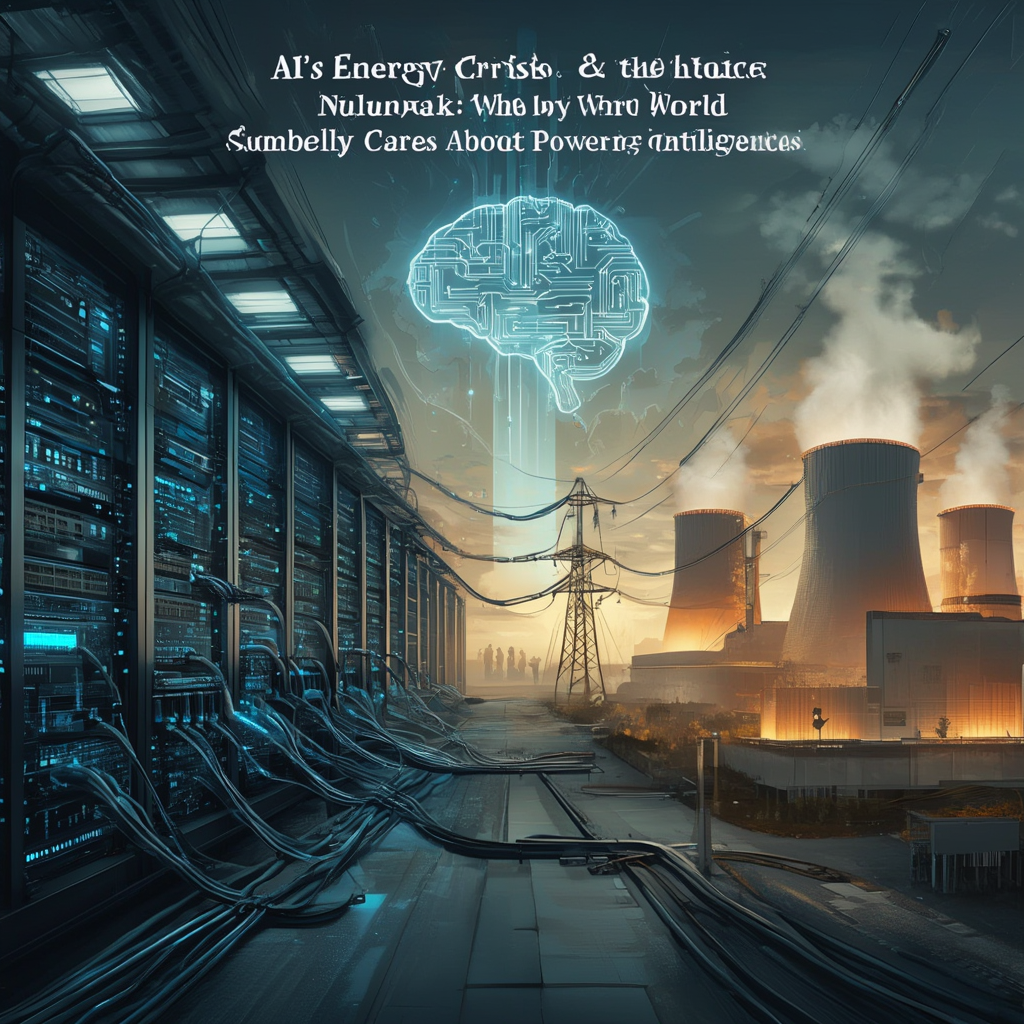
What happens when intelligence becomes hungry—really hungry?
As AI explodes across every industry, the world is waking up to a new reality:
Our power grids weren’t built for machines that think at scale.
Every new model, every bigger data center, every leap in compute… pushes global energy systems closer to their limits. Suddenly, conversations that once felt futuristic—like AI-powered nuclear plants, ultra-efficient chips, and low-energy cryptography—are turning into urgent boardroom priorities.
Today’s trending topic?
AI’s energy demand is getting so intense that nations are revisiting nuclear power with fresh eyes.
Let’s explore why this conversation is everywhere right now—on X, in boardrooms, in government policy circles—and what it means for the future of AI.
The AI Boom Is Stress-Testing Global Power Grids
AI models don’t just need data.
They need electricity—a lot of it.
The more powerful the model, the more compute it demands. And the more compute it demands, the more energy it sucks out of power systems already stretched by:
- EV adoption
- Cloud infrastructure
- Bitcoin mining
- Smart cities
- Electrified transport
Energy analysts say AI’s footprint could soon rival that of small countries.
Suddenly, questions that seemed ridiculous five years ago are becoming very real:
- Can our grids handle AGI-level compute?
- Will energy shortages slow AI progress?
- What powers the next generation of data centers?
The answers are pushing the world toward a controversial but unavoidable solution…
Nuclear Energy: From Cold-War Relic to AI’s Powerhouse?
For years, nuclear was treated like the quiet kid in class—underestimated, misunderstood, and overshadowed by solar and wind.
But in 2025?
The narrative flipped.
Reports from Forbes and Capgemini point to AI-integrated nuclear facilities as a major inflection point this year. Why?
Because nuclear is:
🔹 Clean (near-zero carbon emissions)
🔹 Reliable (unlike intermittent renewables)
🔹 Scalable (can power entire regions)
🔹 High-output (ideal for compute-heavy clusters)
The idea isn’t just “nuclear energy.”
It’s nuclear + AI: smarter optimization, predictive maintenance, autonomous monitoring, and dynamic load balancing.
Imagine:
A nuclear plant that adjusts its output based on real-time compute demand from nearby data centers.
This is becoming more science-fact than science-fiction.
X Is Buzzing: Energy-Efficient Computing Is the New Gold Rush
Tech creators on X are obsessing over:
- Hybrid compute systems
- Energy-efficient AI chips
- Sustainable data centers
- AI hardware economics
- Cooling innovations
Why?
Because scaling AI isn’t just about better algorithms—it’s about electricity.
If your compute costs skyrocket, your AI dreams collapse.
Meanwhile, Bitcoin and crypto watchers are joining the conversation too. Bitcoin mining’s energy profile makes it a proxy for compute demand. So when AI chatter spikes…
➡️ Proxies like MSTR (MicroStrategy) move.
➡️ Investors start predicting energy-compute correlation trades.
➡️ Overnight surges tied to compute demand send ripples through markets.
AI isn’t just disrupting industries—it’s disrupting markets in real time.
Edge Computing & Post-Quantum Cryptography Are Quietly Becoming Heroes
To reduce strain on centralized grids, companies are running AI at the edge—closer to users, with lower energy draw.
At the same time, there’s a rush toward post-quantum cryptography that promises:
- Low-power encryption
- High security
- Better performance for distributed AI systems
This trio—edge AI, sustainable chips, and post-quantum security—is becoming the backbone of future low-energy networks.
The goal is clear:
Smarter AI, smaller footprint.
Why This Trend Is Exploding Right Now
You’re seeing this everywhere today because several forces collided at once:
1. AI Markets Are Set to Hit $294B by Year-End
According to GeeksforGeeks, the industry is expanding so fast that the underlying infrastructure can’t keep up.
Energy becomes the bottleneck.
2. Nuclear Policy Is Being Rewritten
Governments are revisiting nuclear projects with urgency—backed by AI industry pressure.
3. Semiconductor Earnings Are a Make-or-Break Moment
Stocks like MRVL, reporting earnings today, are being watched closely.
Why?
Because they reveal the truth about AI hardware sustainability.
Can chipmakers keep pace?
Or are we hitting the physical limits of efficiency?
4. AI Models Are Doubling in Size Every Few Months
Bigger models = bigger energy bills.
Investors know this.
Policymakers know this.
So does Wall Street.
And suddenly, the world is asking a surprising question:
Can AI grow without breaking the planet?
The World’s Next Power Race: Intelligence Needs Fuel
Here’s the real takeaway:
We’ve been treating AI like software.
But it’s not.
It’s infrastructure—as energy-hungry as steel, manufacturing, or chemicals.
The future of AI depends on:
- Smarter chips
- Cleaner power
- Efficient cryptography
- Decentralized compute
- Nuclear innovation
We’re entering an era where an AI breakthrough isn’t defined by parameter count—but by who can power it.
The nations that solve AI’s energy crisis first…
will lead the next century.
Final Thought: AI Isn’t Limited By Intelligence—It’s Limited By Electricity
The story isn’t just about nuclear.
It’s about acknowledging a bigger truth:
AI has outgrown our power systems.
And now we must redesign the world for artificial intelligence—literally.
This trend is rising because the stakes are enormous:
policy, climate, infrastructure, markets, innovation, and national competitiveness.
The future of AI will be built on megawatts as much as algorithms.