


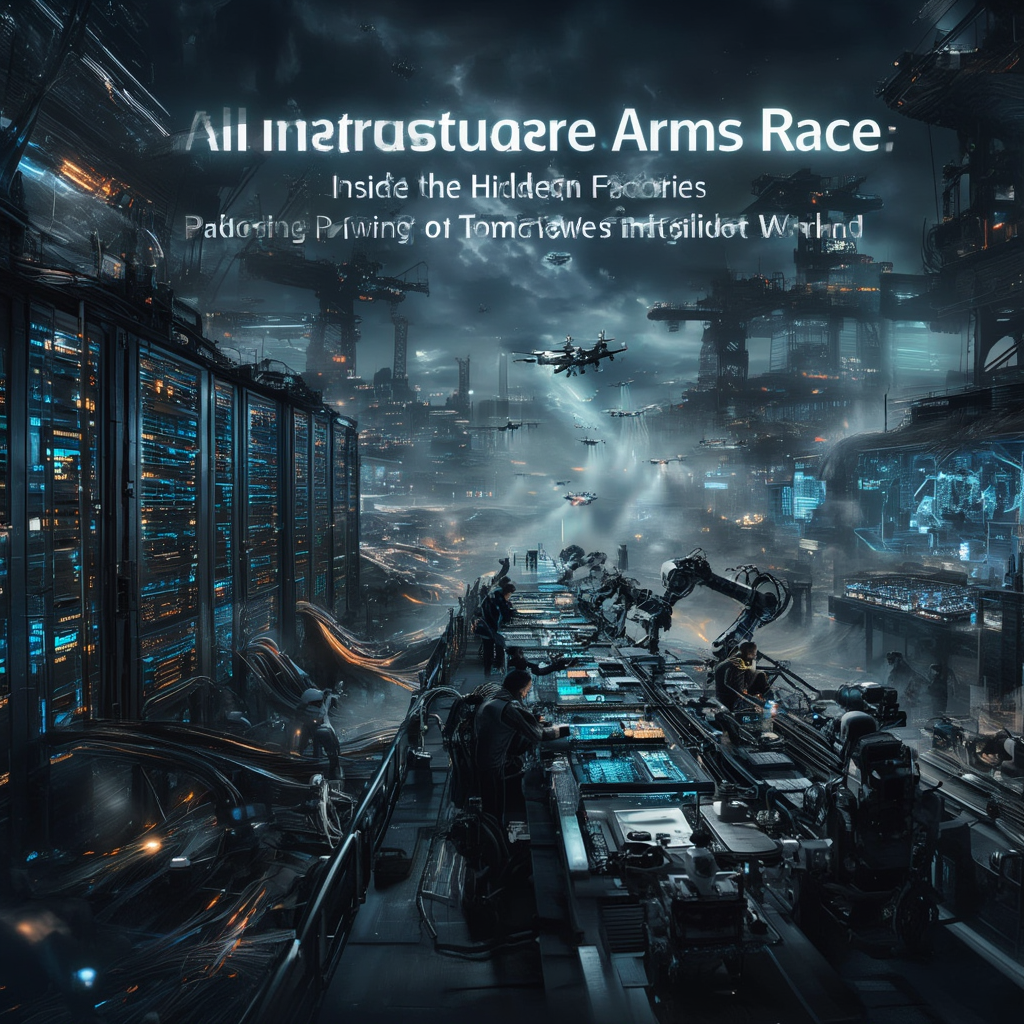
Have you ever wondered whether the real AI revolution is happening somewhere far away from your screen—inside gigantic, humming data centers and robot-filled factories you’ll never see? While the world obsesses over chatbots, filters, and AI avatars, a far bigger transformation is unfolding behind the curtains.
Welcome to the AI Infrastructure Arms Race—a high-stakes scramble where nations, chipmakers, and tech giants are racing to build the physical backbone of the intelligent future. This isn’t just software anymore. This is electricity, metal, fiber optics, rare materials, and supercomputers the size of stadiums.
And the people who control this physical AI layer?
They’ll control the next century.
The Billion-Dollar Quiet War: When Chips Become Power
The star of this new world order?
NVIDIA and Foxconn, the unexpected duo turning AI into a physical empire.
Their $1.4 billion supercomputing cluster, coming to Taiwan by mid-2026, is not just another tech project—it’s a national-level infrastructure event. Powered by NVIDIA’s Blackwell and next-gen platforms, it will feed the next wave of AI servers, factories, humanoid robots, and autonomous everything.
Think of it as an AI mega-reactor.
A machine that generates intelligence instead of electricity.
But this is just one spark in a rapidly spreading wildfire.
- Nokia plans a $4 billion AI push in the U.S.
- Tech giants are flooding the bond market with debt just to power massive new data centers.
- On X, analysts are mapping Taiwan’s nerve-center role in robotics and AI—celebrated for margins, feared for geopolitics.
Add Broadcom’s huge chip agreement with OpenAI and Microsoft’s NVIDIA-Anthropic triangle, and the pattern becomes unmistakable:
Controlling compute has become the new moat.
Not data. Not algorithms. Not apps—computational power itself.
The Rise of “Physical AI”: Machines That Don’t Just Think, They Build
Here’s where the story takes its most curious turn.
What if this arms race doesn’t just produce smarter models…
but smarter machines?
Machines that can:
- build factories
- assemble electronics
- run logistics hubs
- operate warehouses
- manage entire supply chains
A world where AI doesn’t just think—it manufactures.
This is “Physical AI”—the merging of semiconductors, robotics, energy infrastructure, and industrial automation into something entirely new.
And the early cracks in the system are already showing.
**The first bottleneck? Not GPUs.
Something stranger… T-glass.**
This obscure material, essential for stable IC substrates, is suddenly in short supply.
Japan’s Nittobo has quietly become a global chokepoint.
Foundries are scrambling.
Timelines are slipping.
It’s a reminder that the AI revolution isn’t floating in the cloud—it’s grounded in very real, very physical stuff.
Will This Arms Race Rebuild America… or Divide the World?
As U.S. states like Texas and Wisconsin attract mega-data centers and semiconductor fabs, some analysts believe this could spark a new industrial boom—America’s biggest since the post-war era.
But there’s another possibility:
Countries that lack chipmaking and energy infrastructure may fall further behind, creating a new kind of global divide—not digital, but physical.
Because AI isn’t just about code anymore.
It’s about:
- who has the factories
- who controls the compute
- who owns the cooling
- who dominates the supply chains
- who can build the robots that build everything else
This is the new geopolitics of intelligence.
The Long Game: A Capex Cycle That Could Reshape Civilization
One analyst put it bluntly:
The investment cycle ahead could last years, possibly decades.
And the biggest winners won’t be the flashy AI apps—they’ll be the enablers:
- GPUs
- photonics
- edge compute
- advanced cooling
- substrates
- power infrastructure
- robotics platforms
These are the bricks and steel of the AI world.
The scaffolding of an intelligent planet.
So yes—while everyone debates chatbots over their leftover turkey…
the real story is unfolding far below the surface.
AI isn’t just transforming our software.
It’s rebuilding our physical world.
Welcome to the AI Infrastructure Arms Race.
A battle not for users—but for the machinery that will define tomorrow.