


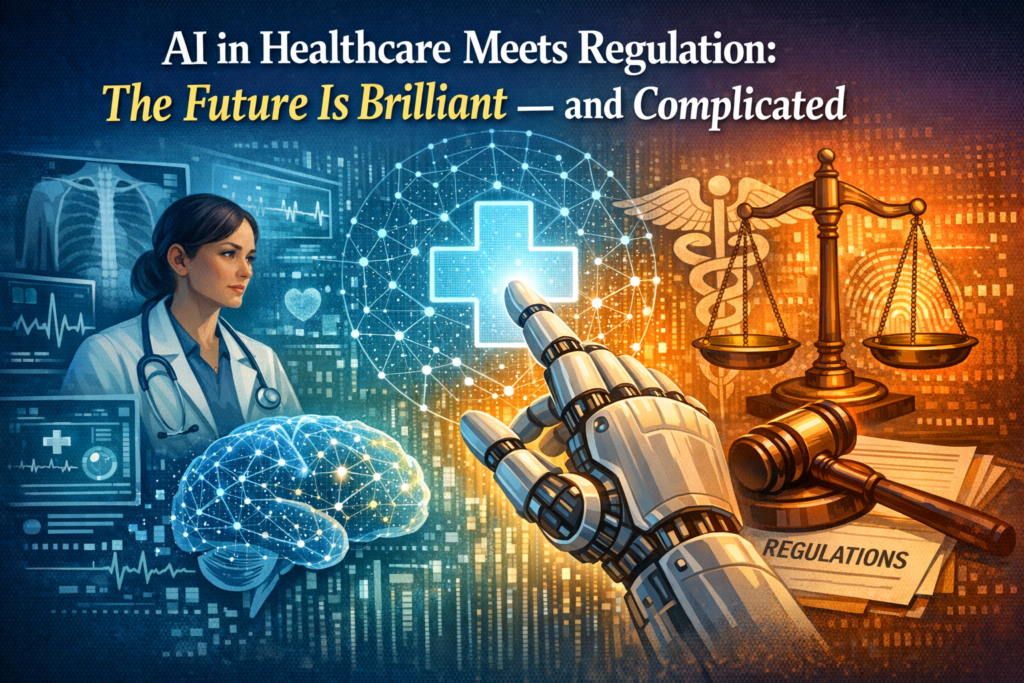
Some stories feel like science fiction until suddenly… they’re not.
Right now, AI in healthcare is one of those stories — unfolding faster than anyone expected. Machines can now examine scans, detect early signs of disease, and even predict health risks long before a doctor notices symptoms.
But as innovation accelerates, something else is growing just as fast:
👉 Global concern.
👉 Policy debates.
👉 Ethical scrutiny.
Welcome to 2025 — a year where artificial intelligence isn’t just transforming healthcare…
it’s challenging the rules that govern it.
🔍 AI-Powered Healthcare: The Breakthrough Everyone’s Talking About
Medical imaging — once limited to human interpretation — is evolving into something almost astonishing.
AI systems are now capable of:
- Detecting micro-patterns invisible to the human eye
- Comparing millions of cases within seconds
- Flagging abnormalities instantly
- Improving diagnosis accuracy for conditions like cancer, neurological disorders, and cardiovascular disease
And this shift isn’t happening in isolation.
Connected devices — from smartwatches to wearable ECG patches — are feeding healthcare systems constant real-time data.
That means the future may look like this:
💡 A smartwatch detects an irregular heartbeat →
💡 AI analyzes patterns →
💡 Doctors receive alerts before symptoms escalate →
💡 Treatment begins earlier than ever possible.
Life-saving? Absolutely.
But — here’s where things get interesting.
⚖️ Innovation vs. Regulation: The World Is Drawing New Lines
For all its promise, AI is entering a territory where technology touches privacy, autonomy, and even rights.
In Europe, regulators are already stepping in.
The EU recently opened scrutiny into Meta’s WhatsApp AI policies — specifically around data collection, transparency, and consent.
If messaging apps face regulatory pressure, imagine what’s next for technologies reading our medical scans, genetics, or brain activity.
Meanwhile, rights groups warn that global internet freedom declined again in 2025, partly due to:
- AI surveillance tools
- Algorithmic misinformation
- Unclear ethical frameworks
- Data exploitation concerns
It’s no longer just a technological race — it’s a philosophical one.
🌍 The Internet Is Split: Fear, Excitement, and Everything Between
Scroll through X and the contrast is striking.
One timeline:
🎥 Viral, hyperrealistic AI-generated medical simulations that look indistinguishable from reality.
🦾 Custom 3D-printed shoes tailored to a person’s bone structure and gait analysis.
The next timeline:
🔐 People debating whether edge AI will protect privacy or quietly normalize surveillance.
It’s a strange moment — where awe and anxiety coexist, shaping public opinion and policy.
🩻 Edge AI: A Possible Middle Path?
A trend gaining momentum is edge AI — where computing happens on the device itself rather than sending data to the cloud.
Why does that matter?
- Medical scans can stay local
- Patient data becomes less vulnerable
- AI can operate faster with reduced internet dependence
But even edge AI sparks questions:
📌 Who owns the diagnosis — the patient, the provider, or the algorithm?
📌 Who’s responsible if AI misdiagnoses?
📌 Should machines be allowed to make clinical decisions?
The answers are not yet clear — and the debate is getting louder.
🚦 The Road Ahead: Controlled Innovation or Ethical Tug-of-War?
We’re standing at a crossroads.
One direction leads to revolutionary healthcare — personalized, predictive, scalable, and accessible.
The other leads to unprecedented monitoring and digital dependency, where the boundaries of privacy are blurred permanently.
The truth?
We’ll likely end up somewhere in between — building rules as fast as the technology evolves.
And maybe that’s the most fascinating part:
📍 AI isn’t just reshaping healthcare —
it’s forcing us to rethink what it means to trust, govern, and protect human data.
🧭 Final Thought
The future of AI in healthcare won’t just depend on breakthroughs in algorithms or hardware —
but on the balance we strike between imagination and responsibility.
One thing is certain:
2025 isn’t just about “What can AI do?”
It’s about something far bigger:
✨ What should it do — and who gets to decide?