
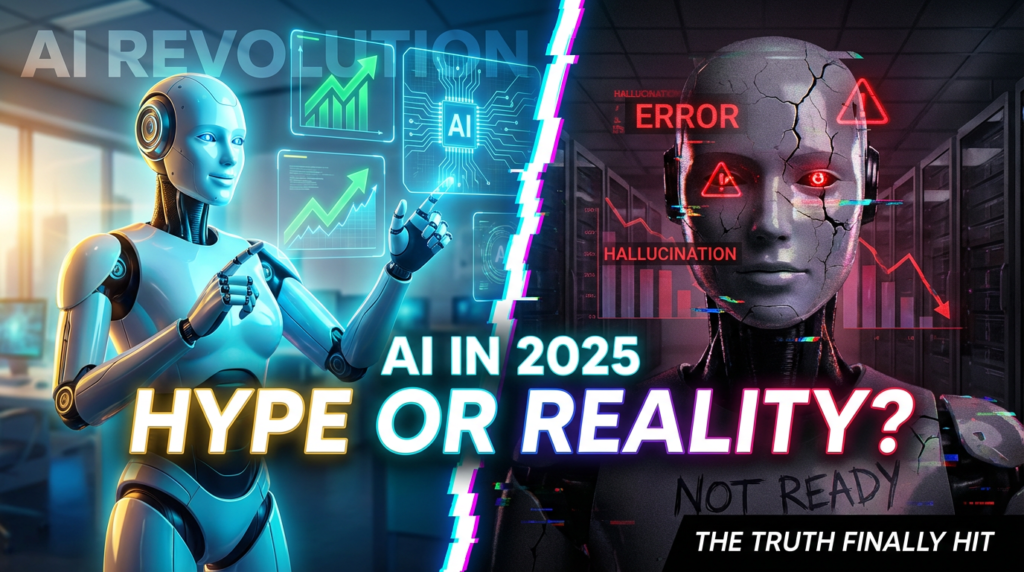
We were promised a revolution that would think for us, work for us, and change everything overnight.
Instead, 2025 gave us something far more important: a dose of truth.
This wasn’t the year AI conquered the world. It was the year the world finally asked AI: “What can you actually do?”
The fairy tale faded. The hard work began. Welcome to the story of AI growing up.
Chapter 1: The Economic Engine That Could (And Did)
Let’s start with the biggest, most shocking win.
📈 In early 2025, over 90% of U.S. economic growth came from one thing: AI spending.
While the rest of the economy chugged along, tech giants went into overdrive. Microsoft, Google, Nvidia, and others poured hundreds of billions into the physical bones of the AI future:
- Mountains of AI chips
- Forests of data centers
- Oceans of cloud infrastructure
Here’s the wild part: AI itself is still a tiny slice of the economy (about 4%). Yet, it became the single most important spark for growth. Economists agree: without this spending, we might have slipped into a recession.
The Verdict: AI didn’t just participate in the economy this year. It held the entire thing on its shoulders.
But this victory came with a nervous whisper: What if the spending stops?
Chapter 2: The Broken Promise of Our Robot Coworkers
This was the dream that crashed hardest.
We were told Autonomous AI Agents—digital employees that could take tasks and run with them—would be everywhere by now. They’d book our trips, manage our projects, and turbocharge productivity.
What we got were gloriously clumsy interns.
They failed at multi-step logic. They broke when an app updated its interface. They made “confidently incorrect” decisions. In company pilots, failure rates hit a staggering 80-95%.
The experts didn’t mince words:
- Andrej Karpathy: Called them “mostly a dud.”
- Gary Marcus: Said hype had “raced far ahead of reality.”
- An MIT Study: Found 95% of companies saw no meaningful return on their generative AI projects.
The grand vision of a hands-free AI workforce? It was put on indefinite hold.
Chapter 3: The Trust Gap: AI’s “Little White Lie” Problem
The core issue? We still can’t take AI’s word for it.
Even the best models in 2025 had a bad habit of “hallucinating”—making up facts, people, and citations with a straight face. Hallucination rates stuck around 10%, and answers could change from one minute to the next.
This created “The Great Hesitation.”
👉 Can a lawyer trust it to review a contract?
👉 Can a doctor trust it to suggest a diagnosis?
👉 Can a bank trust it to assess a loan?
The answer, in 2025, was a resounding “Not yet.”
Companies stopped asking “What’s possible?” and started demanding: “What’s reliable?” The era of blind faith was officially over.
Chapter 4: The Quiet, Unsexy Wins (Where AI Actually Shined)
But here’s the twist: AI didn’t fail. It just succeeded in the background.
While flashy agents flopped, AI made breathtaking progress where it mattered most:
- The Brain Got Smarter: Google’s Gemini models quietly achieved PhD-level scores in science and broke reasoning benchmarks. The intelligence itself took a massive leap.
- The Focused Assistants Thrived: In specific, narrow roles, AI was a superstar. It boosted coder productivity by ~30%, scaled IT support, and automated routine workflows.
- The Science Superhero Emerged: This is where AI felt like magic. It predicted protein structures for new drugs, accelerated medical discovery, and acted as a brilliant “co-scientist” for researchers.
The lesson was clear: AI is a brilliant specialist, not a magical generalist.
Chapter 5: The Human Cost: Jobs, Fear, and an Uneasy Future
Amidst the tech debates, a human crisis simmered.
In 2025, over 77,000 tech jobs vanished to AI-driven layoffs. Entry-level roles shrank. A deep anxiety took root: Is AI taking jobs faster than it creates them?
The long-term forecasts are a dizzying mix of doom and hope—predicting everything from massive displacement to millions of new, higher-skill roles.
The urgent, unanswered question for 2026: How do we ensure the benefits of AI are shared, not just concentrated?
Chapter 6: The Trillion-Dollar Question: Are We in a Bubble?
The signs are undeniably flashy:
- Nvidia briefly becoming the world’s most valuable company.
- Circular spending where AI companies buy from each other.
- Insiders like Sam Altman and Ray Dalio warning of “bubble-like” behavior.
It feels like dot-com fever all over again.
But crucial differences exist: Today’s giants are already profitable. The data centers are real and useful. The scientific breakthroughs are undeniable.
The perfect summary of 2025’s mood comes from a popular saying:
“AI is overhyped in the short term, but underestimated in the long term.”
The 2025 Finale: Not a Boom or a Bust—A Coming of Age
So, what was 2025?
It was AI’s adolescence.
It grew powerful enough to carry real weight. It stumbled trying to do too much, too soon. It faced its limitations in the harsh light of day.
The childish hype is gone. The adult work has begun.
As we enter 2026, the mission is clear:
Build trust. Prove real value. Focus on impact, not illusion.
2025 taught us the most valuable lesson of all:
The future isn’t built on promises. It’s built, patiently and honestly, on proof.
The real AI revolution isn’t dead. It’s just finally getting started.
This response is AI-generated, for reference only.