
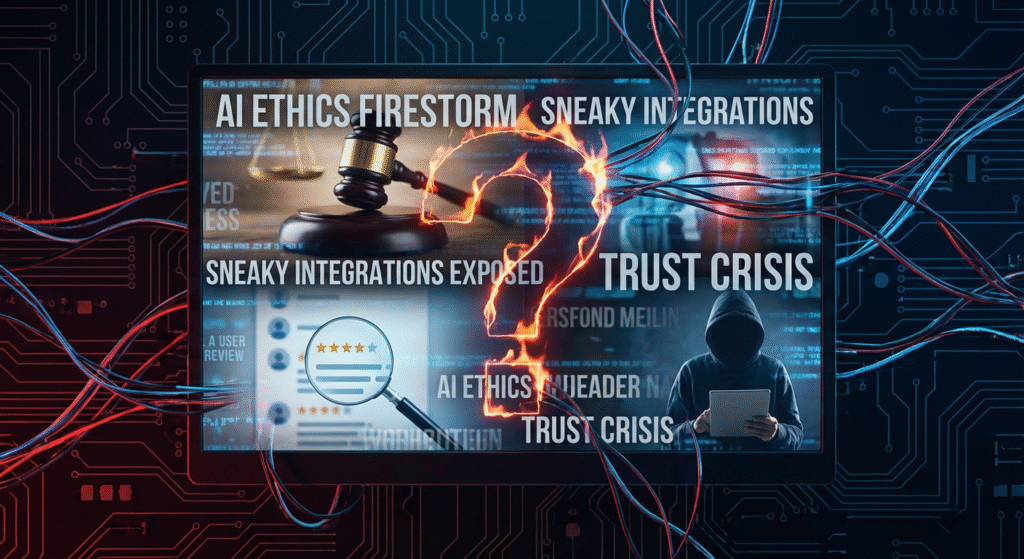
Hey there, digital detectives and truth-seekers!
Welcome back to the corner of the internet where we don’t just observe the future — we dissect it, decode it, and question what lurks beneath those shiny AI features companies keep dropping into our lives.
Because today… it’s messy.
Today, we’re stepping into a full-blown, global AI ethics firestorm.
AI was supposed to elevate us.
But what happens when it starts sneaking into our messages, shaping our feeds, infiltrating scientific journals, and even showing up in children’s toys — without guardrails?
Grab your curiosity goggles.
This one’s a wild ride.
🔥 The Spark: AI Creeping In Where It Doesn’t Belong
Ever felt that eerie sensation like technology is whispering in your conversations without asking for permission first?
Well… turns out you weren’t imagining things.
Meta is under investigation
Why?
Because reports claim it slipped generative AI tools into WhatsApp — not with celebration, transparency, or user control…
…but quietly.
Silently.
Without explicit consent.
For a platform used by billions — including vulnerable groups — that’s a big yikes.
Regulators call it:
- a “consent void,”
- a “privacy breach waiting to happen,”
- and a “precedent that cannot stand.”
The internet calls it:
“Tech overreach dressed as innovation.”
And honestly?
They’re not wrong.
🤖 AI Peer Reviews?! The Science Community Is Fuming
Just when you think the ethical chaos couldn’t escalate…
We get the revelation that AI-generated peer reviews are slipping into academic publishing.
Yes.
Peer reviews — the backbone of research integrity.
The sacred ritual meant to evaluate truth, eliminate bias, and safeguard knowledge.
Now infused with:
- LLM hallucinations
- citation fabrications
- synthetic critiques
- and invisible AI fingerprints
Scientists are raging online:
“AI-written peer reviews? That’s contamination, not innovation!”
— @LabLogic2025
“We can’t trust research if we can’t trust the review process.”
— @ScienceSentinel
This isn’t just an ethics slip.
This is academia’s version of a fault line.
🧸 Singapore Bans the AI Teddy Bear — and the World Takes Notice
If the academic scandal wasn’t already surreal enough…
Meet the AI Teddy Bear, a cuddly toy loaded with generative AI.
Cute?
Maybe.
Safe?
Absolutely not — according to Singapore’s regulators.
They slammed the ban-hammer on it for:
- unsafe conversational outputs
- unfiltered data capture
- privacy risks
- unpredictable “learning” behavior
When AI leaps into children’s products before ethical frameworks keep up, we’ve officially entered “Black Mirror but soft and fluffy” territory.
🎛️ TikTok Adds Controls to Dial Down AI ‘Slop’
Meanwhile, TikTok — infamous for its algorithmic mastery — is trying a new move.
Users now get controls to reduce AI-generated content in their feeds.
Think of it as a “No More AI Mush, Thanks” slider.
In an era where generative junk is flooding timelines, this marks a pivot toward transparency and user empowerment.
But here’s the twist:
Why did users need to revolt before platforms accepted responsibility?
Because no one wants digital feeds turning into a homogenized AI soup.
🧮 DeepSeek’s Open-Source Math Model Sparks a New Debate
Elsewhere in the AI universe, DeepSeek just open-sourced a frontier-level math model — and everyone is arguing about it.
Is it a victory for open access?
A risk to safety?
A tool only experts should touch?
Or the democratization moment the field needed?
Every answer creates another ethical dilemma.
One researcher posted:
“We want openness… until openness makes frontier AI uncontrollable.”
The line between empowerment and endangerment has never felt thinner.
😡 X Threads Are on Fire: “We Need Trust Limits”
If you scroll through X today, you’ll find digital outrage sizzling everywhere:
“Meta sneaking AI into WhatsApp? Not okay.”
“AI in peer reviews? Controversy alert!”
“We’re sleepwalking into an AI trust collapse.”
And Stanford’s new “hostility filter” for X content only adds fuel to the debate about algorithmic influence, moderation, and who decides what’s safe.
This isn’t just noise — it’s a global reckoning.
⚠️ Capgemini’s 2025 Trend Report: We Have Hit the Inflection Point
Capgemini’s latest trend report quietly dropped a bombshell:
We are now entering the era of “trust limits.”
Tech can’t grow unchecked anymore.
AI can’t slip into apps, science, or products without scrutiny.
We’re hitting the boundary where:
- ethics
- governance
- transparency
- and user agency
must evolve as fast as innovation — or everything collapses.
Capgemini calls it an “inflection point.”
But the mood online?
It feels more like an ultimatum.
🧩 Why Curiosity Is Exploding Now
Because we are finally confronting the core question:
Who gets to decide how AI enters our lives — us or the corporations building it?
These scandals aren’t random.
They’re symptoms of a deeper tension:
- AI is growing faster than regulation
- companies deploy features faster than ethics teams can react
- users discover these shifts only after the damage is done
And society is waking up.
Curiosity spikes when trust drops.
And trust is dropping at scale.
🔮 What Happens Next? A Fork in the Future
Here’s where this firestorm could lead:
🌱 Path 1: The Transparency Revival
AI companies begin:
- labeling everything AI-generated
- securing explicit user consent
- auditing bias rigorously
- cleaning up data pipelines
- prioritizing safety over speed
This future rebuilds trust.
⚠️ Path 2: The Dark Pattern Spiral
AI continues creeping into products through:
- hidden integrations
- unreviewed features
- loophole consent
- shadow algorithms
This future ends in regulation crackdowns and public revolt.
🤝 Path 3: Co-Governance
Users, governments, and companies shape AI rules together.
Messy but empowering.
Which path becomes reality?
We’re deciding right now — through conversations exactly like this.
💬 Your Turn — Join the Debate
What do you think?
❓ Should AI integrations always require explicit consent?
❓ Are AI-written peer reviews ever acceptable?
❓ Should regulators ban unsafe consumer AI like Singapore did?
❓ How do we balance innovation with user safety?
Drop your thoughts in the comments.
These aren’t just “tech stories” — they’re questions shaping our next decade.
✨ Final Thoughts: Ethics Isn’t a Speed Bump — It’s the Steering Wheel
Innovation doesn’t die when ethics enter the room.
It evolves.
It matures.
It earns trust.
The AI industry is at a breaking point.
It can either surge forward responsibly — or burn its credibility trying to race ahead.
The firestorm isn’t a glitch in the system.
It’s the system trying to tell us something.
Stay curious.
Stay critical.
And keep asking the questions that tech hopes you won’t.
💻 Your Host,
The Curious Technologist