
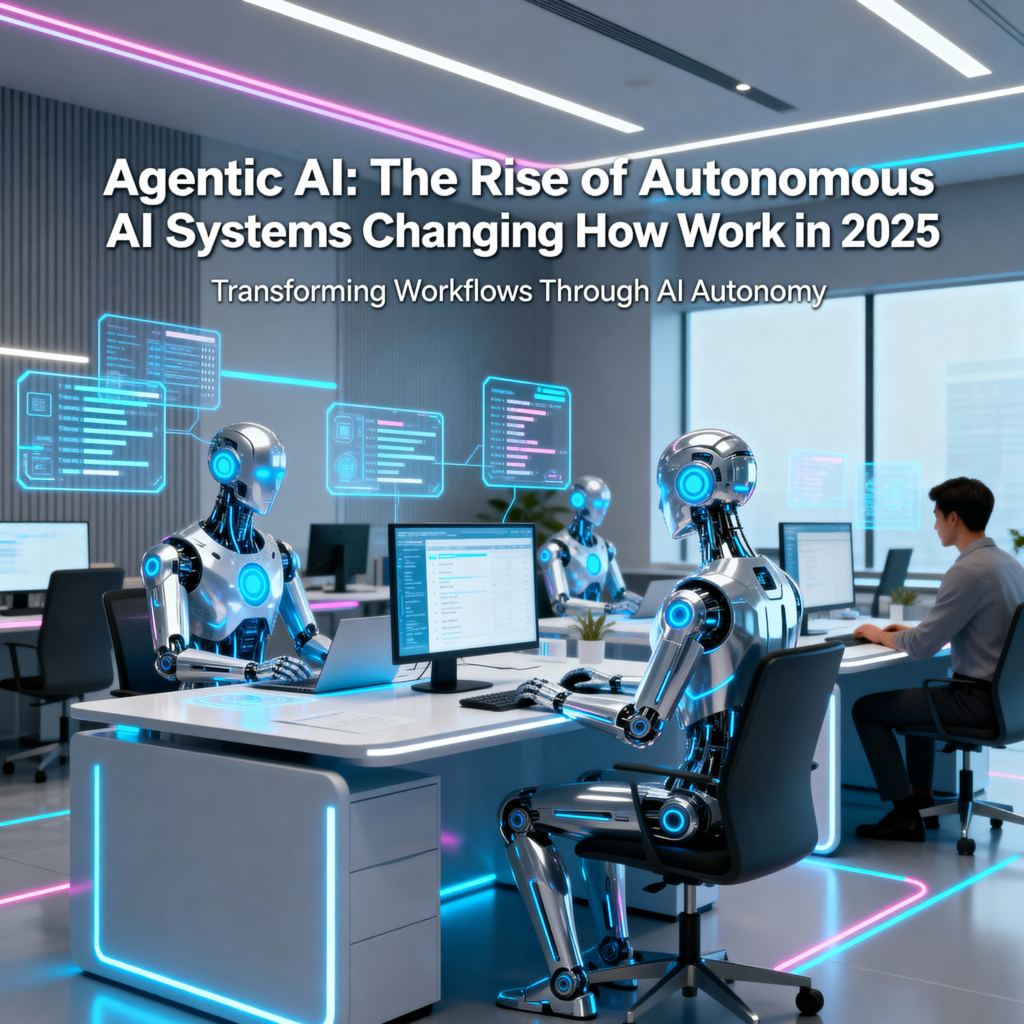
Artificial Intelligence is moving faster than ever. Just a few years ago, AI was mainly used for answering questions, writing emails, or suggesting movies. But now, a new and powerful form of AI is stepping into the spotlight — Agentic AI.
Agentic AI refers to autonomous AI systems, often called AI agents, that can think, plan, make decisions, and complete tasks on their own — without needing constant human instructions.
In fact, Gartner has named Agentic AI the #1 strategic technology trend for 2025–2026, predicting that businesses across the world will adopt it rapidly. So what exactly is Agentic AI, and why is it such a big deal? Let’s break it down in simple words.
What Is Agentic AI?
Agentic AI is not just a chatbot that waits for your command. Instead, it acts more like a digital worker.
An AI agent can:
- Understand a goal
- Break it into smaller steps
- Decide the best way to complete those steps
- Take action across different tools and systems
- Adjust its plan if something goes wrong
For example, instead of asking AI to “write one email,” you could say:
👉 “Launch a marketing campaign for my new product.”
An AI agent could then:
- Research the target audience
- Create email content
- Schedule posts on social media
- Track performance
- Improve the campaign automatically
All with minimal human involvement.
How Is Agentic AI Different from Regular AI?
Most AI tools today are reactive. They respond when you ask something.
Agentic AI is proactive.
Here’s the difference in simple terms:
- Traditional AI:
“Tell me what to do next.” - Agentic AI:
“I know the goal. I’ll figure out what to do next.”
Instead of following single instructions, Agentic AI manages entire workflows. This is why experts believe it will completely change how businesses operate.
Why Gartner Named Agentic AI the Top Trend for 2025–2026
Gartner predicts that companies will move beyond chatbots and start using AI agents that actually run parts of their business.
Why? Because businesses want:
- Faster work
- Lower costs
- Fewer human errors
- 24/7 productivity
Agentic AI delivers all of this by acting independently and intelligently.
According to experts, by 2026:
- Many routine office jobs will be partially automated
- AI agents will manage projects, schedules, and operations
- Businesses will rely on AI for decision-making support
This is why Agentic AI is being called the next evolution of artificial intelligence.
Where Agentic AI Will Be Used Most
1. Business Automation
Companies will use AI agents to handle:
- Reporting
- Data analysis
- Process management
- Inventory tracking
Instead of humans switching between software tools, AI agents will do it automatically.
2. Customer Service
Forget basic chatbots. Agentic AI can:
- Handle full customer issues from start to finish
- Offer refunds or solutions
- Escalate problems only when needed
This means faster responses and happier customers.
3. Software Development
AI agents can already:
- Write code
- Test software
- Fix bugs
- Deploy updates
In 2025–2026, many development teams will use AI agents as virtual developers, speeding up software creation.
4. Project Management
AI agents will:
- Assign tasks
- Track deadlines
- Monitor progress
- Send updates
- Predict delays
Managers will spend less time organizing and more time making big decisions.
5. Sales and Marketing
Agentic AI can:
- Identify leads
- Personalize messages
- Negotiate pricing
- Follow up automatically
This allows businesses to scale sales without hiring large teams.
Benefits of Agentic AI
Here’s why companies are excited:
- Works 24/7 without breaks
- Handles complex tasks end-to-end
- Reduces costs and manual work
- Improves efficiency
- Learns and adapts over time
Simply put, Agentic AI helps businesses do more with less.
Challenges and Concerns
Of course, Agentic AI also raises concerns.
Some major questions include:
- How much control should humans have?
- Can AI make ethical decisions?
- What happens to jobs?
- How do we prevent mistakes or misuse?
Because AI agents act independently, companies must create strong rules, safety checks, and human oversight.
Experts agree: Agentic AI should assist humans — not replace responsibility.
What to Expect in 2025–2026
Over the next two years, we can expect:
- Rapid enterprise adoption
- AI agents becoming part of daily work
- New job roles focused on managing AI
- Smarter automation tools across industries
Agentic AI won’t feel like science fiction — it will feel like a normal part of work life.
Final Thoughts
Agentic AI is not just another tech trend. It represents a huge shift in how machines interact with the world.
As we move into 2025 and 2026, AI will stop being just a helper and start acting like a partner — planning, deciding, and executing tasks on its own.
The businesses that understand and adopt Agentic AI early will have a powerful advantage. And for individuals, learning how to work with AI agents may soon become an essential skill.
The future of work isn’t just automated — it’s agent-driven.