

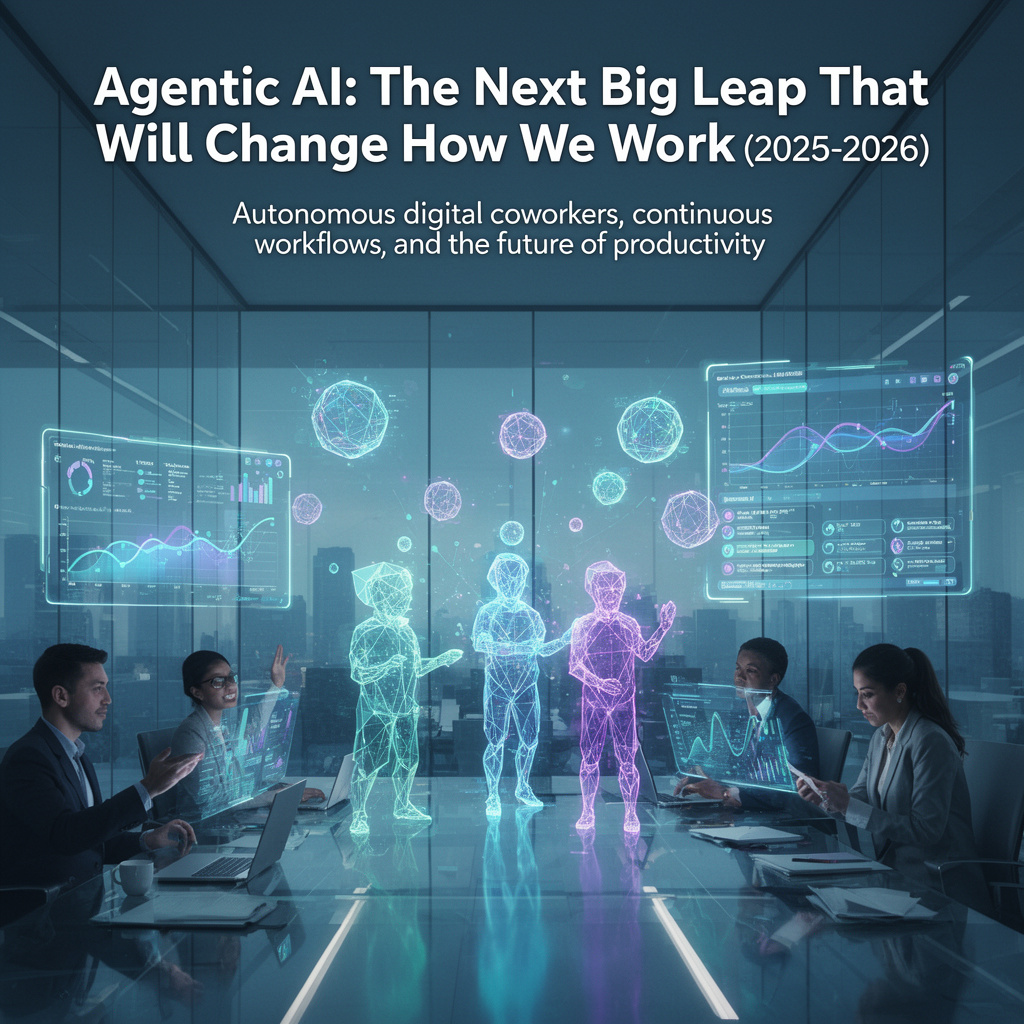
Artificial Intelligence is moving fast. Just a few years ago, AI was mostly about chatbots, writing tools, or image generators. These tools could respond when we asked something—but they couldn’t act on their own.
Now, a new evolution is here, and it’s called Agentic AI.
This new type of AI doesn’t just generate text or images. It can think, plan, decide, and take action—almost like a digital worker. Experts believe Agentic AI will be one of the biggest technology trends of 2025–2026, changing businesses, robots, and even how humans work with machines.
Let’s understand this powerful shift in very simple words.
What Is Agentic AI?
Agentic AI refers to autonomous AI agents—systems that can work independently without constant human instructions.
Unlike traditional AI, Agentic AI can:
- Plan tasks step by step
- Make decisions based on goals
- Use tools and software on its own
- Learn from results and improve
- Interact with real or digital environments
Think of it like this:
Generative AI answers questions.
Agentic AI gets things done.
For example:
- Instead of just suggesting how to schedule meetings, an Agentic AI can check calendars, send emails, book meetings, and follow up—all by itself.
- Instead of writing code only, it can build, test, debug, and deploy software.
That’s a huge leap.
Why Is Agentic AI a Big Trend for 2025–2026?
Top research and consulting companies like Gartner and Deloitte have identified Agentic AI as a top strategic trend for the coming years.
Here’s why:
1. From Assistance to Autonomy
Earlier AI helped humans.
Agentic AI works like a partner.
It doesn’t wait for every command. It understands the goal and figures out how to achieve it.
2. Multi-Step Thinking
Agentic AI can break big tasks into smaller steps and complete them one by one—just like humans do.
This makes it useful for:
- Business operations
- Project management
- Robotics
- Software development
3. Real-World Action
Agentic systems can interact with:
- Software tools
- Databases
- Machines and robots
- Online platforms
This means AI is no longer limited to screens—it’s entering the real world.
Agentic AI in Enterprises (Businesses)
Businesses are already adopting Agentic AI at a massive scale.
Gartner’s Prediction
Gartner predicts that by 2026, many companies will use hybrid AI-human systems, where AI agents handle routine work while humans focus on creativity and strategy.
Deloitte’s Insight
Deloitte highlights that Agentic AI will:
- Automate complex workflows
- Improve decision-making
- Reduce operational costs
- Increase productivity
Imagine an AI agent that:
- Tracks sales data
- Identifies problems
- Suggests solutions
- Takes corrective action automatically
This is not science fiction—it’s already happening.
Agentic AI in Robotics: Millions of Smart Robots
One of the most exciting areas is robotics.
Microsoft and Amazon
Companies like Microsoft and Amazon are deploying millions of robots in warehouses, logistics, and manufacturing.
These robots are powered by agentic capabilities, meaning they can:
- Navigate complex environments
- Adjust to unexpected situations
- Decide the best action without human input
For example:
- A warehouse robot can change routes if an area is blocked.
- A delivery robot can adjust speed and path based on conditions.
This level of autonomy was not possible before.
How Is Agentic AI Different from ChatGPT-Like AI?
Let’s simplify the difference:
| Generative AI | Agentic AI |
|---|---|
| Responds to prompts | Acts on goals |
| One-step answers | Multi-step execution |
| Needs constant input | Works independently |
| Mainly text or media | Real-world actions |
Agentic AI often uses generative AI as a brain, but adds:
- Planning
- Memory
- Decision logic
- Tool usage
That combination makes it extremely powerful.
Real-Life Use Cases of Agentic AI
Here are some practical examples:
1. Automation
AI agents manage emails, customer support, scheduling, and reporting without human help.
2. Software Development
Agentic AI can:
- Write code
- Fix bugs
- Test applications
- Deploy updates
3. Healthcare
AI agents assist doctors by:
- Monitoring patient data
- Flagging risks
- Suggesting treatments
4. Robotics and Manufacturing
Smart robots work safely alongside humans and adapt in real time.
Will Agentic AI Replace Humans?
This is a common fear—but experts say the future is collaboration, not replacement.
Agentic AI will:
- Handle repetitive and complex tasks
- Reduce human workload
- Support better decision-making
Humans will focus more on:
- Creativity
- Emotional intelligence
- Strategy
- Ethics
In short, AI becomes a teammate, not a threat.
Final Thoughts: A New AI Era Has Begun
Agentic AI represents a major turning point in the evolution of artificial intelligence.
It moves AI from:
“Tell me what to do”
to
“I know the goal—I’ll handle it.”
As we enter 2025–2026, Agentic AI will reshape:
- Businesses
- Robotics
- Automation
- The future of work
Those who understand and adopt this technology early will have a big advantage.
The age of thinking, acting AI agents has officially begun—and it’s going to change everything.
This place has some of the best odds I have seen in a while. The community is friendly and the gameplay is top notch. Check out kangjituslot
[5904]vivo500: Login Resmi Situs Slot Gacor dan Casino Deposit Dana,vivo500 menyediakan akses login resmi dan download APK mudah. Nikmati pilihan slot gacor hari ini serta panduan cara main baccarat online. Gabung sekarang juga! visit: vivo500
The daily rewards keep me coming back every single day. It is a great way to boost your balance while having fun. Visit logam88login for more.
Registering was so easy, I was in the game within minutes. The welcome bonuses are a great touch for new players. Get started at 567jiliregister