


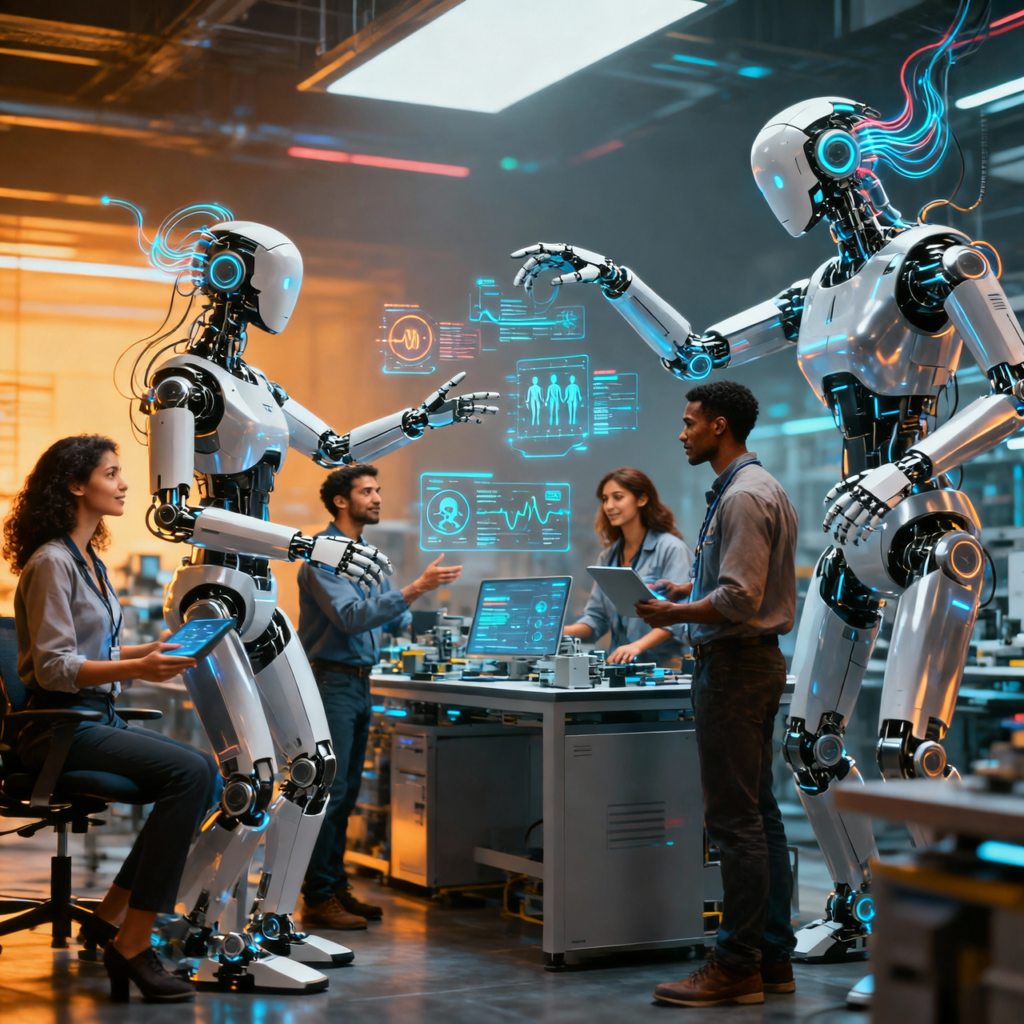
Robots are no longer limited to science fiction movies or factory assembly lines. Thanks to rapid advances in artificial intelligence (AI), robotics is entering a new era — one where machines don’t just follow instructions but work alongside humans, support them, and even enhance human abilities.
This new phase is called Advanced Robotics and Human–Machine Integration, and experts believe it will shape the future of work, healthcare, agriculture, and everyday life.
According to reports from companies like Globant, we are moving quickly toward a world of “level 3 intelligent robots” by 2026 — robots that can operate with high autonomy while still collaborating with humans.
Let’s explore what this means in simple words.
What Is Advanced Robotics?
Traditional robots were designed to perform one task repeatedly, like welding or packaging. They followed strict rules and could not adapt.
Advanced robotics is different.
Modern robots can:
- Learn from data
- Understand their surroundings
- Make decisions
- Adjust to new situations
- Work safely near humans
AI gives robots the ability to think, see, and react, not just move.
What Does Human–Machine Integration Mean?
Human–machine integration means humans and robots working together as partners, not competitors.
Instead of replacing people, robots:
- Support human strength
- Reduce physical strain
- Improve accuracy
- Increase safety
- Boost productivity
This approach fits perfectly with the idea of Industry 5.0, which focuses on human-centered automation — technology designed to help people, not replace them.
The Rise of Exoskeletons: Enhancing Human Strength
One of the most exciting developments is the use of robotic exoskeletons.
An exoskeleton is a wearable robotic suit that:
- Supports muscles and joints
- Reduces fatigue
- Helps lift heavy objects
- Assists people with mobility challenges
These systems are already being used in:
- Factories
- Warehouses
- Hospitals
- Construction sites
For workers who perform physically demanding tasks, exoskeletons help prevent injuries and extend careers.
In healthcare, they are helping patients walk again after injuries or strokes.
Service Robots Enter Everyday Life
Service robots are becoming more common in public and private spaces.
Examples include robots that:
- Deliver food in hotels
- Clean airports and malls
- Assist elderly people at home
- Guide visitors in hospitals
These robots are powered by AI, allowing them to:
- Recognize people
- Navigate complex spaces
- Respond to voice commands
They don’t just save time — they improve comfort and accessibility.
Industrial Robots Get Smarter
Industries like manufacturing, construction, and agriculture are seeing major changes.
Manufacturing
Smart robots now work alongside humans on production lines, handling:
- Repetitive tasks
- Precision work
- Quality checks
Humans focus on creative and problem-solving tasks.
Construction
Robots are helping with:
- Brick laying
- Concrete pouring
- Site inspection using drones
This speeds up projects and improves safety in dangerous environments.
Agriculture
In farming, robots are:
- Planting seeds
- Monitoring crops
- Detecting diseases
- Harvesting produce
This is especially important as farms face labor shortages and climate challenges.
Level 3 Intelligent Robots: What Does That Mean?
Experts classify robots by levels of intelligence.
Level 3 robots can:
- Operate independently in controlled environments
- Make decisions based on real-time data
- Adapt to changes without human input
- Collaborate with humans safely
Globant and other researchers predict rapid growth of these robots by 2026, driven by better AI, sensors, and computing power.
The Role of AR, VR, and Spatial Computing
Advanced robotics is also merging with spatial computing, including Augmented Reality (AR) and Virtual Reality (VR).
This creates immersive experiences where:
- Workers see digital instructions over real machines
- Engineers control robots remotely using VR
- Training happens in safe, virtual environments
For example:
- A technician wearing AR glasses can see step-by-step repair guidance
- A surgeon can practice complex procedures in VR before real operations
This combination makes work safer, faster, and more intuitive.
Industry 5.0: Technology with a Human Focus
Unlike Industry 4.0, which focused on automation and efficiency, Industry 5.0 emphasizes:
- Human creativity
- Personalization
- Sustainability
- Collaboration between humans and machines
Robots are no longer replacing people — they are empowering them.
Challenges and Concerns
Despite the progress, some challenges remain:
- High cost of advanced robots
- Need for skilled workers
- Safety and ethical concerns
- Job transition and reskilling
Experts agree that education and training will be key to making this transition smooth and fair.
What the Future Holds
In the coming years, we can expect:
- More human-friendly robots
- Widespread use of exoskeletons
- Smarter service robots
- Deeper integration with AR and VR
- Growth of Industry 5.0 workplaces
Robots will not take over the world — but they will become valuable teammates.
Final Thoughts
Advanced robotics and human–machine integration mark a powerful shift in how technology fits into our lives.
With AI at the core, robots are becoming smarter, safer, and more helpful than ever before. From factories and farms to hospitals and homes, humans and machines are learning to work together.
The future of robotics is not about replacing humans.
It’s about building a world where technology helps people do their best work — safely, creatively, and humanely.