


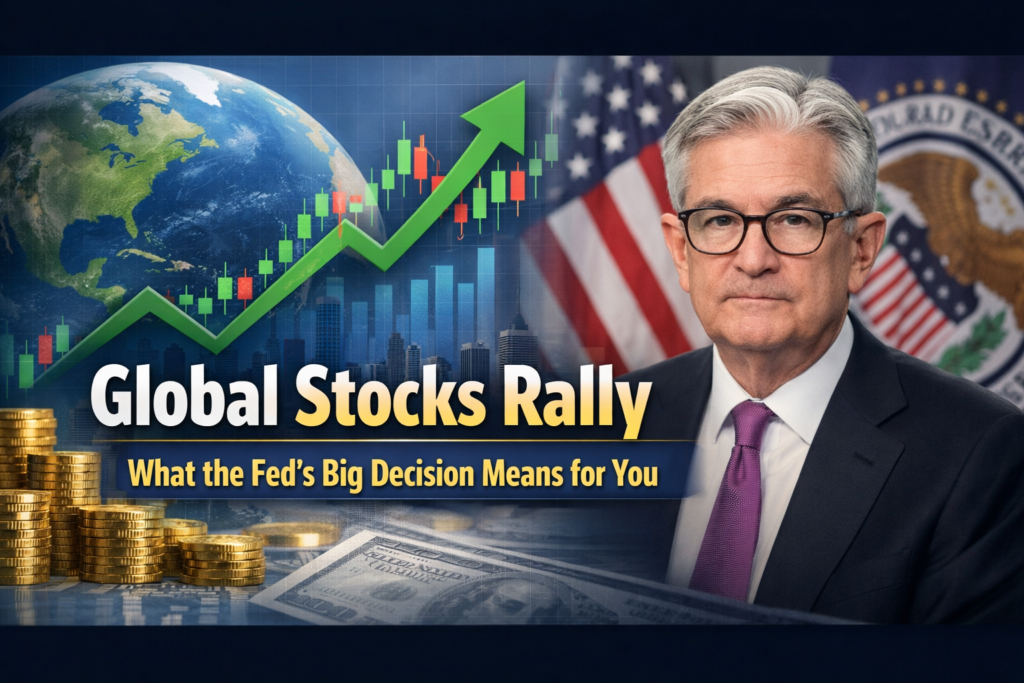
Global Stocks Rally — What the Fed’s Big Decision Means for You
Stock markets are climbing for the third day in a row. But with interest rates, oil prices, and a changing Fed chief all in the spotlight, what’s really going on?
If you’ve been watching the news lately and feeling a little confused by all the financial jargon flying around — “rate hold,” “hawkish Fed,” “dot plot” — you’re not alone. Today, we break it all down in plain English so you understand exactly what’s happening, why it matters, and what it could mean for your wallet.
Here’s the big picture: global stock markets are on a three-day winning streak, and all eyes are on the United States Federal Reserve (the “Fed”), which is announcing its interest rate decision today. At the same time, war in the Middle East is pushing oil prices higher, threatening to make everyday things more expensive for everyone.
So, What Is the Fed and Why Does It Matter?
Think of the Federal Reserve as the “financial doctor” of the United States. Its main job is to keep the economy healthy — not too hot (which causes inflation, making everything expensive) and not too cold (which causes unemployment). It does this mainly by raising or lowering interest rates.
When the Fed raises rates, borrowing money becomes more expensive. This slows down spending and cools inflation. When it lowers rates, borrowing gets cheaper, businesses invest more, people spend more, and the economy heats up.
“The Fed’s main impact on the stock market is to confirm or reject expectations about rates and the economy.”— David Russell, Global Head of Market Strategy, TradeStation
What Did the Fed Do in 2025?
Last year, the Fed cut interest rates three times in a row. This was good news — it meant borrowing became cheaper, businesses grew, and the stock market was happy. Inflation was also cooling down, which gave the Fed confidence to ease up. The economy was heading toward what economists call a “soft landing” — slowing down just enough to control prices without crashing into a recession.
But then 2026 arrived, and things got complicated.
What Changed in 2026?
Two big things happened that shook the financial world:
1. The economy slowed down sharply. In the last three months of 2025, the US economy grew by just 0.7% — much slower than expected. That’s a warning sign. When growth slows too much, companies earn less, people may lose jobs, and the whole system feels the pressure.
2. War broke out in the Middle East, involving Iran. This caused oil prices to skyrocket past $100 per barrel — and at one point they spiked to nearly $120. Since oil powers almost everything (transport, manufacturing, heating), when it gets expensive, prices rise everywhere. This is called an “oil shock,” and it threatens to bring inflation roaring back — just when the Fed was trying to cool it.
Today’s Decision: Hold, Cut, or Hike?
This is the big question everyone on Wall Street is asking. The Fed met over March 17–18 and is announcing its decision today. Here are the three options it had:
Hold rates steady — keep interest rates unchanged at 3.5%–3.75%. This is what most experts expected. The idea is to “wait and watch” — see how long the oil shock lasts before making any moves.
Cut rates — make borrowing cheaper to stimulate the slowing economy. The risk? With oil already driving prices up, cutting rates could pour fuel on the inflation fire.
Raise rates — fight inflation directly. Some economists even suggested the Fed should hike rates to push back against oil-shock inflation. But raising rates when the economy is already weak is risky — it could tip the country into recession.
The Fed went with the “safe” choice: hold rates steady and wait. Markets had already priced this in, which is partly why stocks have been rallying — investors were relieved there were no nasty surprises.
Analysts now say the Fed will likely revise its year-end inflation forecast upward to 3.5% — effectively pausing any hopes of rate cuts in the first half of 2026.— JPMorgan Chase & Goldman Sachs analysts
Why Are Stocks Rallying If Things Look Uncertain?
This seems like a contradiction, right? Bad economic signals, war, high oil prices — and yet stock markets are going up? Here’s why:
Markets don’t just react to today’s news — they react to expectations. When investors were worried that the Fed might suddenly raise rates (which would hurt stock prices badly), markets fell. But now that it’s clear the Fed will hold steady — no sudden shocks — investors feel more confident. The MSCI All Country World Index, which tracks stock markets globally, rose 0.3%, and Asian shares surged as much as 1.4%.
There’s also the “AI factor.” Tech giants like Nvidia, Microsoft, Apple, and Amazon continue to drive strong earnings growth, giving investors reasons to remain optimistic about the long-term.
There’s Also a Leadership Change at the Fed
This is the last Fed meeting where Jerome Powell — who has led the Fed since 2018 — will be front and center. His term ends on May 15, 2026. President Trump has nominated Kevin Warsh to replace him.
Markets see Warsh as someone who was battle-tested during the 2008 financial crisis, and he’s considered more “hawkish” — meaning he tends to prefer keeping rates higher to fight inflation. Investors are watching carefully to see if this leadership shift will change the Fed’s approach going forward.
What Does This Mean for You?
If you have a home loan or car loan, the good news is rates aren’t going higher right now. But they’re also not getting cheaper anytime soon — the dream of a rate cut has been pushed further into the future.
If you have savings in a fixed deposit or money market account, rates remain reasonable for now. If you’re invested in the stock market, the short-term rally is encouraging, but the uncertainty around oil prices and inflation means it’s wise to stay diversified and not bet everything on one sector.
And if you’re a common consumer, expect energy-related costs — petrol, cooking gas, electricity — to remain elevated as long as the Middle East conflict continues to disrupt global oil supply.
The Bottom Line
Today’s Fed decision is a “pause button” on the economy. The Fed is saying: we see the trouble, we’re watching carefully, but we’re not panicking. For now, stocks are relieved. But the real story to follow is whether oil prices stay high, and whether that starts pushing everyday prices higher again.
The next few months — especially with a new Fed chief incoming and the Iran situation unresolved — will be critical for markets, inflation, and ultimately, your financial life.
📖 Quick Glossary — Key Terms Explained Simply
- Federal Reserve (The Fed)
- The central bank of the USA. Controls interest rates to keep the economy balanced.
- Interest Rate
- The cost of borrowing money. Higher rate = more expensive loans. Lower rate = cheaper loans.
- Inflation
- When prices of goods and services rise over time. Too much inflation = your money buys less.
- Hawkish
- When the Fed favors higher interest rates to fight inflation — like a hawk swooping down hard.
- Dot Plot
- A chart the Fed releases showing where officials expect interest rates to be in the future.
- Oil Shock
- A sudden spike in oil prices — usually due to conflict or supply disruption — that ripples through the entire economy.
- MSCI All Country World Index
- A giant index tracking stock market performance across 47 countries. A good gauge of global investor sentiment.
- Soft Landing
- When an economy slows down just enough to reduce inflation without crashing into recession.