


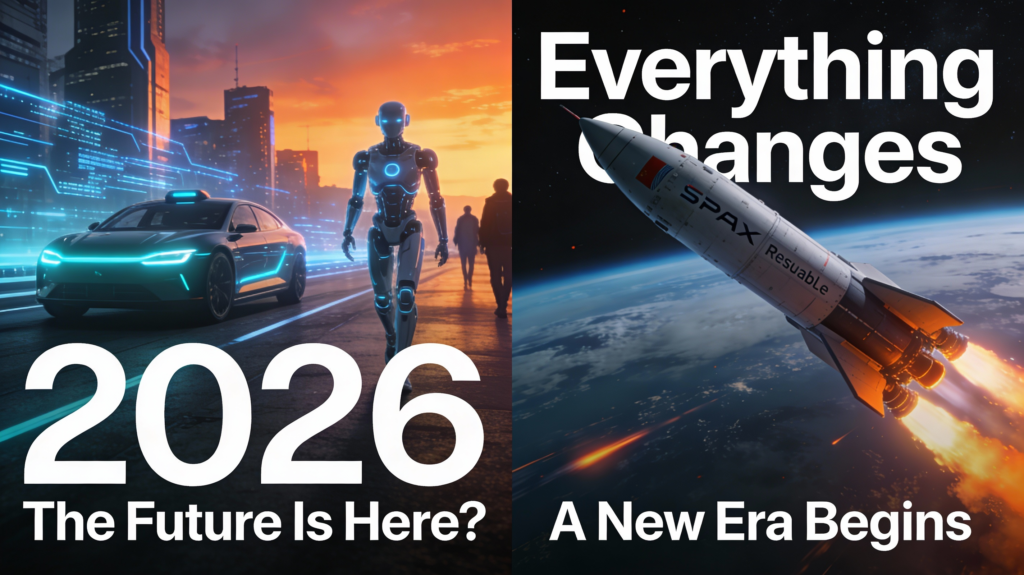
Every few years, a moment appears when multiple technologies don’t just improve—they collide. According to Elon Musk, 2026 could be one of those rare turning points.
Robotaxis with no human drivers.
Humanoid robots working alongside people.
Rockets that make access to space cheaper than ever before.
This isn’t a list of distant science-fiction dreams. Musk believes these breakthroughs could arrive within the same year—and together, they could redefine how we move, work, and explore.
But will 2026 truly be a “banger year,” or is it another over-ambitious promise?
Let’s look closer.
A Perfect Storm of Breakthroughs
What makes 2026 so unusual is not just the scale of ambition, but the convergence of breakthroughs across entirely different domains.
- Autonomous robotaxis aim to remove humans from the driver’s seat entirely
- Optimus humanoid robots are moving from labs into real workplaces
- Fully reusable rockets promise to slash the cost of reaching orbit
If even two of these succeed at scale, the ripple effects could reshape entire industries.
If all three advance together, the impact could be historic.
Robotaxis: The Safety Question That Changes Everything
Robotaxis are perhaps the most visible—and controversial—piece of this vision.
The technology has progressed rapidly, but real-world streets are chaotic. Weather, unpredictable pedestrians, construction zones, and rare edge cases remain major hurdles. More importantly, regulators won’t approve autonomy based on potential—they demand near-perfect safety.
For robotaxis to succeed, they must prove:
- Consistent safety in uncontrolled environments
- Clear accountability frameworks
- Public trust, not just technical success
Until that happens, the driverless future remains fragile.
Humanoid Robots: From Demo to Daily Reality
Tesla’s Optimus robot has already captured attention. But impressive demos are only the beginning.
To truly matter, humanoid robots must:
- Operate reliably for long periods
- Navigate messy, human environments
- Be affordable enough to justify deployment
- Deliver real economic value
This transition—from spectacle to scalability—is one of the hardest leaps in technology. Success could transform manufacturing, logistics, and caregiving. Failure would relegate humanoids to niche applications.
SpaceX and the Race for Cheap Space
Perhaps the boldest challenge lies above Earth.
SpaceX’s goal of full and rapid rocket reusability is about more than launches—it’s about turning spaceflight into something closer to commercial aviation. Rockets must launch, land, refurbish, and relaunch quickly and safely.
That’s not just an engineering problem. It’s an operational, logistical, and economic puzzle of unprecedented scale.
If SpaceX cracks it, space becomes more accessible than ever before.
The Hidden Impact: Society in Transition
These technologies don’t exist in isolation.
- Robotaxis could disrupt millions of driving jobs
- Humanoid robots raise ethical questions about labor and identity
- Cheaper access to space may intensify geopolitical and environmental debates
Innovation at this scale forces society to adapt just as quickly as technology evolves.
The question isn’t just can we build it?
It’s are we ready for it?
A Declaration of Intent, Not a Guarantee
Elon Musk’s 2026 timeline should be seen less as a firm promise and more as a strategic accelerant.
Setting aggressive deadlines:
- Forces rapid iteration
- Attracts talent and capital
- Pushes entire industries forward
Even if every milestone isn’t perfectly achieved by December 31, 2026, the pursuit itself is already reshaping the pace of innovation.
Final Thoughts: The Year That Tests the Future
2026 may not deliver perfection—but it will deliver proof.
Proof of whether autonomy can be trusted.
Proof of whether humanoid robots can work, not just walk.
Proof of whether space can truly become affordable.
If even a fraction of these visions materialize, the future will stop being something we watch in presentations and prototypes. It will arrive—quietly but unmistakably—on our streets, in our workplaces, and in our skies.
And this time, we won’t just be watching.
We’ll be living it. 🚀