


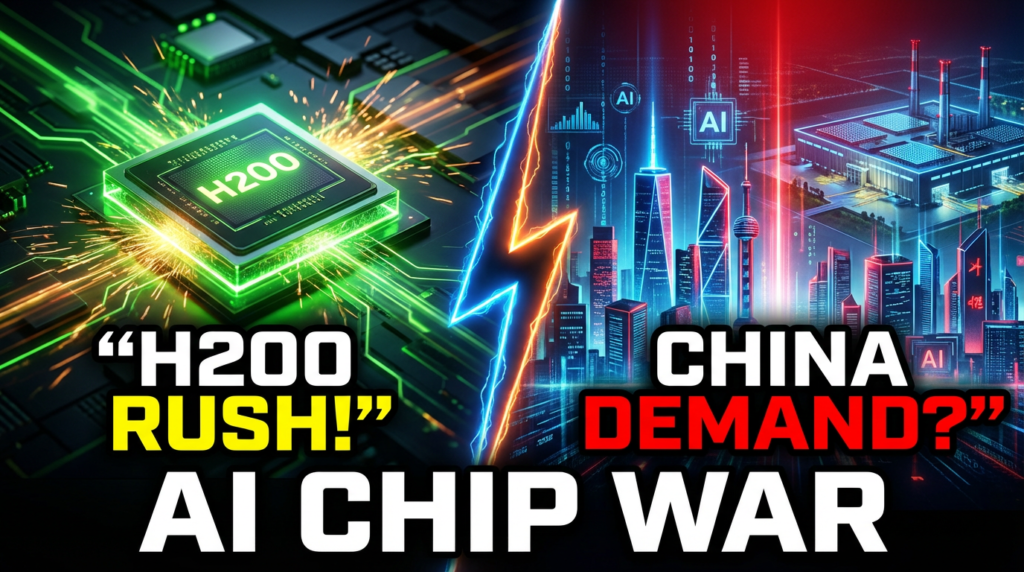
The world of artificial intelligence is moving at lightning speed—and right now, Nvidia is right at the center of the storm.
In a surprising and dramatic turn, Nvidia is rushing to boost production of its powerful H200 AI chips, urgently working with its manufacturing partner TSMC. The reason? Explosive demand from China, especially from tech giants like ByteDance, the company behind TikTok.
What makes this story even more fascinating is that it’s happening despite strict U.S. export controls. So what’s really going on here? And why is the H200 chip suddenly so important?
Let’s break it down in simple words.
🚀 The H200 Chip: Nvidia’s New AI Powerhouse
To understand the rush, you first need to know what the H200 chip is.
The Nvidia H200 is one of the company’s most advanced AI processors. It’s designed to handle huge AI models, massive data sets, and complex tasks like:
- Training large language models
- Powering generative AI tools
- Running advanced data centers
- Supporting recommendation systems and video AI
In short, this chip is a brain for modern AI.
Compared to earlier models, the H200 is faster, more efficient, and packed with more memory—making it extremely valuable for companies racing to lead the AI future.
🇨🇳 Why China Wants the H200 So Badly
China is in the middle of an AI boom.
Major Chinese companies like ByteDance, Alibaba, Tencent, and Baidu are investing billions into AI research, data centers, and new products. From social media algorithms to AI-powered search and video tools, these companies need serious computing power.
And right now, Nvidia’s chips are the gold standard.
Even with U.S. restrictions limiting which chips can be sold to China, Chinese firms are placing huge orders for versions that still meet export rules. The demand has been so strong that Nvidia is now asking TSMC to make more H200 chips—fast.
⚠️ U.S. Export Rules: A Complicated Game
Here’s where things get interesting.
The U.S. government has placed strict controls on exporting high-end AI chips to China, citing national security concerns. These rules are meant to slow China’s access to cutting-edge AI hardware.
But there’s a catch.
- The rules are complex
- Certain versions of chips are still allowed
- Companies adapt designs to meet legal limits
So while Nvidia can’t sell its most powerful unrestricted chips, it can still supply modified or compliant versions—and Chinese companies are buying them aggressively.
This has turned the AI chip market into a global chess match.
🏭 Why TSMC Is Key to Nvidia’s Strategy
Nvidia doesn’t make its own chips.
Instead, it relies on TSMC (Taiwan Semiconductor Manufacturing Company), the world’s most advanced chip manufacturer. TSMC already produces chips for Apple, AMD, and many others—but Nvidia’s sudden push adds more pressure.
By asking TSMC to ramp up production, Nvidia is signaling something important:
👉 The AI chip race is not slowing down—it’s accelerating.
More factories, more wafers, more supply chains—all to keep up with exploding global demand.
💰 What This Means for Nvidia
For Nvidia, this situation is both a challenge and a massive opportunity.
The good news:
- Strong demand means huge revenue
- China remains a critical market
- Nvidia keeps its position as the AI chip leader
The risks:
- Political tensions could tighten rules further
- Supply chain pressure may increase costs
- Overdependence on a single market is risky
Still, Nvidia seems determined to move fast and stay ahead, even in uncertain conditions.
🌍 The Bigger Picture: A Global AI Arms Race
This isn’t just about one chip or one country.
The rush for Nvidia’s H200 highlights a global AI arms race, where:
- Countries want AI leadership
- Companies want faster, smarter systems
- Governments want control and security
AI hardware has become as strategic as oil or energy. Whoever controls the best chips controls the future of technology—from healthcare to defense to entertainment.
And right now, Nvidia holds many of the keys.
🔮 What Happens Next?
Looking ahead, a few things are likely:
- AI chip demand will keep growing
- Export rules may become even stricter
- Chipmakers will create more “rule-compliant” designs
- Competition from rivals like AMD and Chinese chip firms will intensify
One thing is clear: the battle for AI dominance is just beginning.
✨ Final Thoughts: Why This Story Matters
Nvidia rushing to boost H200 chip production isn’t just tech news—it’s a signal of where the world is heading.
AI is no longer a future idea. It’s happening now. And behind every smart AI system is a powerful chip, quietly working at unimaginable speed.
As China, the U.S., and global tech giants push harder, stories like this remind us of one simple truth:
👉 The future of AI will be shaped not just by ideas—but by who can build the fastest chips, the quickest.
And Nvidia is running full speed ahead.