


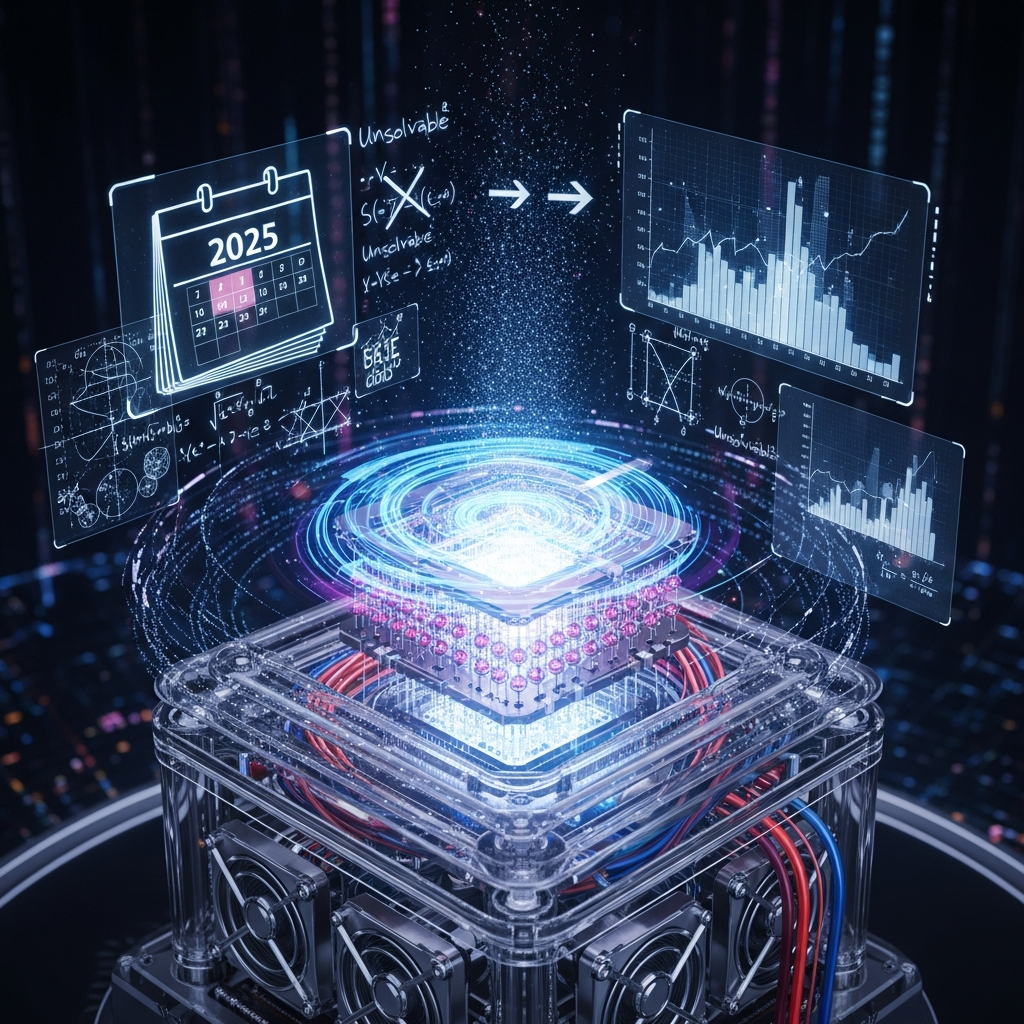
Have you ever wondered what would happen if computers suddenly learned to think in possibilities instead of just 0s and 1s?
What if the problems that take today’s supercomputers centuries to solve could be cracked in minutes?
Welcome to the accelerating world of quantum computing—a realm where physics bends, logic shifts, and innovation speeds up in ways that feel less like technology and more like magic.
And here’s the wild part:
Quantum computing is no longer locked behind laboratory doors. It’s stepping into the real world—into pharmaceuticals, finance, logistics, material science, and into conversations happening right now about the future of security and innovation.
2025 isn’t just another year in tech.
It’s an inflection point—a massive leap forward.
Let’s dive into the breakthroughs redefining what we once thought was impossible.
🧬 From Lab Experiments to Real-World Impact
For years, quantum computing has felt like a futuristic dream—powerful, yes, but far away. Now that dream is turning into practical reality.
Quantum systems are beginning to outperform classical computers in areas like:
- Drug discovery: Simulating molecules so complex that classical computers choke on the math
- Financial modeling: Predicting risk with mind-bending accuracy
- Supply chain optimization: Finding ultra-efficient routes in seconds
- Material science: Designing entirely new materials atom-by-atom
Imagine curing diseases faster, predicting market crashes before they happen, or building safer batteries, lighter metals, and revolutionary chemicals—all powered by quantum logic.
This is why industries aren’t just curious—they’re investing aggressively.
💰 The Investment Surge: A Race to the Quantum Future
Companies, governments, and venture capitalists are pouring money into quantum tech like never before.
Why?
Because quantum computers don’t just make things faster—they make the impossible possible.
Key areas attracting investment include:
🔐 Quantum-Secure Cryptography
As quantum machines grow smarter, our current encryption methods become weaker.
This has triggered a global race for post-quantum security—the next generation of digital defense systems.
🧪 Material Simulations
Quantum systems can simulate chemical interactions with atom-level precision.
This could unlock breakthroughs in energy, aviation, construction, and even climate solutions.
2025 is being called the tipping point—the moment quantum research matures into real, scalable solutions.
🧠 Predictions From Industry Leaders
Two major voices—Globant and the Swiss School of Business—paint an exciting picture of what’s coming.
According to their predictions:
- Quantum computing will enter mainstream commercial use faster than expected
- Companies that adopt it early will leap far ahead in innovation
- Data security will undergo a complete transformation
- Entire industries may be rebuilt from the ground up
This isn’t just evolution.
It’s revolution—with qubits (quantum bits) doing the heavy lifting.
🔮 Quantum Computing and the Speed of Innovation
Here’s something fascinating:
Innovation cycles are getting shorter.
Problems considered “too big” last year are now solvable.
Ideas that once took decades to execute are becoming doable in months.
Quantum computing isn’t just giving us faster answers—it’s reshaping how fast we can imagine new possibilities.
And that changes everything.
🌍 So What Does This Mean for Us?
Quantum tech won’t be invisible.
It will influence our medicines, our money, our supply chains, the materials around us, and even the way our data is protected.
It will fuel new careers, new industries, and new tools we haven’t even imagined yet.
2025 is the moment when quantum computing stops being science fiction and starts becoming a global force—quietly powering the systems we rely on every day.
We are witnessing the birth of a new technological era.
And it’s only getting started.